
Weinan City
Weinan CityWeinan, historically known as Xiagui and Lianshao, is a prefecture-level city in Shaanxi Province, located in the eastern part of the Guanzhong Plain. The terrain is centered on the Wei River axis, forming five geomorphic types:
Weinan City
Weinan, historically known as Xiagui and Lianshao, is a prefecture-level city in Shaanxi Province, located in the eastern part of the Guanzhong Plain. The terrain is centered on the Wei River axis, forming five geomorphic types: two mountain ranges, two plateaus, and a central plain. The climate is temperate monsoon. Total area: 13,030.56 square kilometers. As of November 2022, the city administers 2 districts, 7 counties, and 2 county-level cities. As of the end of 2024, the permanent resident population was 4,583,600. Weinan is an important birthplace of the Chinese nation, known as "Root of Huaxia, Source of Culture, Hometown of Three Sages, Land of Generals and Ministers." The city borders Shanxi and Henan across the Yellow River to the east, connects with Xi'an and Xianyang to the west, is bounded by the Qinling Mountains to the south, and borders Yan'an and Tongchuan to the north. It is 60 km from Xi'an and 80 km from Xianyang International Airport. Two HSR lines (Zhengxi and Daxi) and 6 railways plus 3 expressways and 9 national/provincial highways cross the city, making it the transportation gateway from central-eastern China to the northwest. The city hosts the national 5A scenic area of Mount Hua (Huashan). In 2025, GDP was 223.176 billion yuan, up 5.6%.
History
Weinan as a county name dates to 360 CE during the Former Qin Dynasty (351–394), named for its location south of the Wei River. The area belonged to the Xia Dynasty (c. 2070–1600 BCE) as part of ancient Yongzhou. During the Western Zhou Dynasty (c. 1046–771 BCE), it was part of the royal domain with vassal states including Han and Rui. During the Spring and Autumn period (770–476 BCE), the eastern part belonged to Jin and the western part to Qin. In 687 BCE, the Qin State established Zheng County in present-day Huazhou District. After Qin unified China in 221 BCE, the area south of the Wei River belonged to Liyi and the north to Xiagui. In 360 CE, Weinan County was formally established. The Song, Yuan, Ming, and Qing dynasties maintained it under various prefectures. In December 1994, the Weinan Prefecture was converted to the prefecture-level Weinan City.
Administrative Divisions
Divisional History
In 1950, the Weinan Special District had 105 districts and 908 townships. In 1958, communes were established. In 1984, communes were replaced with township/village system. In 1990, Huayin County became a county-level city. In 2015, Hua County was abolished and Huazhou District was established.
Division Details
As of November 2022: 2 districts (Linwei, Huazhou), 7 counties (Tongguan, Dali, Heyang, Chengcheng, Baishui, Pucheng, Fuping), 2 county-level cities (Hancheng, Huayin). 108 towns, 28 sub-districts, 2,068 administrative villages, 271 communities.
Geographical Environment
Location and Boundaries
Middle reaches of the Yellow River, eastern Guanzhong Plain, between 108°58′–110°35′E and 34°13′–35°52′N. North-south: 182.3 km; east-west: 149.7 km. Total area: 13,030.56 km².
Landforms
Five geomorphic types centered on the Wei River: two mountain ranges (north and south), two plateaus, and the central alluvial plain—the widest section of the "800-li Qinchuan" (the fertile Guanzhong Plain). Elevation: 330–2,645m. Terrain: high in the north and south, low in the middle, widening east-west.
Climate
Temperate monsoon climate with warm winters, hot summers, and four distinct seasons. Average annual temperature: 12.5–14.8°C. Average annual precipitation: 489.6–795.0 mm (flood season May–September: 372.1–625.3 mm). Annual sunshine: 1,784.1–3,130.6 hours.
Hydrology
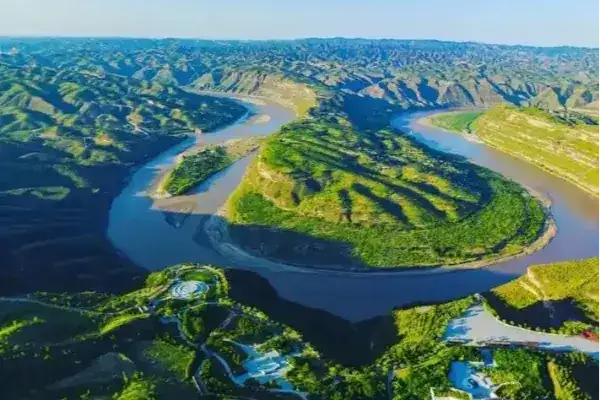
Rivers belong to the Yellow River system. The Yellow River, Wei River, and Luo River (North Luo) are the main transit and inflow rivers. 4,113 rivers and channels over 1 km. 25 rivers with drainage areas exceeding 100 km². Groundwater: 656 million m³ annual extractable, 1.508 billion m³ total recharge.
Natural Resources
Water Resources
Yellow River average annual runoff: 24.68 billion m³; Wei River: 6.341 billion m³; Luo River: 639 million m³. Total local water resources: 1.313 billion m³ (1.004 billion groundwater, 722 million surface).
Mineral Resources
51 mineral types discovered, 33 with proven reserves. Advantageous minerals: coal, molybdenum, gold, copper, cement limestone, marble. Spatial pattern: "south non-ferrous metals, north energy, central geothermal and building materials."
Biological Resources
360+ wild animal species (35 nationally protected, including red-crowned crane, black stork, whooper swan, blue sheep, golden pheasant). 20+ domestic breeds (Qinchuan cattle, Guanzhong donkey, dairy goat). 2,500+ wild plant species, 150+ cultivated species.
Population
As of end 2024: 4,583,600 (down 20,400 from 2023). Urban: 2,459,600 (53.66% urbanization rate). Birth rate: 5.92‰; death rate: 9.04‰; natural growth rate: -3.12‰. As of end 2025: 4,533,800, urban 2,505,400 (55.26%). Birth rate: 4.66‰; death rate: 9.34‰; natural growth rate: -4.68‰.
Politics
Economy
Overview
In 2025, GDP was 223.176 billion yuan (up 5.6%). In 2024: GDP 215.773 billion (up 5.7%). Primary: 42.729 billion (up 3.4%); secondary: 57.263 billion (up 6.5%); tertiary: 115.781 billion (up 6.1%). Urban per capita disposable income: 43,364 yuan (up 4.0%); rural: 18,769 yuan (up 7.5%). Urban-rural ratio: 2.31 (narrowed 0.08). Fixed asset investment grew 11.5%.
Primary Industry
In 2024: grain output 2.654 million tonnes (up 2.8%, record high); vegetables 3.4265 million tonnes (up 3.9%); fruits 4.365 million tonnes (up 5.0%). Pig slaughter: 2.3215 million (up 4.7%); inventory: 1.6069 million (up 7.0%).
Secondary Industry
In 2024: above-designated-size industry grew 7.3%. Manufacturing grew 13.2% (raw materials manufacturing +18.0%, high-tech manufacturing +10.2%).
Tertiary Industry
In 2024: retail sales 81.65 billion (up 6.7%); above-designated-size retail 27.785 billion (up 10.3%). New energy vehicles +125.8%. Financial deposits: 421.162 billion (up 7.9%); loans: 224.109 billion (up 11.6%). Local fiscal revenue: 8.777 billion (up 3.3%); expenditure: 57.648 billion (up 2.1%).
Social Undertakings
Science and Technology
In 2022: 380 technology contracts (23.25 billion yuan). 1,740 patents authorized (99 invention). 789 valid invention patents (1.832 per 10,000).
Education
As of end 2022: 2,112 schools (1,209 kindergartens, 645 primary, 183 junior high, 42 high school, 10 special education, 23 vocational). 730,553 students, 70,729 staff. Higher education: Weinan Normal University, Shaanxi Railway Engineering Vocational College, Weinan Vocational Technical College.
Culture
As of end 2022: 12 performing troupes, 7 theaters, 12 cultural centers, 12 public libraries (2.4295 million books).
Healthcare
As of end 2022: 3,928 medical institutions (172 hospitals, 75 community centers, 199 township health centers). 34,933 beds (27,998 in hospitals), 40,948 health workers (12,414 physicians).
Sports
In 2022: 148 major sports events (2 national, 3 provincial). 24,000+ social sports instructors, 315 sports organizations. The 18th Shaanxi Provincial Games will be held in Weinan in August 2026.
Social Security
As of end 2022: employee pension 727,300; resident pension 2.7178 million; unemployment 241,700; work injury 370,000; employee medical 468,700; resident medical 3,739,000; maternity 270,500. Urban minimum living: 3,822 households/7,289 people (610–620 yuan/month); rural: 54,424 households/141,217 people. 8,659 rural special-care recipients.
Transportation
6 railways (Longhai, Baoxi, Houxi, Ningxi, Daxi HSR, Zhengxi HSR) and 3 expressways (Lianhuo, Xiyu, Weinan-Pucheng) plus 9 national/provincial highways. County-wide railway and township-wide paved road coverage. Highway density: 43.2 km/100 km² (highest in Shaanxi). 268.4 km expressways (highest in Shaanxi). 60 km from Xi'an, 90 km from Xianyang Airport.
Historical Culture
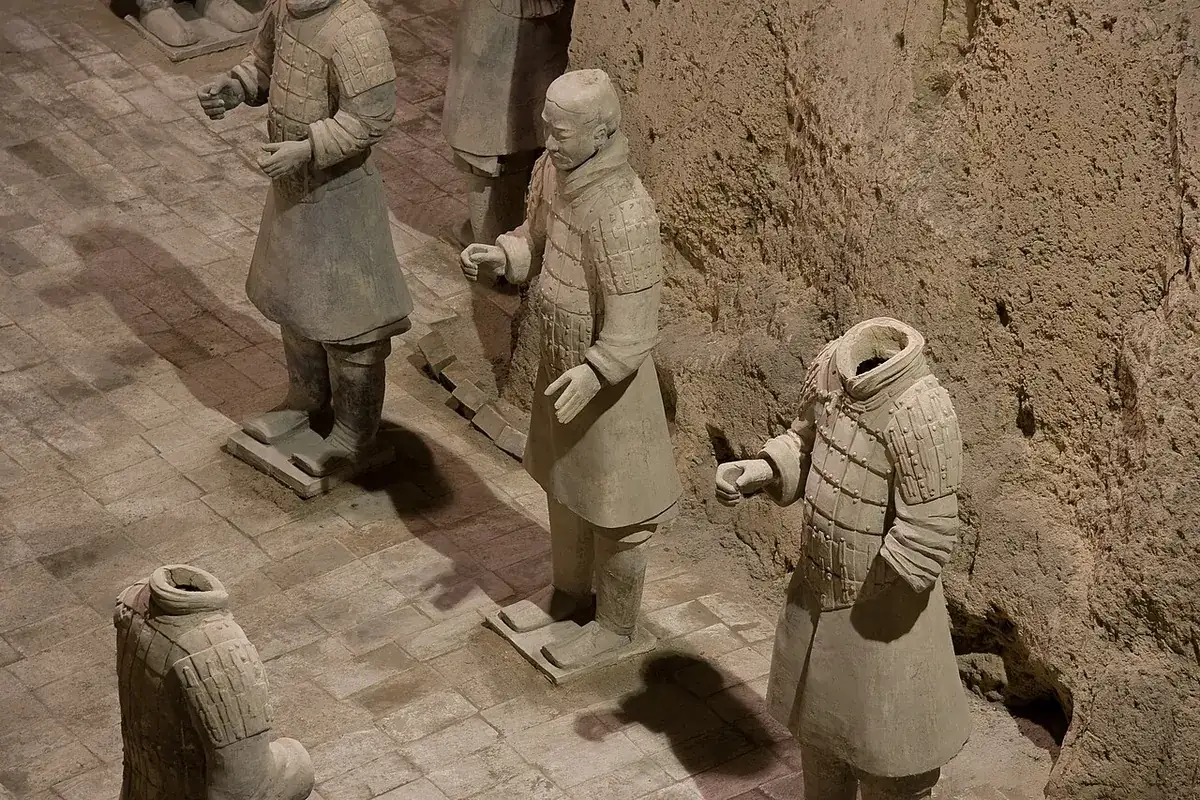
Weinan is one of the birthplaces of the Chinese nation. The term "Huaxia" originates from Weinan: "Hua" refers to Mount Hua, "Xia" refers to Xiayang (the narrow region between them). The Lantian Ape Man (~800,000 years ago) and Dali Man (~200,000 years ago) lived here. The area produced Cangjie (creator of Chinese characters), Du Kang (inventor of wine), Sima Qian (author of the Records of the Grand Historian), Bai Juyi (Tang Dynasty poet), Kou Zhun (Song Dynasty statesman), and others. 12 items listed as national intangible cultural heritage, including Huaxian shadow puppetry, Huayin Laoqiang (old tune), Heyang string puppetry, Tongzhou Bangzi opera, and Fuping Agong opera.
Scenic Spots
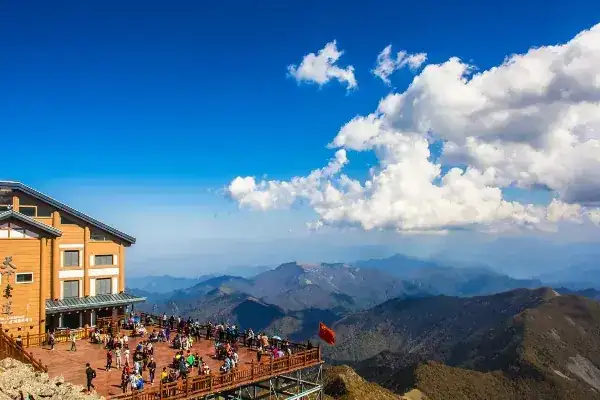
As of end 2022: 3,697 immovable cultural relics (1,207 ancient sites, 739 tombs, 1,371 ancient buildings, 26 grottoes/inscriptions, 353 modern historical sites). 61 national key cultural heritage units (68 points), 165 provincial units, 398 county-level. 79 A-level scenic areas: 1 national 5A (Mount Hua Scenic Area), 14 national 4A (including Lesser Mount Hua National Forest Park, Fuping Ceramic Village, Qiachuan Scenic Area, Sima Qian Temple, Hancheng Museum, Dangjia Village Ming-Qing residences, Yaotou Kiln, Tongzhou Lake, Qiaoling Mausoleum, etc.).
Local Specialties
Crystal cake, Fuping dried persimmon, jujube cake, moon cake, Baishui Dukang liquor, Tongzhou watermelon, Linwei grapes, Chishui green onions, Pucheng crisp pears, mutton soup, time-specified baozi, tofu pao mo, Pucheng fireworks, Heyang xué noodles, Tongguan meat sandwich, Tongguan pickled vegetables, buckwheat noodles, Chengcheng wheat bubble soup, Dali winter jujube.
Famous Figures
"Three Sages": Cangjie (sage of writing), Du Kang (sage of wine), Sima Qian (sage of history). "Three Worthies": Kou Zhun (Song Dynasty statesman), Zhang Renyuan (Tang Dynasty general), Bai Juyi (Tang Dynasty poet). Also: Sima Qian, Yang Zhen, Yang Jian (Sui Dynasty founder), Guo Ziyi, Yang Hucheng, Xi Zhongxun, and others.
Honorary Titles
National Health City, National "Safe Agriculture" Demonstration City, National Double Support Model City, third-tier city (2023).
Travel information can change. Check current opening hours, reservations and entry requirements before you travel.
Traveller discussion
Start the conversation with a helpful tip or a question.