
Tongchuan City
Tongchuan CityTongchuan, formerly known as Tongguan, is a prefecture-level city in Shaanxi Province, located in the eastern part of northwest China, in central Shaanxi, at the junction of the Guanzhong Basin and the northern Shaanxi Plateau
Tongchuan City
Tongchuan, formerly known as Tongguan, is a prefecture-level city in Shaanxi Province, located in the eastern part of northwest China, in central Shaanxi, at the junction of the Guanzhong Basin and the northern Shaanxi Plateau. The climate is temperate monsoon. Total area: 3,882 square kilometers. As of October 2022, the city administers 3 districts, 1 county, and 1 economic and technological development zone. As of the end of 2022, the permanent resident population was 705,000, with an urbanization rate of 64.41%. Tongchuan was established as a city in April 1958. In 2002, Yao County was abolished and Yaozhou District was established. The city is an important part of the Guanzhong economic belt, a must-pass route to the Mausoleum of the Yellow Emperor and the revolutionary sacred land of Yan'an. The Xi'an-Yan'an High-Speed Railway (opened December 26, 2025) passes through Tongchuan. The city features the Yaowang Mountain (former residence of Sun Simiao, the "King of Medicine"), a national key cultural heritage site. In 2024, GDP was 58.882 billion yuan, up 6.4%.
History
During the Xia (c. 2070–1600 BCE) and Shang dynasties, the area belonged to ancient Yongzhou. During the Spring and Autumn and Warring States periods (770–221 BCE), it was part of the Qin State. In 456 BCE, Pinyang County was established. During the Western Han Dynasty (206 BCE–9 CE), Duiyu County was established. In 446 CE, the Northern Wei (386–534) established Tongguan County. In 575, the Northern Zhou (557–581) renamed it Tongguan County (meaning "same as the official"). The name was changed to Tongchuan in 1946 to avoid confusion with Tongguan County in Henan. In 1958, the county was abolished and Tongchuan City was established. In 1983, Yijun County was placed under Tongchuan. In 2002, Yao County became Yaozhou District.
Administrative Divisions
As of October 2022: 3 districts (Wangyi, Yintai, Yaozhou), 1 county (Yijun), 1 economic development zone. 21 townships, 17 sub-districts, 73 communities, 359 administrative villages. Government: No. 9 Zhengyang Road.
Geographical Environment
Location and Boundaries
Central Shaanxi, at the southern edge of the northern Shaanxi Loess Plateau, between 108°35′20″–109°29′04″E and 34°48′16″–35°35′16″N. East-west: 80.97 km; north-south: 84.025 km. Total area: 3,882 km² (1.9% of Shaanxi).
Landforms
Complex terrain with mountains, plateaus, ridges, hills, valleys, and river plains. The highest point is Mount Miao (1,734.2m) in Yijun County; the lowest at 536m in the Zhaoshui River valley. The terrain slopes from northwest to southeast.
Geology
Located on the southeastern margin of the Ordos Platform Syncline within the Sino-Korean Paraplatform, with the Weihe Graben cutting the connection to the "Qinling Axis," forming a transitional structure between platform and rift valley.
Climate
Temperate monsoon climate. Average annual temperature: 8.9–12.3°C, decreasing from southeast to northwest. Extreme maximum: 39.7°C; extreme minimum: -21°C. Large diurnal temperature differences. Four distinct seasons with cold winters, hot summers, rapid spring warming, and quick autumn cooling.
Hydrology
Two major river systems: the Shichuan River system (2,240.8 km² basin, with the Qi and Ju rivers as main components) and the Luo River system (1,648.8 km² basin). Rivers are characterized by short courses, small volumes, steep gradients, and dramatic water level fluctuations.
Natural Resources
Water Resources
Total water resources: 229.5 million m³ (228.8 million surface, 59 million developable groundwater).
Plant Resources
618 vascular plant species (106 families, 384 genera). Forest coverage: 46.5%. Main tree species: Chinese pine, mountain aspen, black locust, Chinese arborvitae, paulownia, apple, walnut, persimmon, pear, and peach. 683 traditional Chinese medicine species, with 164 commonly collected (codonopsis, astragalus, bupleurum, scutellaria, forsythia, salvia).
Animal Resources
141 wild animal species (24 orders, 55 families): 26 mammals (Chinese zokor, chipmunk, rock squirrel, polecat, otter, hare, wild boar, roe deer); 101 bird species (chukar, ring-necked pheasant, magpie, kite, swift, woodpecker, cuckoo, sparrow).
Mineral Resources
20 mineral types (14 with proven reserves), 75 occurrences. Total resources: 4.72 billion tonnes (retained: 3.6 billion). Energy minerals: coal (1,298.3 km² coal-bearing area, 48 occurrences), oil shale (6.77 billion tonnes), petroleum (100+ million tonnes), coalbed methane. Non-metallic: limestone, ceramic clay, refractory clay, kaolinite, etc. The city is one of China's major coal and cement production bases.
Population
As of end 2022: 705,000, urbanization rate 64.41%. 34 ethnic minorities, mainly Hui, Manchu, Zhuang, Miao, and Tujia.
Politics
Economy
Overview
In 2024, GDP was 58.882 billion yuan (up 6.4%). Primary: 3.754 billion (up 3.9%); secondary: 21.263 billion (up 5.5%); tertiary: 33.865 billion (up 7.1%). Structure: 6.4:36.3:57.5. Per capita GDP: 83,586 yuan (up 6.5%). Private economy: 34.539 billion (58.7% of GDP).
Primary Industry
In 2023: agricultural output 6.678 billion yuan, value added 3.863 billion (up 4.5%). Grain output: 326,200 tonnes; fruits: 737,500 tonnes (apples: 710,200, up 6.2%); vegetables: 86,300 tonnes; meat: 13,300 tonnes (up 15.6%); milk: 23,800 tonnes; eggs: 26,700 tonnes.
Secondary Industry
In 2023: above-designated-size industry grew 10.7%. Energy industry grew 16.6% (68.6% of total); manufacturing grew 7.5% (35.4%). High-tech manufacturing grew 48.8%. Revenue: 44.931 billion (up 4.2%); profits: 6.638 billion. Major products: raw coal 18.2699 million tonnes (up 8.6%); cement 13.498 million tonnes (up 2.8%); electrolytic aluminum 304,200 tonnes; power generation 14.099 billion kWh (up 17.2%). Construction: 79 qualified enterprises.
Tertiary Industry
In 2023: retail sales grew 6.9%; above-designated-size retail grew 9.0%. New energy vehicles sales grew 254.5%. Signed 772 investment projects totaling 135.366 billion yuan. Import/export: 1.532 billion yuan (up 16.9%); exports: 1.199 billion (up 141.1%).
Social Undertakings
Science and Technology
In 2023: 262 technology-based SMEs, 151 high-tech enterprises (up 60). 501 patents authorized (44 invention). 2022 R&D expenditure: 245 million yuan (0.48% intensity).
Education
In 2023: 118 primary/secondary schools, 75,834 students (11,695 high school, 19,078 junior high, 44,325 primary). 131 kindergartens (77 public, 54 private), 19,315 children. Tongchuan Vocational and Technical College: 3,520 enrolled, 2,379 graduated.
Culture
In 2023: 1 municipal TV station, 2 county radio stations, 2 performing troupes, 5 cultural centers, 38 cultural stations, 5 public libraries (858,800 books). 5 comprehensive archives.
Healthcare
As of end 2023: 816 medical institutions (45 hospitals, 42 community centers, 32 township health centers, 471 village clinics). 7,411 beds, 8,319 health workers (2,680 physicians, 3,858 nurses).
Sports
In 2023: 48 major public sports events. Sports lottery: 143 million yuan (up 20.8%).
Social Security
In 2023: employee pension 234,100; retiree pension 107,700; resident pension 302,000 (280,700 rural); unemployment insurance 87,100; basic medical insurance 711,900 (211,700 employee, 500,200 resident, 95%+ coverage). 6 welfare institutions with 2,169 beds, 67 community day-care centers, 391 rural mutual-aid homes. 27,300 minimum living allowance recipients. Urban standard: 665 yuan/month; rural: 5,370 yuan/year.
Transportation
On December 26, 2025, the Xi'an-Yan'an High-Speed Railway opened, connecting Tongchuan to the national HSR network (299 km, 350 km/h design speed). Stations: Tongchuan, Tongchuan North, Yijun. As of 2023: total highway mileage 4,513.61 km (278.54 km expressway). 178,100 civilian vehicles (122,600 automobiles). Postal revenue: 255 million yuan; express delivery: 11.1029 million parcels (up 71.8%).
Scenic Spots
Zhaojin Xiangshan: National key cultural heritage site, national Danxia geopark, national patriotism education base, one of 100 national red tourism classic scenic areas. Includes the Shaanxi-Gansu Border Revolutionary Base Memorial Hall and the Xuejiazhai fortress.
Yaowang Mountain: National key cultural heritage site, 1.5 km east of Yaozhou District. Former residence of Sun Simiao (c. 581–682), the "King of Medicine" of the Tang Dynasty (618–907). Originally called "Five Terrace Mountain," renamed after Sun was honored as "Medicine King."
Fudi Lake: Semi-humid/semi-arid climate, 96%+ vegetation coverage. Contains Neolithic and Yangshao culture sites, the Fudi Buddhist-Daoist shared grotto, and the Niujiazhuang grotto.
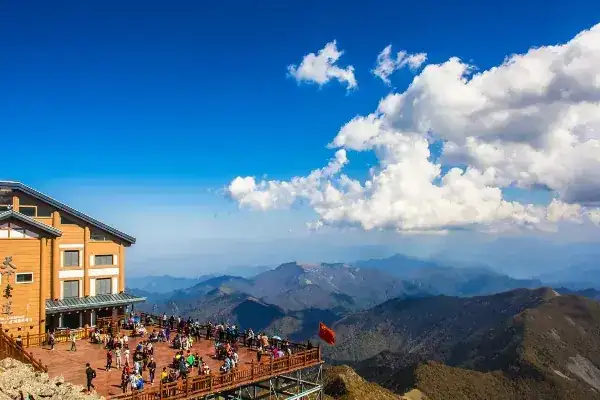
Yuhua Palace: In Yintai District, 37 km from Tongchuan, at 2,401.67m elevation, 2,482 hectares, 95.6% forest coverage. Average temperature 8.4°C, humidity 75%.
Local Specialties
Yijun Walnuts: Large, thin-shelled, sweet kernels, high oil content. National geographical indication certified trademark.
Yaozhou Snowflake Candy ("Zazi Candy"): Traditional local sweet—crisp, fragrant, with health benefits for digestion and cough relief.
Famous Figures
- Fu Xuan (3rd century CE): Western Jin writer and philosopher, co-author of the Book of Wei and author of Fu Zi.
- Linghu Defen (583–661): Tang Dynasty politician and historian, compiler of the Book of Zhou.
- Sun Simiao (c. 581–682): Renowned physician and pharmacologist, honored as the "King of Medicine."
- Liu Gongquan (778–865): Famous Tang Dynasty calligrapher, alongside Yan Zhenqing known as "Yan-Liu."
- Fan Kuan (c. 950–1032): Northern Song landscape painter, one of the three great masters of Song landscape painting.
- Jing Wumu (late Qing): Pioneer of the Shaanxi 1911 Revolution, praised by Sun Yat-sen as "Rising Star of the Revolution" and "Great Pillar of the Northwest Revolution."
Honorary Titles
National Civilized City (2020), China's Most Happy City (2019, 2020), National Health City (2022), National Double Support Model City (2025), China's Most Charming City, National Sponge City Construction Demonstration City (2021), Health City Model City (2021).
Travel information can change. Check current opening hours, reservations and entry requirements before you travel.
Traveller discussion
Start the conversation with a helpful tip or a question.