
Nyingchi City
Nyingchi CityNyingchi City (Nyingchi), formerly known as "Kongpo" (Tibetan: "Nyi Chi," meaning "Sun Throne"), is a prefecture-level city under the Tibet Autonomous Region. Located in southeastern Tibet, it is known as the "Jiangnan of Tibet
Nyingchi City
Nyingchi City (Nyingchi), formerly known as "Kongpo" (Tibetan: "Nyi Chi," meaning "Sun Throne"), is a prefecture-level city under the Tibet Autonomous Region. Located in southeastern Tibet, it is known as the "Jiangnan of Tibet" and "Pearl of the Snowland." Total area: 114,870 square kilometers. It borders Lhasa, Shannan, Nagqu, and Qamdo within Tibet, Yunnan to the east, and India and Myanmar along the border. Average elevation: 3,100 meters. As of June 2026, it administers 1 district, 5 counties, and 1 county-level city. As of the end of 2025, the permanent resident population was 238,900. Nyingchi is China's richest hydropower region, has the largest primeval forest, and is a world-class biodiversity area, with theoretical hydropower potential of 143 million kilowatts and 47.6% forest coverage. It features the Yarlung Tsangpo Grand Canyon, Mount Namcha Barwa, and Basum Tso. In 2025, the gross regional product was 29.234 billion yuan, up 7.3%.
History
The earliest written record of Nyingchi history is the Kongpo Demu cliff inscription. For many years, the Kongpo area was ruled by the Kongpo King. During the Sakya and Phagmodrupa periods (13th–16th centuries), the area came under the Karma Kagyu school. In the 17th century, the Ganden Phodrang government divided the area into several estates. In 1931, the Tibetan government established Bomi and Bodoi counties. In 1951, Tibet was peacefully liberated. In 1960, Nyingchi Special District was established with 7 counties. In 1963, it was abolished and its counties redistributed. In 1986, Nyingchi Administrative Office was restored. In 2015, Nyingchi Prefecture was abolished and prefecture-level Nyingchi City was established with Bayi District.
Administrative Divisions
As of June 2026, Nyingchi administers 1 district (Bayi), 5 counties (Gongbo'gyamda, Mainling, Metok, Bomi, Zayu, Lang), and 1 county-level city (Mainling), with 56 townships/subdistricts and 504 villages. The City People's Government is at No. 18 Guangfu Avenue, Bayi Town, Bayi District.
Geographical Environment
Location
Nyingchi borders Lhasa, Shannan, Nagqu, and Qamdo within Tibet, Yunnan Province to the east, and India and Myanmar along the border. Total area: 114,870 square kilometers.
Topography
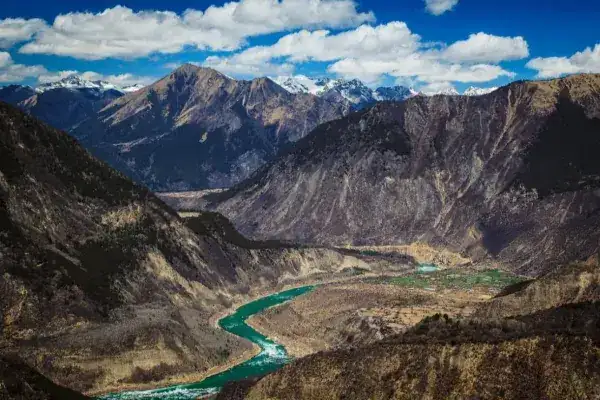
The Nyenchen Tanglha Mountains lie to the north, the eastern Himalaya to the south, Gangdise remnants to the northwest, and Hengduan Mountains to the east. The highest peak is Mount Namcha Barwa at 7,782 meters; the lowest point is at Baxika in Metok County at 155 meters, with a relative elevation difference of 7,627 meters. The terrain slopes from northwest to southeast, with typical alpine gorge and mountain valley landforms. The Yarlung Tsangpo valley between the Himalaya and Gangdise is the largest river valley.
Climate
Nyingchi has a maritime monsoon climate influenced by the Indian Ocean. The Himalaya intercepts warm, moist air from the Bay of Bengal, creating diverse vertical climate zones from tropical to alpine. The south slopes range from tropical to frigid zones; the north slopes have simpler zones. The Yarlung Tsangpo gorge serves as a channel for warm moist air. Climate types include low mountain tropical northern margin, mountain subtropical, mountain temperate, and alpine cold zones. Characteristics: less sunshine, long winters without summer, uneven precipitation distribution.
Vegetation
Vegetation types range from tropical to alpine, with both horizontal and vertical zonation. Main types include alpine cushion vegetation, subalpine meadow, dark coniferous forest (spruce, fir), light coniferous forest (pine), cypress forest, hardwood evergreen forest, deciduous broadleaf forest, subtropical broadleaf forest, tropical rainforest, and valley meadow.
Hydrology
Rivers mainly belong to the Yarlung Tsangpo and Nu River systems, plus the Jitai Qu, Zayu Qu, and Danlong Qu. Rivers flow southward due to the north-to-south slope.
Natural Resources
Animal Resources
94 mammal species (7 orders, 20 families, 60 genera), 315 bird species (18 orders, 47 families, 174 genera), 43 reptiles, 32 amphibians, 24 fish, and 2,322 insect species. Protected species include black stork (Class I), ruddy shelduck (Class II), black-necked crane (Class I), snow leopard (Class I), clouded leopard (Class I), tiger (Class I), red panda (Class II), and many pheasants, eagles, and mammals.
Plant Resources
4,817 higher plant species in 261 families and 1,327 genera (480 bryophytes, 429 ferns, 36 gymnosperms, 3,872 angiosperms), plus 686 macrofungi species (240 edible, 180 medicinal). Class I protected plants include Cyathea (tree fern), giant cypress, Himalayan yew, and Amentotaxus. Class II protected plants include 20+ species. 1,000+ medicinal plant species including Fritillaria, rhubarb, snow lotus, Cordyceps, and Gastrodia. Wild flowers include rhododendron, crabapple, magnolia, primrose, gentian, and Meconopsis.
Land Resources
Agricultural land is scattered in river valleys at 150–4,200 meters (mostly below 3,000 m). Forest land extends from valley bottoms to 4,200–4,600 meters. Pasture land is found above and below the tree line, up to 5,800 meters.
Water Resources
Yarlung Tsangpo Basin
Annual average flow: ~44,400 m³/hour. In Nyingchi, it flows through Lang, Mainling, Bayi, and Metok counties, 728.3 km in Bayi District, with hydropower potential of 71.413 million kilowatts.
Niyang River: 307.5 km, drainage area 17,535 km², 13 major tributaries, hydropower potential 2.695 million kilowatts.
Parlung Zangbo: 266 km main stream, 28,631 km² basin, 8.62 million kilowatts. Yigong Zangbo: 286 km, 13,533 km², 5.123 million kilowatts.
Population
Population Size
According to the Seventh Census (November 1, 2020): 238,936 (up 22.46% from 2010). Males: 127,548 (53.38%); females: 111,388 (46.62%). As of end 2025: 238,900.
Ethnic Composition
Tibetan: 159,783; other minorities: 20,170; Han: 58,983 (2020 Census).
Politics
Territorial Dispute
In 1914, the British representative Henry McMahon drew the "McMahon Line" at the Simla Conference, illegally placing approximately 90,000 square kilometers of Tibetan territory under British India. The Chinese central government has never recognized this illegal border line.
Leadership
Economy
Overview
In 2025, the gross regional product was 29.234 billion yuan, up 7.3%. By industry: primary 2.042 billion, up 10.5%; secondary 10.491 billion, up 10.2%; tertiary 16.701 billion, up 5.5%. Structure: 6.98:35.89:57.13. Fixed-asset investment up 62.9% (private investment down 40.5%). General public budget revenue: 2.027 billion, up 9.46%. General public budget expenditure: 22.194 billion, down 9.95%. Rural per capita disposable income: 29,367 yuan, up 7.1%. Urban: 52,918 yuan, up 6.6%.
Primary Industry
Total agricultural output: 2.49 billion yuan, up 8.3%. Grain area: 21,714.4 hectares, up 3.7%. Grain output: 102,158.36 tons, up 6.6%. Livestock inventory: 588,900 head (cattle 400,500, up 1.7%; sheep 10,300, down 1.4%; pigs 161,200, down 30.8%). Meat output: 19,087.8 tons, up 5.1%. Milk: 36,669.3 tons, up 4.3%.
Secondary Industry
Industrial added value: 2.773 billion yuan, up 10.4%. Above-scale industrial added value up 18.7%. Above-scale industrial output up 12.1% (light industry up 24.9%, heavy industry down 4.2%). Traditional Chinese medicine production: 4,405.1 tons, up 23.3%. Natural drinking water: 16 producers, 27,824.05 tons, up 261.77%.
Tertiary Industry
Total retail sales: 7.711 billion yuan, up 5.1% (urban 6.346 billion, up 5.8%; rural 1.365 billion, up 1.6%). Foreign trade: 9.874 million yuan, up 17.2% (all exports). Total deposits: 69.353 billion, up 43.65%. Total loans: 66.712 billion, up 31.86%. Green finance loans: 27.535 billion, up 43.09%. By January 2026, total loans exceeded 70 billion. Tourist arrivals: 17.354 million, up 13.38%. Tourism revenue: 16.29 billion yuan, up 17.91%.
Transportation
Overview
In 2025: highway passengers 2.5061 million, up 44.77%. Highway freight: 2.881 million tons, up 9.54%. Civil aviation passengers: 967,800, up 21.46%. Total highway mileage: 7,425.272 km (5,286.72 km paved). 100% township accessibility, 96.4% village accessibility.
Civil Aviation
Nyingchi Mainling Airport: Tibet's third civil airport, opened 2005. Located in the Yarlung Tsangpo valley at 2,949 meters elevation, 50 km from Bayi Town. Rated "Best Branch Tourism Airport" in 2015.
Railways
On June 25, 2021, the Lhasa-Nyingchi Railway (Tibet's first electrified railway) opened, with 8 stations in Nyingchi: 4 passenger/freight stations (Lang County, Mainling, Gangga, Nyingchi) and 4 passing stations.
Social Affairs
Education
1 secondary vocational (2,418 students), 11 secondary schools (16,058 students), 61 primary schools (22,001 students), and 8,995 kindergarten children.
Culture
510 art troupes (1 municipal, 7 county, 502 village), 63 cultural centers/stations, 8 public libraries, 1 museum. Radio coverage: 99.67%, TV coverage: 99.75%.
Healthcare
Outpatient visits: 940,500. Hospitalizations: 37,200. 81 health institutions with 1,960 health workers (1,495 physicians). 8.2 health workers and 6.3 beds per 1,000. Maternal mortality: 48.8 per 100,000. Infant mortality: 7.32 per mille.
Sports
Nyingchi Sports Training Base: Built in 2016, 9,100 million yuan investment, designated as a national comprehensive sports training base in 2017. 89 competitions held in 2025. Sports lottery sales: 178 million yuan, up 12.5%.
Social Security
5,656 new urban jobs. 40,942 rural labor transfers. 1,771 public welfare positions. Enterprise pension: 56,977 (47,612 contributing, 9,365 retired). Urban-rural pension: 91,349. Employee medical: 46,407. Urban-rural medical: 157,411. Unemployment: 30,565. Urban minimum living: 299. Rural minimum living: 2,509. 1 children's welfare institution (285 children). 7 elderly care institutions (495 centralized, 620 home-based).
History and Culture
Cultural Relics
Intangible Cultural Heritage
Scenic Spots
Local Specialties
Famous People
Historical Figures
Revolutionary Martyrs
Honorary Titles
In November 2023, named "National Food Safety Demonstration City." In 2025, selected for the National Double Support Model City (County) list.
Travel information can change. Check current opening hours, reservations and entry requirements before you travel.


Traveller discussion
Start the conversation with a helpful tip or a question.