
Zunyi City
Zunyi CityZunyi City, abbreviated as "Zun," formerly known as Bozhou, is a prefecture-level city under Guizhou Province, located in southwestern China, northern Guizhou. It borders Guiyang to the south, Chongqing to the north, and Sichuan P
Zunyi City
Zunyi City, abbreviated as "Zun," formerly known as Bozhou, is a prefecture-level city under Guizhou Province, located in southwestern China, northern Guizhou. It borders Guiyang to the south, Chongqing to the north, and Sichuan Province to the west. The terrain is highly variable with complex landforms, belonging to the central subtropical plateau humid monsoon zone with four distinct seasons and simultaneous rain and heat. As of 2023, it administers 3 districts, 7 counties, 2 autonomous counties, and 2 county-level cities, with a total area of 30,762 square kilometers. As of end 2024, the permanent resident population was 6,494,500. Zunyi is Guizhou's sub-center city, an emerging industrial city, and important agricultural production base. It is an important transportation hub connecting north-south and east-west in Southwest China, and the core of the Chengdu-Chongqing-Guizhou Economic Corridor. It is the hometown of Moutai, one of China's three famous liquors, and the site of the historic Zunyi Conference, known as the "City of Turning Points, Capital of Conferences." It has World Cultural Heritage Hailongtun and World Natural Heritage Chishui Danxia. In 2025, the gross regional product was 520.612 billion yuan, up 4.3%.
History
Human activity dates back 206,000–240,000 years, with Paleolithic remains at Yanhuidong in Tongzi County. During the Spring and Autumn period, the area belonged to various states including Zangke, Ba, Shu, and Bo. During the Warring States period, it was part of the "Great Yelang Kingdom." In 130 BC, Qianwei Commandery was established. In 111 BC, Zangke Commandery was established, ending the 250+ year Yelang Kingdom. In 639, the Tang Dynasty (618–907) renamed Langzhou to Bozhou, which lasted 962 years. In 642, Luomeng County was renamed Zunyi County, marking the first appearance of the name "Zunyi." From the late Tang to the end of the Ming Dynasty (1368–1644), Bozhou was ruled by the Yang family chieftains for 725 years. In 1600, the "Pacification of Bo" campaign ended the chieftain system and introduced direct governance. In 1727, Zunyi Prefecture was transferred from Sichuan to Guizhou Province. In 1935, the famous Zunyi Conference was held. In 1949, Zunyi was liberated. In 1997, prefecture-level Zunyi City was established.
Administrative Divisions
Evolution
Multiple reorganizations from 1951–1961. In 1997, prefecture-level Zunyi City was established with Honghuagang District. In 2004, Huichuan District was established. In 2016, Zunyi County was abolished and Bozhou District was established.
Division Details
As of end 2023: 3 districts (Honghuagang, Huichuan, Bozhou), 7 counties, 2 autonomous counties (Daozhen Gelao and Miao, Wuchuan Gelao and Miao), and 2 county-level cities (Chishui, Renhuai), with 54 subdistricts, 179 towns, 13 townships, and 8 ethnic townships, 642 communities, and 1,448 villages (plus Xinpu New Area managing 3 subdistricts and 5 towns). The City People's Government is at Building 1B, Jiantou Mansion, Fuqian Road, Honghuagang District.
Geographical Environment
Location
Zunyi is in northern Guizhou, northeastern Yunnan-Guizhou Plateau, between 27°8'–29°12' north latitude and 105°36'–108°13' east longitude, spanning 254 km east-west and 230.5 km north-south. Total area: 30,762 square kilometers. 140 km south to Guiyang, 239 km north to Chongqing.
Topography
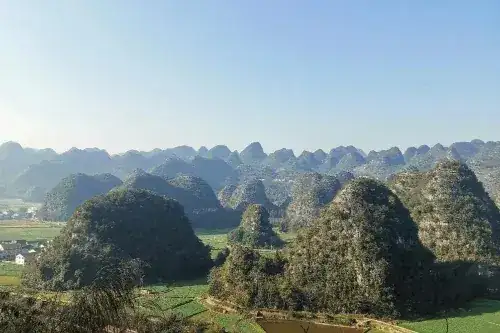
Transition zone from Yunnan-Guizhou Plateau to Hunan hills and Sichuan Basin. Elevation: 800–1,300 m. Flatlands and valley basins: 6.57%; hills: 28.35%; mountains: 65.08%. The Dalou Mountains run SW-NE, dividing northern and southern water systems. Karst landforms cover ~75% of the area.
Climate
Central subtropical plateau humid monsoon climate. Four distinct seasons. Annual average temperature: 15.1°C. Frost-free period: 250–350 days. Annual sunshine: 1,000–1,300 hours (23–29% sunshine rate). Annual precipitation: 900–1,200 mm (range 800–1,600 mm), decreasing from east to west.
Hydrology
All rivers belong to the Yangtze basin, divided into the Wujiang and upper Yangtze (Chishui and Qijiang) systems. Major rivers: Wujiang, Xiangjiang, Furongjiang, Hongduhe, Chishui, Tongzihe, and Xiushui. Average annual water resources: 17.24 billion cubic meters (17.4% of Guizhou's total). 290 rivers over 10 km, 412 rivers over 20 km² drainage area.
Natural Resources
Water Resources
Groundwater runoff: 4.389 billion cubic meters (24.4% of surface runoff). Per capita water: ~700 cubic meters. Theoretical hydropower potential: 3.2506 million kilowatts (developable: 6.0682 million kW, developed: 1.4366 million kW). Wujiangdu Station (1.25 million kW) and Goupitan Station (3 million kW) on the Wujiang.
Land Resources
39% multi-use land (suitable for agriculture, forestry, pasture), 58% dual-use (forestry and pasture), 3% unsuitable. Main soil types: yellow soil, limestone soil, paddy soil, alluvial soil (low hills); purple soil, skeleton soil (low mountains); yellow-brown soil (above 1,400 m).
Biological Resources
2,009 higher plant species with subtropical evergreen broadleaf forest as the typical type. 93.3% of Guizhou's rare wildlife resources. 83 species under national Class I and II protection including silver fir, tree fern, dove tree, golden camellia, black leaf monkey, white-crowned long-tailed pheasant, and large civet. 23 nature reserves (2 national), 5 forest parks (2 national). Forest area: 1,493,700 hectares. Forest coverage: 48.56%.
Mineral Resources
60+ proven mineral types. Coal, bauxite, titanium, manganese, magnesium, molybdenum, barium, and caustic soda are important domestically and provincially. Coal reserves: 26+ billion tons at <1,500 m depth (5.04 billion tons proven, 3rd in Guizhou after Liupanshui and Bijie).
Population
As of end 2024: 6,494,500 permanent residents (down 86,100). Registered population: 8,308,900. Multiple ethnic groups including Han, Tujia, Yi, Bai, Dai, Zhuang, Miao, Hui, Gelao, and others.
Politics
Economy
Overview
In 2025, the gross regional product was 520.612 billion yuan, up 4.3%. In 2024: 502.72 billion, up 5.7%. By industry: primary 56.964 billion (11.3%), secondary 200.667 billion (39.9%), tertiary 245.089 billion (48.8%). Per capita GDP: 76,897 yuan. Fixed-asset investment down 2.9% (industrial up 13.4%). Total fiscal revenue: 144.613 billion, up 10.5%. General public budget revenue: 34.776 billion, up 6.6%.
Primary Industry
Total agricultural output: 100.423 billion yuan, up 3.9%. Grain area: 9.07 million mu. Grain output: 2.38 million tons. Chili pepper area: 1.2657 million mu, output 1.5514 million tons. Tea: 144,700 mu harvested, 109,500 tons. Fruit: 689,700 mu, 930,500 tons. Meat: 506,500 tons (pork 418,500 tons; beef 40,800 tons). Pig sales: 4,421,300.
Secondary Industry
902 above-scale industrial enterprises. Industrial added value: 184.789 billion yuan, up 7.6%. Above-scale industrial added value up 8.1%. Four traditional industries (coal, electricity, tobacco, liquor) account for 90.0% of above-scale value, with liquor manufacturing alone at 78.7%. Revenue: 216.87 billion, up 5.5%. Profits: 101.43 billion, up 16.9%. Construction added value: 15.948 billion, down 4.8%.
Tertiary Industry
Services added value: 245.089 billion yuan, up 5.4%. Wholesale/retail: 86.575 billion, up 6.3%. Transportation: 12.421 billion, up 18.7%. Finance: 24.666 billion, up 1.4%. Total retail sales: up 6.3%. Above-quota retail: 67.591 billion, up 20.6%. Online sales: 24.62 billion, up 99.1%. Total deposits: 706.112 billion, up 5.3%. Total loans: 665.593 billion, up 3.9%. Insurance premiums: 9.605 billion, up 2.9%.
Social Affairs
Science and Technology
247 high-tech enterprises, 192 technology-based SMEs. R&D expenditure: 2.672 billion yuan (0.56% of GDP). 407 invention patent grants. 3,686 valid invention patents.
Education
2,891 schools, 1,523,900 students. 7 universities, 25 vocational high schools, 83 high schools, 328 junior high, 853 primary, 1,573 kindergartens. Compulsory education consolidation: 107.0%. High school enrollment: 93.6%.
Culture
36 cultural service units, 5 art troupes, 18 cultural centers, 15 public libraries, 27 museums/memorials, 254 township cultural stations. Radio and TV coverage: 99.93%.
Healthcare
4,256 health institutions: 216 hospitals, 208 township health centers, 238 community health centers, 2,219 village clinics. 62,923 health workers (24,178 physicians, 27,976 nurses). 59,339 beds (45,253 hospitals).
Sports
Olympic Center "one stadium, three venues" completed. Huichuan Sports Center upgraded. County-level sports facilities coverage achieved.
Social Security
Urban minimum living standard: 777 yuan/month (up from 614 in 2019). Rural: 569 yuan/month (up from 325). Urban-rural pension: 3.3994 million. Employee pension: 1.2607 million. Work injury: 1.1686 million. Unemployment: 625,000. Medical insurance: 6.65 million. Maternity: 682,400.
Transportation
Highways
Total mileage: 41,915 km (1,820 km expressway, 35,488 km rural).
Railways
Aviation
Water Transport
Chishui Port: Guizhou's largest port, 720,000 tons/year capacity. The Chishui River connects to the Yangtze, reaching ports from Chongqing to Shanghai. Six ports under construction on the Wujiang. Total navigable mileage: 1,052 km.
Public Transportation
46 bus routes totaling 498.5 km in the central urban area, including peak express, night, and suburban routes. Public transport accounts for 30% of urban trips. Regular fare: 1 yuan; air-conditioned/night: 2 yuan. IC card and UnionPay accepted.
History and Culture
Dialect
Southwestern Mandarin with seven sub-dialects: Zunyi, Suiyang, Yuqing, Tongzi, Wuchuan, Renhuai, and Chishui, each centered on its county seat.
Folk Customs
Cultural Heritage Sites
Cultural Heritage Sites
Scenic Spots
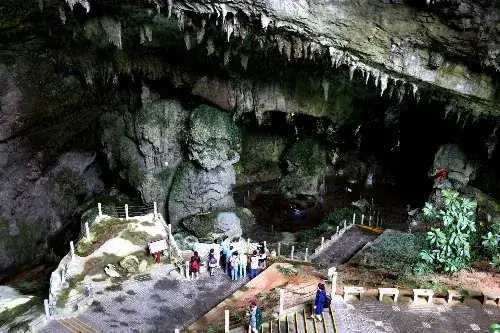
Part of the greater Southwest China tourism area and the Sichuan-Chongqing-Guizhou golden triangle. 3 major categories, 40 types, 100+ scenic spots. 17 national-level and 75 provincial-level resources. Features mountains, water, forests, and caves.
Local Specialties
Snacks
Yaxi Huang's Beef, small-leaf bitter tea, Zunyi tofu noodle, chili pepper, Zunyi mutton noodle, hollow noodle, Fenggang health oil tea, potato cake, Renhui three-chicken, Hema mutton, Nanbai yellow cake, Liu Erma rice skin, Zheng'an handmade rice skin, Shangji tofu skin, mung bean noodle, buckwheat noodle, Tian's steamed dumplings.
Fine Liquors
Moutai (one of China's three famous liquors "Mao-Wu-Jian"), Dongjiu, Xijiu, Zhenjiu, and Yaxijiao Liquor.
Famous People
Sister Cities
Honorary Titles
National Civilized City, National Forest City, National Hygienic City, Double Support Model City, China Excellent Tourist City, National Garden City, National Historical and Cultural City (first batch).
Travel information can change. Check current opening hours, reservations and entry requirements before you travel.
Traveller discussion
Start the conversation with a helpful tip or a question.