
Aba Tibetan and Qiang Autonomous Prefecture
Aba Tibetan and Qiang Autonomous PrefectureAba Tibetan and Qiang Autonomous Prefecture, abbreviated as Aba Prefecture, is an autonomous prefecture in Sichuan Province, located in the northwestern part of the province at the southeastern edg
Aba Tibetan and Qiang Autonomous Prefecture
Aba Tibetan and Qiang Autonomous Prefecture, abbreviated as Aba Prefecture, is an autonomous prefecture in Sichuan Province, located in the northwestern part of the province at the southeastern edge of the Qinghai-Tibet Plateau, bordering the Chengdu Plain. It features typical plateau terrain with high elevation, bounded by Gansu and Qinghai provinces to the north and northwest, and adjacent to Mianyang, Deyang, and Chengdu to the east and southeast. The average elevation exceeds 3,000 meters with pronounced vertical climate variation. As of July 2026, the prefecture administers 12 counties and one county-level city (Maerkang), with a total area of 84,242 square kilometers. The seat of the prefecture government is in Maerkang. As of the end of 2025, the registered population was 891,300. The prefecture is home to the Qiang ethnic culture ecological protection zone and renowned scenic areas including Jiuzhaigou, Huanglong, Wolong, and Mount Siguniang. In 2025, the prefecture achieved a regional GDP of 60.119 billion yuan (approximately $8.35 billion USD), growing 5.5% year-on-year.
Historical Evolution
Human habitation in Aba dates back to the Neolithic Age. During the Qin and Han dynasties, administrative structures were established in the Songpan area. The Western Han dynasty set up Wenshan Commandery (headquartered in present-day Maoxian). During the Sui, Tang, and Song dynasties, the Jimi (loose-rein) prefecture system was widely practiced. The Yuan dynasty established Songpan as a government seat and initiated the Tusi (chieftain) system. The Ming and Qing dynasties continued this system, with the Qing dynasty intensifying the "gaituguiliu" policy (replacing native chieftains with centrally appointed officials) under Emperor Qianlong.
During the Republic of China period, Aba was placed under the Western Sichuan Circuit. From 1935 to 1936, the Chinese Red Army established revolutionary bases in the area during the Long March, creating the Gele Desha Republic — the first ethnic minority autonomous government in Chinese history.
After the founding of the People's Republic of China in 1949, the area was fully liberated by 1952. In 1953, the Sichuan Tibetan Autonomous Region (prefecture-level) was established, renamed Aba Tibetan Autonomous Prefecture in 1955, and formally renamed Aba Tibetan and Qiang Autonomous Prefecture in 1987.
Administrative Divisions
As of July 2026, Aba Prefecture administers one county-level city (Maerkang) and 12 counties: Jinchuan, Xiaojin, Aba, Ruoergai, Hongyuan, Rangtang, Wenchuan, Li, Maoxian, Songpan, Jiuzhaigou, and Heishui. These comprise 219 townships (51 towns and 168 rural townships), 1,354 administrative villages, and 64 designated communities.
Geography
Location and Terrain
Aba Prefecture is located at the southeastern edge of the Qinghai-Tibet Plateau in northwestern Sichuan, between 100°30′–104°27′ E and 30°35′–34°19′ N. It spans approximately 414 km north-south and 360 km east-west, covering 84,242 square kilometers (17.31% of Sichuan's total area). The average elevation exceeds 3,000 meters. The highest peak is Mount Siguniang at 6,250 meters. Plateau and mountain canyon terrain each account for roughly half of the total area.
Climate
The climate ranges from subtropical valley conditions to alpine zones depending on elevation. Average annual temperatures range from 0.8°C on the northwestern plateau to 13.0°C in river valleys. In 2022, the prefecture's average temperature was 9.3°C, with annual precipitation of 704.9 mm.
Hydrology
Aba hosts China's largest highland swampland, concentrated in Ruoergai and Hongyuan counties, serving as a major wetland protection area. There are approximately 540 lakes with a total water surface of about 70.5 square kilometers. The Minjiang River and its largest tributary, the Dadu River, flow through the entire prefecture.
Geology
The area sits on the Longmenshan fold-fracture zone, straddling tectonic fault lines and seismic belts. Rock structures are fragile and loose due to fault activity. Approximately 1.21 million mu (about 80,700 hectares) of natural grassland has degraded.
Natural Disasters
Aba is located in the central section of China's North-South Seismic Belt, with over 30 active fault lines. Since earthquake records began in 638 CE, the region has experienced multiple major earthquakes, including the devastating Wenchuan Earthquake of May 12, 2008, which caused 69,227 deaths and 17,923 missing persons, affecting over 15.1 million people.
Natural Resources
Water Resources
Annual water resources total 44.6 billion cubic meters, with theoretical hydropower potential of 19.33 million kW (14% of Sichuan's total). The developable capacity is 14 million kW (11% of Sichuan's total).
Mineral Resources
Fifty-five mineral types have been discovered, including 12 large deposits and 10 medium-sized deposits. Key minerals include gold, lithium, granite, marble, limestone, peat, mineral water, garnet, lignite, and hot springs.
Forest and Grassland Resources
The prefecture hosts over 4,000 plant species, including 70 nationally protected species. There are over 1,900 species of wild medicinal herbs, earning it the nickname "natural medicine treasury." Forest coverage is substantial, with 3,300 wan mu (approximately 2.2 million hectares) of forest area.
Biological Resources
Aba has 557 vertebrate species and is a primary habitat for 104 nationally protected animals, including giant pandas, takins, golden snub-nosed monkeys, and white-lipped deer.
Nature Reserves
Aba has 25 nature reserves totaling 2.29 million hectares, including 5 national-level reserves (Jiuzhaigou, Wolong, Ruoergai Wetland, Mount Siguniang, and Baihe). The Wolong Nature Reserve in Wenchuan County is one of China's largest, home to over 100 giant pandas (roughly one-tenth of the national total), and was the world's first giant panda research center.
Population
As of the 2020 census, the resident population was 822,587, a decrease of 8.47% from 2010. As of the end of 2025, the registered population was 891,300. The ethnic composition is 61.0% Tibetan, 18.5% Qiang, 17.4% Han, 3.0% Hui, and 0.2% other ethnicities.
The Tibetan population is concentrated in Ruoergai, Hongyuan, Aba, Rangtang, Maerkang, and Heishui, and is subdivided into Amdo, Jiarong, and Baima regional groups. The Qiang people are mainly distributed in Maoxian, Wenchuan, Li, Songpan, and Heishui counties.
Religion
The major religions include Bon (an indigenous Tibetan religion), Tibetan Buddhism (with Nyingma, Kagyu, Sakya, and Gelug schools), and the Qiang people's polytheistic belief system centered on nature worship and ancestor veneration, particularly the worship of white stones.
Politics
The prefecture operates under the autonomous governance system for ethnic minority regions. The prefecture government is seated in Maerkang City.
Economy
Overview
Over the decade following the 18th Party Congress, cumulative fixed-asset investment exceeded 400 billion yuan (approximately $55.6 billion USD), three times the total of the preceding 60 years. Per capita GDP rose to 56,473 yuan (approximately $7,843 USD), up 150% from 2012. All 103,800 impoverished residents were lifted out of poverty on schedule.
In 2025, the regional GDP reached 60.119 billion yuan (approximately $8.35 billion USD), up 5.5%. The primary industry added value of 11.644 billion yuan (approximately $1.62 billion USD, +4.6%); the secondary industry 14.159 billion yuan (approximately $1.97 billion USD, +5.3%); the tertiary industry 34.316 billion yuan (approximately $4.77 billion USD, +6.0%), serving as the core engine of economic growth. Fixed-asset investment grew 28.9%.
Primary Industry
Aba develops five characteristic industries: vegetables, fruits, potatoes, medicinal herbs, and edible fungi. In 2025, the total output value of agriculture, forestry, animal husbandry, and fishery was 19.966 billion yuan (approximately $2.77 billion USD), up 4.5%. Grain output was 167,800 tons. Vegetable and edible fungi production reached 837,200 tons.
Secondary Industry
The power generation and supply industry is the pillar of the secondary sector. Three provincial-level industrial parks have been established: Sichuan Aba Industrial Park, Chengdu-Aba Industrial Concentration Zone, and Deyang-Aba Ecological Economic Industrial Park. In 2025, total industrial added value was 12.29 billion yuan (approximately $1.71 billion USD), up 4.8%. The industrialization rate was 20.4%.
Tertiary Industry
In 2025, the service sector achieved an added value of 34.316 billion yuan (approximately $4.77 billion USD), up 6.0%. Wholesale and retail trade grew 10.5%, accommodation and catering 6.4%, and finance 4.1%. Total retail sales of consumer goods reached 12.462 billion yuan (approximately $1.73 billion USD), up 7.4%.
Economic Functional Zones
Aba is building a new industrial structure of "three bases co-developed, five industries co-optimized," cultivating "6+N" highland agriculture, "5+N" eco-industry, and "1+6" modern services. This includes six core agricultural sectors (cattle/sheep, pigs, specialty fruits and vegetables, highland produce, quality grains and oils, authentic medicinal herbs), multiple eco-industrial fields, and cultural tourism supported by six service industries. The prefecture has established 57 modern agricultural parks and two "enclave industrial parks" (Chengdu-Aba and Deyang-Aba).
Social Affairs
Education
As of the end of 2025, Aba has 2 regular institutions of higher education, 48 secondary schools, 157 primary schools, and 125 kindergartens. The gross enrollment rate for pre-primary education is 97.0%, compulsory education retention rate 97.6%, and gross high school enrollment rate 96.0%.
Healthcare
The prefecture has 1,521 health institutions with 5,852 beds and 8,132 health professionals, including 3,248 licensed physicians and 2,867 registered nurses. The hospital delivery rate for pregnant women is 98.11%.
Science and Technology
In 2025, 250 patents were granted. There are 23 high-tech enterprises and 101 technology-based SMEs. Technology contract transactions totaled 29.32 million yuan (approximately $4.07 million USD).
Culture
The prefecture has 8 performing arts troupes, 14 cultural centers, 174 township cultural stations, 28 museums, 14 public libraries, and 1,354 rural bookhouses. Radio and television coverage rates are 92.87% and 99.55% respectively.
Sports
In 2025, Aba hosted the Sichuan Provincial City Football League, organized 81 mass sports events attracting nearly 990,000 participants, and held the Mount Siguniang Trail Run with over 2,400 domestic and international competitors, generating direct economic benefits of 5.85 million yuan (approximately $812,500 USD).
Social Security
Urban new employment reached 8,502 persons. Basic pension insurance covered 231,200 urban workers and 374,800 urban and rural residents. Basic medical insurance covered 816,200 people. 67,081 rural residents received minimum living allowances.
Environmental Protection
In 2025, PM10 averaged 18.2 μg/m³ and PM2.5 averaged 14.0 μg/m³. Urban air quality met Grade I standards with 100% excellent air quality days. The prefecture ranked second in Sichuan and ninth nationally for atmospheric environment quality. All monitored river sections met Grade II or above water quality standards, with 100% compliance.
Transportation
Overview
During the 13th Five-Year Plan period, Aba completed 70.891 billion yuan (approximately $9.85 billion USD) in transportation investment, exceeding 40% of total fixed-asset investment. All townships achieved 100% paved road and bus access, and all counties connected to Grade III or higher highways.
Highways
Major national highways include routes G317, G213, G347, G544, G247, G248, G350, G351, and G227. In 2022, transportation investment reached 22.538 billion yuan (approximately $3.13 billion USD). The Wenma Expressway is operational, and multiple expressway projects are under construction.
Railways
The Xi'an-Chengdu Railway passes through Maoxian, Songpan, and Jiuzhaigou with a design speed of 200 km/h and total length of 573 km. Construction is actively underway on the Aba section, with significant tunnel and bridge progress. The Chengdu-Lanzhou Railway (Aba section) has accumulated 14.476 billion yuan (approximately $2.01 billion USD) in investment since construction began.
Aviation
Two passenger airports operate: Aba Hongyuan Airport and Jiuzhai Huanglong Airport. The latter, at an elevation of 3,447 meters in Songpan County, opened in 2003 and has served nearly 20 million passengers, with peak annual throughput exceeding 1.75 million. It connects to 21 domestic cities via 11 airlines.
Public Transportation
As of 2020, Aba operates 43 passenger bus routes with 53 vehicles, connecting Maerkang City with Chengdu, Dujiangyan, Aba County, Hongyuan, Li County, and Wenchuan.
History and Culture
Cultural Heritage Protection
Key national-level protected cultural sites include the Zhuokeji Tusi Official Residence in Maerkang, Zhibo Watchtowers in Songgang, Songpan Ancient City Walls, Bangtuo Monastery in Rangtang, Cuorji Monastery, Yingpanshan Ruins, Jiangweicheng Ruins, Risimanba Watchtower House, and Red Army Long March relics. In 2025, the prefecture surveyed all 2,132 immovable cultural relics and reported over 300 new discoveries.
Intangible Cultural Heritage
There are 19 national-level, 73 provincial-level, and 457 prefecture-level intangible cultural heritage items, including Heishui Kastawen dance, Jiuzhaigou dance, Qiang flute performance and crafting, and the Qiang Wale'erzu Festival.
Local Festivals
Aba's diverse ethnic composition gives rise to numerous traditional festivals, including Tibetan New Year (Losar), the Qiang New Year, horse racing festivals, and the Zhuanshan (circumambulation) festival, reflecting the rich cultural traditions of the Tibetan, Qiang, and other ethnic communities.
Scenic Areas
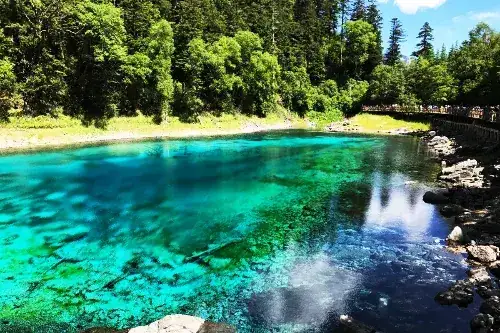
As of the end of 2021, Aba has 53 A-level scenic areas, including 3 at the 5A level and 24 at the 4A level. Jiuzhaigou National Nature Reserve holds three top-tier titles: World Natural Heritage, Man and Biosphere Reserve, and Green Globe 21 certification. Other notable attractions include the Huanglong Scenic Area, Wolong National Nature Reserve, and Mount Siguniang Scenic Area. The prefecture also features 4 national forest parks and 6 provincial-level scenic areas. Nature reserves cover 2.27 million hectares, accounting for 27% of the prefecture's total area.
Honors Received
In April 2025, Aba was awarded the title of National Double Support Model City (County).
Travel information can change. Check current opening hours, reservations and entry requirements before you travel.
Traveller discussion
Start the conversation with a helpful tip or a question.