
Guangyuan City
Guangyuan CityGuangyuan City, known in ancient times as Lizhou, is a prefecture-level city in Sichuan Province. Located in northern Sichuan, it borders Gansu and Shaanxi Provinces to the north, Nanchong City to the south, Mianyang City to t
Guangyuan City
Guangyuan City, known in ancient times as Lizhou, is a prefecture-level city in Sichuan Province. Located in northern Sichuan, it borders Gansu and Shaanxi Provinces to the north, Nanchong City to the south, Mianyang City to the west, and Bazhong City to the east. Situated at the northern edge of the Sichuan Basin in the transition zone from mountains to basin, it has a subtropical humid monsoon climate and serves as an important ecological barrier in the upper reaches of the Jialing River. As a regional center at the junction of Sichuan, Shaanxi, and Gansu, Guangyuan has been named one of China's Top Ten Livable Cities, a National Tourism Standardization Demonstration City, and a National Top Ten Health and Wellness City. The total area is 16,319 square kilometers. As of March 2024, Guangyuan administers 3 districts and 4 counties. As of the end of 2024, the permanent resident population was 2.225 million. Guangyuan has long been known as the "Gateway to Northern Sichuan and the Throat of the Shu Road." With over 2,300 years of city-building history, it is one of the important birthplaces of Ba-Shu civilization. It is the birthplace of Wu Zetian, the only female emperor in Chinese history, a concentrated showcase of ancient plank road and Shu Road culture, and the core corridor of Three Kingdoms historical culture. It was also the core area of the former Sichuan-Shaanxi Soviet and the departure point of the Long March of the Fourth Front Army of the Red Army. With 3 expressways and 4 railways converging in its territory, it is designated as a national comprehensive transportation hub city. The city has 47 national A-level tourist attractions, including 1 national 5A-level attraction (Jianmen Shu Road and Jianmen Pass) and 21 4A-level attractions. In 2025, Guangyuan's GDP reached 134.878 billion yuan (approximately $18.7 billion USD), up 6.4% at constant prices.
Historical Evolution
During the Xia Dynasty, Guangyuan was part of the Yin State; during the Zhou Dynasty, it was part of the Ju State, which formed a "tripartite balance" with the Ba State and the Shu State. In 316 BC, the State of Qin conquered Shu and annexed Ju, establishing Jiameng County (seat at present-day Zhaohua Town, Zhaohua District) under Shu Commandery.
The area underwent numerous administrative changes across dynasties. During the Eastern Jin Dynasty (390 AD), Xing'an County was established (seat at present-day Lizhou District). The Northern Wei established West Yizhou, the Liang Dynasty renamed it Lizhou, and the Western Wei set up the Lizhou General Administration. During the Sui Dynasty, Xing'an County was renamed Mian'gu County. During the Tang Dynasty, it was elevated to a General Protectorate. During the Five Dynasties period, the old city area of Guangyuan served as the seat of county, prefecture, and military administration.
During the Yuan Dynasty, drawing from the I Ching's phrase "Great is the Heavenly Origin" and the concept of the Yuan Dynasty's far-reaching virtue and vast territory, Mian'gu County was renamed Guangyuan County. The Ming Dynasty saw it downgraded from a prefecture to a county. The Qing Dynasty and the Republic of China maintained the Ming system.
In December 1949, Guangyuan and Zhaohua were liberated. In 1950, the Jiange Commissioner's Office was established in Guangyuan, administering 10 counties. In 1952, it was renamed Guangyuan Prefecture. In 1953, it came under Mianyang Prefecture. In 1959, Zhaohua County was merged into Guangyuan County. In February 1985, the prefecture-level Guangyuan City was established, with Qingchuan, Wangcang, and Jiange counties transferred from Mianyang, and Cangxi County from Nanchong.
Administrative Divisions
In 1989, Yuanba and Chaotian suburban districts were established. In 2007, the central district was renamed Lizhou District. In 2013, Yuanba District was renamed Zhaohua District. As of December 2024, Guangyuan City administers Lizhou District, Zhaohua District, Chaotian District, Wangcang County, Qingchuan County, Jiange County, and Cangxi County, comprising 23 townships, 112 towns, and 7 sub-districts. The municipal government is headquartered at No. 24, North Renmin Road, Lizhou District.
Geographical Environment
Location and Boundaries
Guangyuan City is located in northern Sichuan Province, between 31 deg 31 min and 32 deg 56 min N, and 104 deg 36 min and 106 deg 45 min E. It borders Gansu Province and Shaanxi Province to the north, Nanchong to the south, Mianyang to the west, and Bazhong to the east. The total area is 16,319 square kilometers.
Topography and Landforms
Guangyuan is situated at the northern edge of the Sichuan Basin, in the transition zone from mountains to basin. The Motianling and Micang Mountains traverse the city's north, serving as boundary mountains between Sichuan-Gansu and Sichuan-Shaanxi respectively. The Longmen Mountains extend diagonally through the west. The terrain slopes from north to southeast, with ridge elevation differences exceeding 3,200 meters. The Motianling ridge descends from 3,837 meters at its western peak to 2,784 meters eastward, dropping sharply to 800 meters southward.
Climate
Guangyuan has a subtropical humid monsoon climate. Located at the southern foot of the Qinling Mountains, it is a transition zone combining southern humid climate features with northern clear-sky characteristics. The annual average temperature is 16.1 degrees Celsius, with July averaging 26.1 and January 4.9. Annual rainfall ranges from 800 to 1,000 mm, with 1,300 to 1,400 sunshine hours and a 220 to 260 day frost-free period. However, droughts and floods occur frequently.
Natural Resources
Water Resources
Guangyuan has over 4,700 water conservancy projects, including 6 medium-sized and 558 small reservoirs. Total water resources reach 6.867 billion cubic meters, with groundwater resources of 1 billion cubic meters. The hydropower potential reaches 2.96 million kilowatts, with the completed Baozhusi Power Station having an installed capacity of 700,000 kilowatts.
Forest Resources
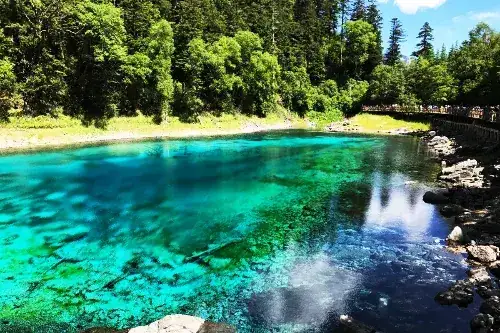
Guangyuan's forest coverage rate is 58.85%, with a forest area of 14.162 million mu and timber stock of 65 million cubic meters. The city hosts the Giant Panda National Park, 6 scenic areas including Jianmen Shu Road and Bailong Lake, 13 nature reserves, 10 forest parks, and 2 national wetland parks. In 2023, walnut production reached 248,200 tons and fresh olive fruit production reached 6,000 tons.
Biological Resources
Guangyuan is home to 532 species of wild vertebrates (excluding fish), including 25 national first-class protected species such as giant pandas, Sichuan golden snub-nosed monkeys, and Sichuan takin. There are 92 national second-class protected species and nearly 400 species of wildlife with important ecological, scientific, and social value. The city also hosts 2,620 wild plant species, including 9 species under national first-class protection and 48 under national second-class protection.
Mineral Resources
Guangyuan has discovered 42 mineral types, with 34 currently being mined. Major minerals include coal, natural gas, geothermal energy, natural asphalt, iron, manganese, gold, molybdenum, graphite, and various building stones. Guangyuan has been recognized as one of China's first "Hometowns of Hot Springs," with proven natural asphalt ore reserves exceeding 100 million tons.
Population
According to the Seventh National Census (November 1, 2020), the permanent resident population was 2,305,657. At the end of 2023, the registered population was 2.9125 million. The permanent resident population was 2.249 million with an urbanization rate of 49.57%, up 1.02 percentage points. The birth rate was 5.30 per mille, the death rate 8.84 per mille, and the natural growth rate minus 3.54 per mille.
Politics
Economy
Overview
In 2025, Guangyuan's GDP reached 134.878 billion yuan (approximately $18.7 billion USD), up 6.4% at constant prices. The primary industry added value of 22.053 billion yuan grew 3.3%; the secondary industry added value of 43.501 billion yuan grew 8.3%; and the tertiary industry added value of 69.324 billion yuan grew 6.2%. The three industries contributed 8.4%, 44.1%, and 47.5% to economic growth respectively.
In 2024, the GDP was 127.933 billion yuan (approximately $17.8 billion USD), up 6.4%, outpacing both national and provincial growth rates. Consumer prices fell 0.2%. Fixed asset investment grew 2.7%. In 2023, the private economy added value reached 64.846 billion yuan, accounting for 55.0% of GDP. Total public budget revenue was 11.847 billion yuan, up 14.0%.
Primary Industry
In 2024, the added value of agriculture, forestry, animal husbandry, and fishery was 21.742 billion yuan, up 2.6%. Total grain output was 1.639 million tons, up 1.3%. Oil production reached 322,100 tons, up 4.6%. Vegetable and edible mushroom output was 3.3311 million tons, up 4.0%. Hog slaughter was 3.575 million head, down 8.5%.
Secondary Industry
In 2024, above-scale industrial added value grew 12.3%, outpacing national and provincial rates by 6.5 and 5.7 percentage points respectively. Mining grew 9.3%, manufacturing 11.8%, and utilities 16.2%. The "1+3+3" industrial advantage sector output grew 15.8%, with aluminum-based new materials growing 27.7%, energy and chemical industry 8.4%, and food and beverage industry 4.8%.
Tertiary Industry
In 2024, total retail sales of consumer goods reached 52.971 billion yuan, up 5.5%. Online retail sales of above-scale enterprises grew 144.0%. The service industry added value grew 7.5%, with leasing and business services growing 17.0% and information technology services 8.2%. At the end of 2023, total financial institution deposits reached 225.745 billion yuan (up 9.2%), with household deposits of 176.588 billion yuan. Total loans reached 146.930 billion yuan (up 13.9%). Telecom revenue was 2.038 billion yuan with 2.6558 million mobile phone users. The city had 1,785 "four-above" enterprises, an increase of 116 from the previous year.
Social Affairs
Science and Technology
In 2023, Guangyuan granted 1,015 patents, including 79 invention patents. There were 275 national technology-based SMEs, 68 national high-tech enterprises, 1 national high-tech industrialization base, 4 provincial-level ones, and various research and innovation platforms including provincial key laboratories and engineering technology research centers.
Education
In 2023, Guangyuan had 706 schools of all types with 381,900 students and 28,800 full-time teachers. This included 5 higher education institutions with 27,800 students, 24 regular high schools with 48,300 students, 115 junior high schools with 78,600 students, and 253 primary schools with 131,500 students.
Culture
At the end of 2023, Guangyuan had 2 state-owned art performance troupes, 8 cultural centers, 198 township cultural stations, 18 museums, 8 public libraries with 1.8934 million volumes, and 7 media convergence centers. Radio coverage reached 99.35% and TV coverage 99.72%.
Healthcare
At the end of 2023, Guangyuan had 2,652 medical institutions with 20,436 beds and 21,611 health professionals, including 7,809 practicing physicians and 9,410 registered nurses. The city has 4 Grade-A tertiary hospitals including Guangyuan Central Hospital and Guangyuan First People's Hospital.
Sports
In 2022, Guangyuan organized over 600 mass sports events with over 1.2 million participants. The city's 16 public sports venues served over 1.57 million visitors. Sports lottery sales reached 306 million yuan, up 17.6%.
Social Security
At the end of 2023, 575,700 people participated in enterprise employee basic pension insurance, 1.2106 million in urban-rural resident basic pension insurance, and 2.1285 million in urban-rural resident basic medical insurance. Urban minimum living allowance covered 55,100 people with 147 million yuan distributed, and rural minimum living allowance covered 187,900 people with 432 million yuan distributed.
Transportation
Overview
Guangyuan has historically been a transportation hub for the Sichuan-Shaanxi-Gansu border region. The reconstructed Guangyuan Railway Station integrates the Baocheng double-track, Lanyu Railway, and Xi'an-Chengdu High-Speed Railway, situating the city at the heart of the Chengdu-Xi'an-Chongqing-Lanzhou corridor.
As of the end of 2023, total highway mileage was 24,526 kilometers, including 575 kilometers of expressway. Railway operating mileage was 511 kilometers, with 9.89 million passengers transported (up 97.4%). Guangyuan Panlong Airport handled 536,500 passengers, up 134.0%.
Highways
Multiple expressways serve Guangyuan, including the Chengdu-Mianyang-Guangyuan, Guangyuan-Shaanxi, and Guangyuan-Bazhong expressways, along with the G5 Beijing-Kunming Expressway.
Railways
The Baocheng Railway double-track and the Guangyuan-Wanzhou Railway (Guangba section) are operational. The Lanyu Railway and Xi'an-Chengdu High-Speed Railway were under construction. The reconstructed Guangyuan hub station became a junction for four railways, making it the second-largest railway hub in Sichuan after Chengdu.
Aviation
Guangyuan Panlong Airport (completed in 2000, suspended in 2004, resumed in 2009; Class 4C) operates direct routes to 8 cities including Beijing, Shanghai, Hangzhou, Guangzhou, and Shenzhen.
Waterways
Guangyuan Port, the fifth major inland river port in Sichuan with production capacity (after Luzhou, Yibin, Nanchong, and Guang'an ports), officially opened to navigation in December 2014. The city has 10 navigable rivers (including the Jialing River, Bailong River, Dong River, and Qingjiang River), with 693 kilometers of year-round navigable waterways, and 10 large and medium-sized reservoirs including Bailong Lake and Tingzikou Reservoir.
History and Culture
Featured Festivals
The Guangyuan Daughters' Festival, with the tradition of "Women Cruising the River Bend," is a distinctive folk cultural event. The first festival in 1988 was held at the Jialing River near Huangze Temple, the empress worship temple, where legend says Lady Yang conceived Wu Zetian through a dragon encounter at the "Lizhou River Pool."
According to legend, in 623 AD, Wu Zetian's father Wu Shiyue, then military governor of Lizhou, was watching dragon boat races on the Jialing River when a black dragon leapt from the water onto his boat, startling his wife Lady Yang into a swoon. She was later found pregnant and gave birth to Wu Zetian the following year. After Wu Zetian ascended the throne, the 23rd day of the first lunar month became a women's gathering day in Guangyuan, gradually forming the custom of "Women Cruising the River Bend," the earliest women's festival in Guangyuan.
Guangyuan is the core section of the Ancient Shu Road, with the Jinniu Road (Guangyuan section) listed in China's World Cultural Heritage Tentative List. The Jianmen Poetry Festival is held biennially, with the first edition in September 2015.
Cultural Heritage Sites
Paleontological sites include the Wangcang dinosaur fossil site. Early human activity sites include the Zhongzi Neolithic site in Chaotian District and the Zhangjiapo Neolithic site. Guangyuan is a strategic Three Kingdoms town with over 140 historical sites, including Jiangwei City, Zhonghui's former camp, Jiangwei's Tomb, Fei Yi's Tomb, Deng Ai's Tomb, Cuiyun Corridor, Mingyue Gorge, Jiameng Pass, Tianxiong Pass, and Baishui Pass.
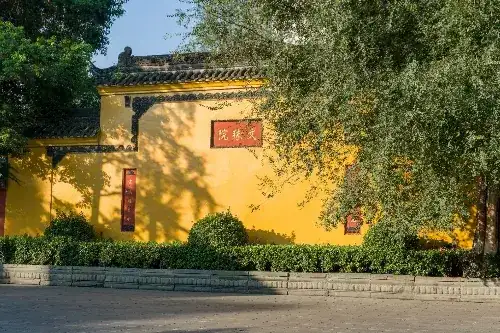
Guangyuan has Sichuan's earliest, longest-lasting, and largest grotto complex. The most representative include: the Huangze Temple Cliff Statues, carved beginning in the Northern Wei Dynasty and designated a national first-batch cultural heritage protection unit; the Thousand Buddha Cliff Statues with over 7,000 extant carvings spanning from the Northern Wei to the Qing Dynasty; and the Guanyin Cliff carvings from the Tang Dynasty's Tianbao era, depicting historical events including the An Lushan Rebellion and Emperor Xuanzong's flight to Sichuan.
Literature and Arts
Guangyuan has published tourism book series including "Three Kingdoms and Guangyuan," "Red Guangyuan," "Huangze Temple," and "Thousand Buddha Cliff," as well as novels about Empress Wu Zetian. The large-scale music and dance drama "Legend of the Empress" was staged, and the TV drama "Forcing the Crossing of the Jialing River" was produced, depicting the Red Army's revolutionary struggles.
Scenic Spots
As of the end of 2022, Guangyuan had 1 AAAAA-level scenic area, 21 AAAA-level scenic areas, 19 AAA-level scenic areas, and 6 AA-level scenic areas, along with national-level wetland parks.
Famous Local Products
Notable Figures
Honorary Titles
Travel information can change. Check current opening hours, reservations and entry requirements before you travel.
Traveller discussion
Start the conversation with a helpful tip or a question.