
Zigong City
Zigong CityZigong is a prefecture-level city in Sichuan Province, located in the southern part of the Sichuan Basin. It borders Longchang City and Luxian County to the east; Luzhou City's Jiangyang District, Yibin City's Nanxi District, Cui
Zigong City
Zigong is a prefecture-level city in Sichuan Province, located in the southern part of the Sichuan Basin. It borders Longchang City and Luxian County to the east; Luzhou City's Jiangyang District, Yibin City's Nanxi District, Cuiping District, Xuzhou District, and Jiang'an County to the south; Qianwei County and Jingyan County to the west; and Renshou County, Neijiang City's Shizhong District, Dongxing District, and Weiyuan County to the north. The terrain is higher in the northwest and lower in the southeast, with a subtropical monsoon humid climate featuring warm winters, hot summers, early springs, and short autumns. The total area is 4,381 square kilometers. As of the end of 2025, the city administers 4 districts and 2 counties, with a resident population of 2.405 million. Zigong was "established as a city because of salt" — the characters "Zi" and "Gong" derive from two salt wells: "Ziliujing" and "Gongjing." It is a regional center of southern Sichuan, a southern central city of the Chengdu-Chongqing Economic Circle, and the center of the Southern Sichuan Urban Agglomeration. Zigong is an important dinosaur fossil site in China, known as the "Hometown of Dinosaurs," and is famous for the Zigong Dinosaur Museum, one of the world's three major dinosaur museums. The city's salt-based cuisine, known as Zigong Salt Gang Cuisine, represents the "Xiaohebang" school of southern Sichuan, distinct from the "Shanghebang" and "Xiahebang" styles of Chengdu and Chongqing. In 2025, Zigong's GDP reached 200.366 billion yuan (approximately $27.8 billion USD), growing 6.9% over the previous year.
History
During the Qin Dynasty, the Fushun and Rongxian areas belonged to Ba and Shu Commanderies respectively. In the Han Dynasty, Qianwei Commandery was established, with Fushun under Jiangyang County and Rongxian under Nan'an County. By the Eastern Han under Emperor Zhang, well salt was already being produced, with famous salt wells including Fushi Well and Dagong Well.
During the Northern Zhou Dynasty, counties and towns were established around salt production. Fushi County was named after Fushi Well, and Gongjing Town after Dagong Well. In the Tang Dynasty, Fushi County became Fuyi County, and Gongjing Town was elevated to Gongjing County under Rongzhou. In the Song Dynasty, Gongjing County merged into Rongde County. During the Ming Dynasty, Fuyi County was renamed Fushun County, and Rongzhou was downgraded to a county. In the Jiajing era, Fushun's salt production center shifted westward, and new wells including Ziliujing were opened.
During the Anti-Japanese War, coastal areas fell to invasion, and Sichuan salt again supplied central China. To meet economic and wartime needs, the Nationalist Government established the city. In August 1939, salt-producing areas from Fushun County's Fifth District and Rongxian County's Second District were carved out, and the city was named "Zigong" by combining the first characters of "Ziliujing" and "Gongjing." The municipal government was formally established on September 1, 1939. Zigong was liberated on December 5, 1949. In 1983, the State Council approved transferring Fushun County to Zigong's jurisdiction.
Administrative Divisions
In 2005, a major administrative reorganization adjusted district boundaries across the city. In 2019, a new round of township consolidation reform was carried out.
Division Details
As of the end of 2025, Zigong administers 4 districts (Ziliujing, Gongjing, Da'an, and Yantan) and 2 counties (Rongxian and Fushun), comprising 2 townships, 63 towns, and 25 subdistricts. The municipal government is located at No. 443 Dangui Avenue, Ziliujing District.
Geography
Location
Zigong is located in the southern Sichuan Basin, between 28 degrees 55'37"–29 degrees 38'25"N and 104 degrees 02'57"–105 degrees 16'11"E, covering 4,381 square kilometers.
Topography
The terrain is higher in the northwest and lower in the southeast. Low mountains in the northwest reach 500–800 meters, with the highest point at Dingjiashan peak in Rongxian at 901 meters. The southeast generally sits at 300–400 meters, with the lowest point at 241 meters where the Tuojiang River exits Fushun. Hills dominate the landscape at 83.7% of the area, with low mountains at 7.1% and gently rolling plains at 9.2%.
Climate
Zigong has a subtropical humid monsoon climate with an annual average temperature of 17.5–18.0 degrees Celsius. Annual precipitation averages 1,000–1,100 mm, with 53%–60% falling in summer. Annual sunshine totals 1,150–1,200 hours, about 40% less than the lower Yangtze River region at the same latitude.
Hydrology
Annual water resources total approximately 1.46 billion cubic meters. Rivers belong to the Minjiang River and Tuojiang River systems. The Tuojiang system includes the first-order tributary Fuxi River and second-order tributaries such as Xushui River, Weiyuan River, and Changtan River. There are 44 rivers with drainage areas exceeding 50 square kilometers.
Natural Disasters
Zigong is prone to moderate earthquakes, hailstorms, droughts, and floods. In January 2020, a magnitude 4.3 earthquake struck Fushun County. In August 2020, severe storms brought rainfall up to 213.9 mm in Rongxian, causing flooding along the Tuojiang River that affected over 101,000 people, with direct economic losses of approximately 70 million yuan (about $9.7 million USD).
Natural Resources
The city has 178,500 hectares of arable land and 104,000 hectares of forest. Higher plants include 314 species across 71 families. Nationally protected wildlife includes 15 species such as otters, golden cats, and various owls. By 2022, 340 bird species had been recorded, including the critically endangered Chinese merganser and Baer's pochard.
Mineral Resources
Zigong has relatively scarce mineral resources, with 18 extractable types including natural gas, shale gas, coal, salt, limestone, and kaolin. Proven rock salt reserves total 7.142 billion tons. Shale gas theoretical reserves are approximately 2.5 trillion cubic meters, and conventional natural gas reserves about 241.2 billion cubic meters. Limestone reserves total 107 million tons, and usable coal reserves 44 million tons.
Population
As of the end of 2025, the registered population was 3.0625 million, with a resident population of 2.405 million. The urbanization rate reached 59.17%, up 1.02 percentage points. The birth rate was 3.7 per thousand, the death rate 11.0 per thousand, and the natural growth rate was -7.3 per thousand, reflecting a continuing population decline.
Ethnic Composition
Zigong is home to 46 ethnic minorities, including Yi, Miao, and Tujia peoples, living in scattered communities throughout the city.
Politics
Current Leadership
The city is governed by the CPC Zigong Municipal Committee and the Zigong Municipal People's Government.
Sister Cities
Zigong maintains sister-city relationships with several domestic and international cities.
Economy
In 2025, Zigong achieved a GDP of 200.366 billion yuan (approximately $27.8 billion USD), up 6.9% at constant prices. The primary, secondary, and tertiary industries contributed 23.86 billion, 56.41 billion, and 120.096 billion yuan respectively, growing 3.8%, 6.5%, and 7.9%. The industrial structure adjusted from 12.6:28.7:58.7 to 11.9:28.2:59.9. Per capita GDP was 83,209 yuan (approximately $11,557 USD), up 7.5%. Total financial revenue reached 31.117 billion yuan (approximately $4.32 billion USD), up 15.3%. Fixed asset investment grew 6.0%, with private investment increasing 14.1%.
Primary Industry
In 2025, grain output reached 1.463 million tons, up 0.9%. Oil crop production was 213,600 tons and vegetable output 2.995 million tons. Livestock included 1.814 million pigs slaughtered (up 1.8%) and 32.406 million poultry (down 3.9%). Aquatic products totaled 105,800 tons, up 5.3%.
Secondary Industry
Industrial value-added grew 10.9% in 2025. Above-scale industrial enterprises achieved revenue of 71.72 billion yuan (approximately $9.96 billion USD), up 11.5%, with total profits of 4.98 billion yuan, up 124.3%. Key growth sectors included oil and gas extraction (up 96.2%), transport equipment manufacturing (up 68.7%), and automobile manufacturing (up 66.6%). Construction industry value-added grew 0.4%.
Tertiary Industry
Total retail sales of consumer goods reached 81.803 billion yuan (approximately $11.36 billion USD), up 6.2%. Import and export volume totaled 6.822 billion yuan (approximately $947.5 million USD), up 5.2%. The service industry's value-added reached 120.096 billion yuan (approximately $16.68 billion USD), up 7.9%. By year-end, financial institution RMB deposits totaled 345.346 billion yuan (approximately $47.97 billion USD), up 9.1%. Insurance premium income was 7.135 billion yuan (approximately $991 million USD), up 7.4%.
Social Affairs
In 2025, Zigong implemented 105 key science and technology projects, with 210 high-tech enterprises, 27,836 valid registered trademarks, and 2,725 valid invention patents. The city has 513 schools with 384,900 students and 26,200 full-time teachers. Higher education institutions include Sichuan University of Science and Engineering, Sichuan Health and Rehabilitation Vocational College, and Zigong Vocational and Technical College.
Healthcare comprised 2,156 institutions with 18,624 hospital beds and 27,621 health workers. Total medical visits reached 24.2578 million. The city has 30 sports venues and 6 sports parks, with athletes winning 345 medals at provincial-level or above, including 133 gold medals.
Social Security
As of the end of 2025, unemployment insurance covered 196,500 people, urban employee basic pension insurance covered 377,800 people, and urban-rural resident basic medical insurance covered 2.0801 million people.
Transportation
Zigong's transportation is primarily road-based. Major expressways include the Neijiang-Yibin, Lezhi-Zigong, and Chengdu-Zigong-Luzhou-Chishui expressways. During the 13th Five-Year Plan, the city built a "half-hour city, one-hour southern Sichuan, two-hour Chengdu-Chongqing" transportation circle. The Chengdu-Zigong-Yibin and Mianyang-Luzhou high-speed railways brought high-speed rail service. The Zigong Fengming General Airport became Sichuan's first A1-class general aviation airport and was approved as a national civilian unmanned aircraft testing base.
As of the end of 2025, total highway mileage reached 11,061.54 km, including 286.96 km of expressways. In 2025, highway passenger volume was 23.57 million and freight volume 61.1724 million tons. The Neijiang-Kunming Railway runs north-south through the city. In December 2023, the Chengdu-Zigong-Yibin high-speed railway opened, ushering Zigong into the "dual high-speed rail" era. Water transport includes 10 navigable rivers with 53 passenger terminals. The "Night Tour of Fuxi" has become a city landmark.
Public Transportation
As of December 2021, Zigong had 1,121.8 standard buses operating 60 routes, with 80.8 km of bus lanes and 715 bus stops.
History and Culture
Zigong boasts well salt culture, dinosaur culture, lantern festival culture, and culinary culture, earning the titles "Millennium Salt Capital," "Hometown of Dinosaurs," "Lantern City of China," and "Capital of Gastronomy." The "Three Great Treasures of Zigong" (salt, dinosaur fossils, and lanterns) and "Three Minor Treasures" (paper-cutting, Gong fans, and tie-dye) are cultural hallmarks.
The Zigong Lantern Festival has been a tradition since the Tang Dynasty, now one of China's most representative lantern festivals. Intangible cultural heritage includes the Zigong well salt deep drilling technique, Gong fans, Zigong tie-dye, and the Zigong Lantern Festival, all listed as national-level intangible cultural heritage. The city has 230 cultural heritage protection sites, including 12 national-level sites, and hosts the Zigong World Geopark, a UNESCO Global Geopark.
Religion
Zigong is a multi-religion city. Four religions — Buddhism, Islam, Catholicism, and Protestantism — are currently practiced. There are approximately 35,000 believers and over 200,000 followers. The city has 22 officially approved religious venues, including 13 Buddhist, 5 Catholic, 3 Protestant, and 1 Islamic sites.
Scenic Spots
As of March 2023, Zigong has 18 A-level tourist attractions, including 9 at 4A level.
Main Attractions
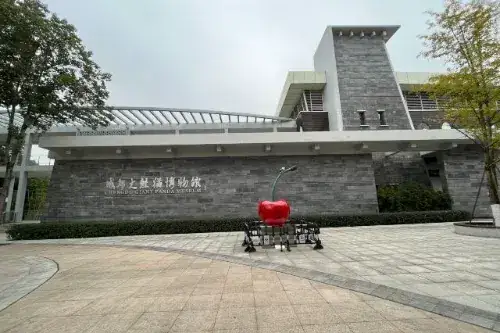
- Zigong Dinosaur Museum: A national 4A-level scenic area and national first-class museum, built on the Dashanpu Dinosaur Fossil Site. It houses nearly all known Jurassic dinosaur species from 205–135 million years ago and was praised by National Geographic as "the best dinosaur museum in the world."
- Zigong Fantawild Dinosaur Kingdom: A tourism project with a total investment of 3.1 billion yuan (approximately $430.6 million USD), covering over 400,000 square meters, integrating AR, VR, and immersive technologies for dinosaur-themed experiences with a design capacity of over 3 million visitors annually.
- Shenhai Well: Drilled in 1835 to a depth of 1,001.42 meters, the world's first well exceeding 1,000 meters, using traditional percussion drilling. A key component of the Zigong World Geopark.
- Salt Industry History Museum: China's only salt industry history museum, housing the world's most complete collection of ancient well-drilling and well-repairing tools, plus salt industry contracts and historical records.
- China Lantern Museum: The world's only professional museum dedicated to lantern culture, showcasing the history of Chinese lanterns and the Zigong Lantern Festival.
- Xianshi Ancient Town: A national 4A-level scenic area along the Fuxi River, featuring well-preserved Ming-Qing era southern Sichuan architecture.
- Rongxian Giant Buddha Temple: A Tang Dynasty stone Buddha carved 36.67 meters high, listed as a national key cultural heritage protection site.
Special Products
Signature foods include cold-eaten rabbit (Lengchi Tu), fire-edge beef (Huobianzi Beef), and Fushun tofu pudding. Jiuhong watermelon has over 40 years of cultivation history, with an annual production value reaching 100 million yuan (approximately $13.9 million USD). The city has 11 national geographical indication products.
Arts and Crafts
The "Three Minor Treasures of Zigong" include:
- Zigong Paper-cutting: Known for its rustic charm and vivid imagery, with domestic and international influence.
- Gong Fan: A weaving craft originating in the late 19th century, passed down through five generations, with each fan taking about two months to complete.
- Zigong Tie-dye: A folk craft dating back to the Qin-Han period, producing sought-after indigo printed fabrics.
Famous People
Notable figures from Zigong include Zhao Xi, Song Yuren, Liu Guangdi, and Li Zongwu.
Honors
Zigong has received numerous honors: National Historical and Cultural City (1986), China Excellent Tourism City (2004), National Garden City (2014), National Civilized City (2020), National Pilot City for Industrial Transformation and Upgrading (2017), and China's Most Promising Cultural Tourism City (2024, the only Sichuan city selected). In 2025, the Zigong Acrobatic Troupe won three awards including the sole "Youth Star" prize at the 20th Basel International Youth Circus Festival in Switzerland, and the city was named "China's Green Fluorine Capital."
Travel information can change. Check current opening hours, reservations and entry requirements before you travel.
Traveller discussion
Start the conversation with a helpful tip or a question.