
Dongguan City
Dongguan CityDongguan City, a prefecture-level city under Guangdong Province, China, is located in the central-southern part of Guangdong Province on the eastern bank of the Pearl River Estuary, in the Pearl River Delta at the lower reaches
Dongguan City
Dongguan City, a prefecture-level city under Guangdong Province, China, is located in the central-southern part of Guangdong Province on the eastern bank of the Pearl River Estuary, in the Pearl River Delta at the lower reaches of the Dongjiang River. It borders Huizhou City's Huiyang District to the east, and faces Guangzhou City's Panyu and Nansha districts across the sea to the west. To the north, it neighbors Guangzhou's Huangpu and Zengcheng districts and Huizhou's Boluo County across the river. At its southernmost point, Yantian Reservoir in Fenggang Town connects with Shenzhen City's Longgang District. Dongguan has a subtropical monsoon climate with long summers, no winter, abundant sunshine, plentiful rainfall, and distinct wet and dry seasons. The terrain is higher in the southeast and lower in the northwest. The total land area is 2,460.38 square kilometers, with a sea area of 78.5 square kilometers. As of January 2024, Dongguan administers 4 sub-districts, 28 towns, and 350 administrative villages. As of end-2025, the permanent population was 10.8004 million, with a registered population of 3.4528 million. Local dialects include Cantonese and Hakka. The municipal government is headquartered at No. 99 Hongfu Road, Nancheng Sub-district. Dongguan's history traces back to the pre-Qin period. In the sixth year of the Tianjian era of the Liang Dynasty (507 CE), Dongguan acquired its name. On October 17, 1949, the entire territory of Dongguan County was liberated. In January 1988, Dongguan was elevated to a prefecture-level city as a "direct-administration city," directly administering towns and sub-districts without county-level divisions. In October 2025, it was recognized as a National Demonstration City for Rule of Law Government. Dongguan is an important node city in the Guangdong-Hong Kong-Macao Greater Bay Area, a national advanced manufacturing base, and a host city for an international science and technology innovation center, home to global unicorn enterprises such as OPPO and vivo, and hosting national science infrastructure including the China Spallation Neutron Source and the Advanced Attosecond Laser Facility. In 2025, Dongguan's regional GDP reached 1,276.02 billion yuan (approximately US$175.3 billion), up 4.0% year-on-year.
Historical Evolution
Pre-Qin Period
Dongguan's history dates back 7,000 to 6,000 years to the pre-Qin period, evidenced by the Haogang Shell Mound Site and the Qishi Wanfu An Site. During the Spring and Autumn and Warring States periods, Dongguan belonged to the "Baiyue" territory.
Qin, Han, and Northern and Southern Dynasties Period
In 214 BCE, Dongguan belonged to Panyu County in Nanhai Commandery. In 111 BCE, under the Western Han, Dongguan was under Nanhai Commandery. In 331 CE, during the Eastern Jin, Dongguan was established as a county, initially named Bao'an County. In 507 CE, during the Liang Dynasty, Dongguan Commandery was renamed Dongguan, giving the city its name.
Sui, Tang, Song, and Yuan Periods
In 757 CE, Bao'an County was renamed Dongguan County, and the county seat was moved to Daochong (present-day Guancheng Sub-district). In 1152 CE, Xiangshan Town was separated to establish Xiangshan County (present-day Zhongshan City). During the Song Dynasty, Dongguan's salt industry flourished, making it one of the most densely concentrated salt-producing areas in the Lingnan region.
Ming and Qing Periods
In 1381, Dongguan established the Nanhai Guard. In 1573, Xin'an County (present-day Shenzhen) was carved out from the Dongguan and Dapeng defense garrisons. In 1839, Lin Zexu carried out the Humen Destruction of Opium on the Humen beach, destroying all confiscated opium—19,178 chests and 2,119 bags, totaling 1,188,127 kilograms. In 1840, the First Opium War broke out, with Humen as a major battlefield. In 1843, the Treaty of Humen was signed at Humen. In 1856, the Second Opium War erupted, and British forces attacked Dongguan, where Garrison Officer Deng Anbang led militia in heroic resistance. In 1900, Dongguan organized volunteer militia to drive British forces back south of the Shenzhen River.
Republic of China Period
In 1912, the Dongguan branch of the Chinese United League was established. In 1918, after the Constitutional Protection Movement failed, Guangdong fell under the control of the Guangxi warlord clique. In 1941, Kuomintang forces launched repeated "encirclement" operations against Zeng Sheng's guerrilla forces in Dalingshan. In 1945, Japan surrendered, and Zeng Sheng and Yin Linping led troops to accept the surrender. In August 1949, the Dongguan County Committee of the Communist Party and the County People's Government were established.
After the Founding of the People's Republic of China
On October 17, 1949, the entire territory of Dongguan County was liberated. Over subsequent decades, Dongguan's administrative affiliation changed several times. In September 1985, with State Council approval, Dongguan County was reconstituted as Dongguan City (county-level). In January 1988, Dongguan was elevated to a prefecture-level city under direct provincial administration, functioning as a direct-administration city without county-level divisions.
Administrative Divisions
As of January 2024, Dongguan has 4 sub-districts, 28 towns, 350 administrative villages, and 247 communities. The municipal government is headquartered at No. 99 Hongfu Road, Nancheng Sub-district.
Geography
Location
Dongguan is located in the central-southern part of Guangdong Province, on the eastern bank of the Pearl River Estuary, in the Pearl River Delta. It lies between 113°31′–114°15′ E longitude and 22°39′–23°09′ N latitude. The total land area is 2,460.38 square kilometers, with a sea area of 78.5 square kilometers.
Climate
Dongguan has a subtropical monsoon climate. In 2022, annual precipitation was 1,755.9 mm; the average temperature was 23.1°C; and annual sunshine totaled 1,848.6 hours. The highest temperature was 37.7°C on July 28, and the lowest was 5.5°C on February 21.
Geology
Geologically, Dongguan is situated in the Dongguan fault basin at the southwestern edge of the Boluo Fault. Exposed strata include Sinian, Devonian, Carboniferous, Triassic, Jurassic, and Cenozoic systems.
Topography
The terrain is higher in the southeast and lower in the northwest. Hills and terraces account for 44.5% of the land area, alluvial plains 43.3%, and mountains 6.2%. Yinpingzui Mountain's main peak, at 898.2 meters, is the highest point. The northwestern area is a delta plain formed by the Dongjiang River.
Hydrology
Dongguan is at the lower reaches of the Dongjiang River, with 96% of its territory in the Dongjiang basin. Major rivers include the Dongjiang main stream, Shima River, Hanxi River, and Dongyin Canal. The Dongjiang divides at Shilong Town into a north branch (42 km) and south branch (39.5 km), forming the Dongjiang Delta. The sea area of 78.5 square kilometers lies in the Shiziyang and Lingdingyang waters, with a coastline of 92.95 kilometers.
Soil
Soil types include paddy soil, lateritic red earth, alluvial soil, and moisture soil, with eight main categories covering approximately 96.6% of the total area.
Natural Disasters
Dongguan, situated along the coast and river in a subtropical monsoon climate zone, frequently experiences typhoons, heavy rain, lightning, and severe convective weather. In 2020, the Dongjiang basin experienced historically rare low-water conditions, with the three major reservoirs recording their lowest inflow since construction, severely affecting Dongguan's water supply.
Natural Resources
Water Resources
In 2022, total water resources amounted to 2.101 billion cubic meters, including 2.075 billion cubic meters of surface water and 422 million cubic meters of groundwater. Year-end reservoir storage totaled 138 million cubic meters.
Land Resources
As of 2022, the total surveyed land area was 246,000 hectares, including 8,896.72 hectares of cultivated land, 24,200 hectares of orchard land, 37,000 hectares of forest land, and 123,400 hectares of urban, village, and industrial-mining land.
Mineral Resources
Dongguan has identified 24 types of minerals across 73 mining sites, primarily building granite, salt, mineral water, and geothermal resources. Metal and non-metal minerals are scattered across eastern and southern mountainous areas.
Marine Resources
Dongguan's southern subtropical shallow waters support diverse habitats with 88 fish species, 18 shellfish species, and 21 crustacean species, serving as breeding grounds for various economic species.
Biological Diversity
As of 2022, Dongguan recorded 1,667 wild vascular plant species across 204 families and 797 genera, including 12 species under national second-class protection. Animal records include 41 reptile species, 18 amphibian species, 151 bird species, and 30 mammal species, with several listed on the IUCN Red List and CITES appendices.
Nature Reserves
As of 2021, Dongguan designated 29 priority protection units covering 400.86 square kilometers (16.30% of the city area), including the Yinpingzui Nature Reserve, Mashan Nature Reserve, Lianhuashan Nature Reserve, and Dalingshan Forest Park.
Politics
Dongguan operates under the leadership of the CPC Dongguan Municipal Committee, with the People's Congress and People's Government constituting the local governance structure. The city was recognized as a National Demonstration City for Rule of Law Government in October 2025.
Population
Population Size
As of end-2025, the permanent population was 10.8004 million, an increase of 229,600 over the previous year, with an urbanization rate of 93.63%. The registered population was 3.4528 million. The birth rate was 10.32‰ and the death rate 3.53‰, with a natural growth rate of 6.8‰.
Ethnic Groups
The population is predominantly Han Chinese. Among the 950,000 ethnic minority residents, the Zhuang, Miao, Yao, Bouyei, Tujia, and Dong peoples account for 813,000. Minorities mainly migrated from other provinces after the Reform and Opening-up.
Language
Local dialects include Cantonese (84%) and Hakka (16%). Twenty of 32 towns and sub-districts use Cantonese exclusively, while Qingxi and Fenggang towns predominantly speak Hakka, and Zhangmutou Town is purely Hakka-speaking.
Religion
Dongguan has five major religions: Buddhism, Taoism, Catholicism, Christianity, and Islam. There are 58 registered religious activity venues, including 38 Buddhist temples, 6 Taoist temples, 8 Christian churches, 1 Catholic church, and 1 Islamic gathering point. The city has three municipal religious associations.
Economy
Overview
In August 1978, Dongguan introduced China's first "three supplies and one compensation" enterprise—the Taiping Handbag Factory—marking the start of Dongguan's Reform and Opening-up. In 2024, regional GDP reached 1,228.215 billion yuan (approximately US$168.7 billion), up 4.6%. The industrial ratio was 0.3:55.4:44.3. Per capita GDP was 116,661 yuan (approximately US$16,381). In 2025, regional GDP reached 1,276.02 billion yuan (approximately US$175.3 billion), up 4.0%.
Primary Industry
In 2024, total crop sowing area was 375,300 mu, grain output 14,500 tons, and aquatic product output 54,300 tons. The city had 203 farmer cooperatives and 68 agricultural leading enterprises.
Secondary Industry
In 2024, above-scale industrial value-added grew 6.9%. High-tech manufacturing grew 12.7% and advanced manufacturing 11.1%. Industrial profits totaled 138.281 billion yuan. Construction value-added reached 32.741 billion yuan. In 2025, above-scale industrial value-added grew 4.0%, with electronic information manufacturing up 6.6%.
Tertiary Industry
In 2024, wholesale and retail value-added was 83.956 billion yuan, finance 88.061 billion yuan, and real estate 85.426 billion yuan. Total retail sales reached 444.626 billion yuan. Import and export volume was 1,388.04 billion yuan, up 8.3%. Financial institution deposits reached 2,854.387 billion yuan, with 84 listed companies. As of end-January 2026, deposits surpassed 3 trillion yuan for the first time.
Key Enterprises
In April 2024, the Hurun Global Unicorn Index 2024 listed Dongguan-based OPPO and vivo among the world's top 100 unicorns (ranked 15th and 18th), and among China's top ten (ranked 6th and 7th).
Social Development
Science and Technology
As of end-2024, Dongguan had 10,200 national high-tech enterprises. Patent grants totaled 81,852, with 15,269 invention patents (3rd in province). PCT applications reached 2,528 (2nd in province). The city hosts the China Spallation Neutron Source and Advanced Attosecond Laser Facility.
Education
As of end-2024, Dongguan had 1,287 kindergartens, 347 primary schools with 820,600 students, 211 junior high schools, 60 senior high schools, and 9 higher education institutions with 170,100 students. Greater Bay Area University enrolled its first undergraduates in 2025. Dongguan University of Technology, established in 1992, was the city's first undergraduate institution, with Nobel laureate Yang Zhenning as honorary president.
Culture
The city had 876 public libraries, 53 museums, and 146 cinema venues. It broadcast 34 radio and 37 television program channels.
Healthcare
Dongguan had 4,667 medical institutions including 9 Grade-III Class-A hospitals, with 74,400 health professionals and 37,000 hospital beds. Outpatient visits reached 72.3182 million and inpatient admissions 1.4695 million.
Sports
Dongguan athletes won 260 gold, 175 silver, and 180 bronze medals. The city hosted 3,060 fitness events with 3.9 million participants, and has 20,373 sports venues including 897 football fields and 6,414 outdoor basketball courts.
Social Security
As of end-2024, 6.3825 million people participated in urban employee basic pension insurance. The social insurance fund had revenues of 130.866 billion yuan, expenditures of 127.665 billion yuan, and a cumulative balance of 241.719 billion yuan. The city had 47 eldercare institutions and provided minimum living allowances to eligible residents.
Transportation
Overview
In 2024, total highway and waterway freight transport was 158.7377 million tons, up 5.5%. Port cargo throughput reached 201.0878 million tons. The highway network totals 3,529.25 kilometers with a density of 143.47 km/100 km². Dongguan is a railway hub at the intersection of the Guangzhou-Kowloon, Guangzhou-Shenzhen, Guangzhou-Meizhou-Shantou, and Beijing-Kowloon railways, with two national first-class ports (Humen Port and Dongguan Railway Port).
Highways
Dongguan's highway network includes National Route 107 and 10 major roadways, with a "five vertical, four horizontal, six connecting" expressway system. As of end-2024, the city had 4.4146 million motor vehicles, up 6.1%.
Railways
Dongguan operates 4 national railways and 2 intercity railways, with stations including Humen, Dongguan South, Dongguan, Dongguan East, Zhangmutou, Changping, and Dongguan West. The city is strategically located between Guangzhou, Shenzhen, and Hong Kong.
Aviation
Dongguan has no airport; approximately 80% of air cargo transits through Hong Kong International Airport via the Dongguan-Hong Kong International Airport Logistics Center in the Humen Port Comprehensive Bonded Zone.
Shipping
Dongguan possesses 53 kilometers of Pearl River main channel coastline. As of 2019, Dongguan Port had 165 production berths with an annual throughput of 198 million tons. In 2024, port throughput reached 201.0878 million tons.
Public Transportation
As of end-2020, Dongguan operated 6,330 buses with 100% electrification, 466 routes totaling 8,842 km. Dongguan Metro Line 1 (Phase 1) opened November 28, 2025, covering 57.46 km with 25 stations. Metro Line 2 opened May 2016, covering 37.8 km with 15 stations. Metro Line 3 (Phase 1) is expected to begin construction by 2024 and complete around 2029.
Culture
Overview
Dongguan is a representative city of Guangfu culture and an important birthplace of Lingnan culture, the starting point of China's modern history, an important base of resistance during the anti-Japanese war, and a pioneer of Reform and Opening-up.
Cuisine
Dongguan cuisine belongs to the Cantonese culinary tradition's Guangzhou school. Representative dishes include Dalang olive sauce fried rice, Zhongtang fish bao, Humen crab roe porridge, and Zhangmutou Hakka salted chicken. Local specialties include lychee, Machong bananas, Houjie laifen noodles, Houjie cured sausage, Baisha oil duck, and Humen shrimp paste.
Local Specialties
Humen sugar apple (custard apple) is a premium fruit from Humen Town, with two varieties (coarse-scale and fine-scale), known for its soft, smooth flesh and rich nutritional and health benefits.
Customs
Every fifth lunar month, towns across Dongguan's water regions hold dragon boat events. Shatian Town was named "Hometown of Dragon Boats." The "Selling Labor Festival" in Dongkeng traces to the Ming Dynasty. Dongguan is also renowned as the "Hometown of Lychee," with cultivation documented since the Yuan Dynasty.
Arts
Dongguan is an important birthplace of Cantonese opera, known as the "Hometown of Cantonese Opera and Quyi." The Qilin Dance, with over 300 years of history, was recognized when Zhangmutou Town was named "China's Hometown of Qilin" in 2003.
City Symbol
The city flower of Dongguan is the white magnolia (Michelia alba), an evergreen native of southern China, symbolizing a pioneering and upward-striving spirit.
Scenic Spots
Overview
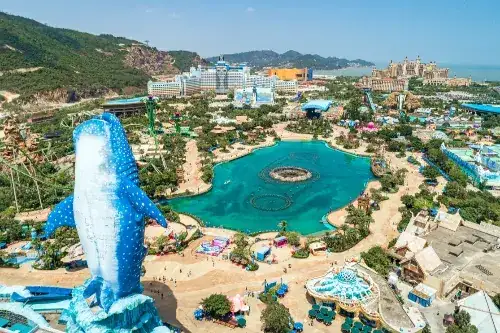
Dongguan has 26 rated tourist attractions, including 14 AAAA-level and 12 AAA-level sites. In 2022, the city received 38.8626 million visitors with total tourism revenue of 30.741 billion yuan (approximately US$4.42 billion).
Important Scenic Spots
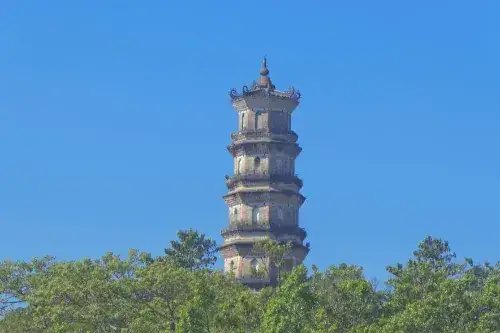
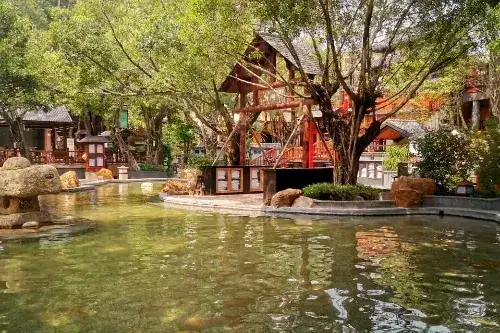
Notable attractions include the Opium War Museum in Humen (established 1957, managing approximately 800,000 square meters of historical sites including Lin Zexu's Opium Destruction Pools and Humen Fortresses); Guanyin Mountain National Forest Park in Zhangmutou Town (over 92% forest coverage, nearly 1,000 wild plant species); Keyuan Garden (built in 1850, one of the Four Great Gardens of Qing-era Guangdong, renowned for its exquisite design across 2,200 square meters); Xiangshi Zoo (over 100 animal species); and the Guangdong Dongjiang Column Memorial Hall in Dalingshan Town (opened 2005, the largest site-based anti-Japanese war museum in Guangdong, covering 53,319 square meters).
International Exchange
Domestic
Dongguan maintains close economic and cultural ties with cities across the Guangdong-Hong Kong-Macao Greater Bay Area, serving as a key node connecting Guangzhou, Shenzhen, and Hong Kong.
International
Dongguan has established international cooperation through its position in the Greater Bay Area, with global business connections spanning Belt and Road countries. Its import and export volume with Belt and Road countries reached 408.18 billion yuan in 2024.
Notable Figures
Throughout history, 32 prominent Dongguan natives have made significant contributions to Chinese history, including military leaders He Zhen, Yuan Chonghuan, and Jiang Guangnai; legal pioneer Wang Chonghui; architects Mo Bozhi and He Jingtang; scholars Rong Geng and Zhang Yinlin; and sports legend Chen Jingkai, the first Chinese athlete to break a world record.
Important Honors
Dongguan has received numerous national-level recognitions, including being designated a National Demonstration City for Rule of Law Government (2025), a national advanced manufacturing base, and an important node city in the Guangdong-Hong Kong-Macao Greater Bay Area. The city hosts multiple national-level science infrastructure facilities and is home to globally recognized technology enterprises.
Travel information can change. Check current opening hours, reservations and entry requirements before you travel.
Traveller discussion
Start the conversation with a helpful tip or a question.