
Meizhou City
Meizhou CityMeizhou City is a prefecture-level city in Guangdong Province, located in the northeastern part of the province at the junction of Fujian, Guangdong, and Jiangxi provinces, covering 15,876 square kilometers. The name "Meizhou" d
Meizhou City
Meizhou City is a prefecture-level city in Guangdong Province, located in the northeastern part of the province at the junction of Fujian, Guangdong, and Jiangxi provinces, covering 15,876 square kilometers. The name "Meizhou" dates to 971 CE. In 1988, the prefecture-level Meizhou City was formally established. As of 2022, it administers 2 districts, 5 counties, and 1 county-level city. At the end of 2023, the registered population was 5.3508 million and the resident population 3.8491 million. Meizhou is a National Hakka Culture Ecological Reserve, the primary departure point for Hakka people migrating worldwide since the Ming and Qing dynasties, and is honored as the "World Hakka Capital." Over 7 million overseas Chinese and compatriots from Hong Kong, Macao, and Taiwan trace their ancestral roots to Meizhou. In 2013, the China (Meizhou) Immigration Memorial Square — the only UNESCO immigration memorial project in China — was inaugurated. Meizhou is the hometown of Marshal Ye Jianying, a famous old revolutionary base area, and the only prefecture-level city in Guangdong entirely within the former Central Soviet Area. In 2025, Meizhou's GDP reached 158.323 billion yuan (approximately US$21.8 billion), growing 5.8% year-on-year.
History
In 483 CE, Chengxiang County was established. In 945 CE, it was elevated to Jingzhou. In 971 CE, renamed Meizhou to avoid a naming taboo — the origin of the name "Meizhou." In 1733, Chengxiang became Jiaying Prefecture, governing five counties. In 1912, renamed Mei County. In 1988, the prefecture-level Meizhou City was formally established.
Administrative Divisions
Meizhou administers 2 districts (Meijiang, Meixian), 5 counties (Dabu, Fengshun, Wuhua, Pingyuan, Jiaoling), and manages Xingning City (county-level). In 2013, Mei County was converted to Meixian District.
Geography
Location
Meizhou is located in northeastern Guangdong, between latitudes 23°23′–24°56′N and longitudes 115°18′–116°56′E. It borders Fujian to the east, Chaozhou, Jieyang, and Shanwei to the south, Heyuan to the west, and Jiangxi to the north. Total area: 15,876 sq km.
Geology
Complex fold and fault structures, situated in the southern South China fold system, with fault zones trending northeast, east-west, northwest, and north-south.
Topography
Terrain is higher in the north, lower in the south. Mountains account for 24.3%, hills and terraces 56.6%, plains 13.7%, and water 5.4%. The mountain system includes the Wuyi, Lianhua, and Fenghuang ranges. Over 140 peaks exceed 1,000 meters, with Tongguzhang (1,560 m) the highest. Major basins include Xingning Basin (400 sq km, the largest), Meijiang Basin (120 sq km), and Jiaoling Basin (100 sq km).
Climate
Typical subtropical monsoon climate in the transition zone between southern and central subtropical regions, with long summers, short winters, abundant sunlight, and concentrated rainfall.
Hydrology
Main rivers include the Hanjiang River (470 km, 343 km within Meizhou), Meijiang River (307 km, 271 km within Meizhou), and Tingjiang River (323 km, 55 km within Meizhou), plus the Qinjiang, Wuhua River, Ningjiang, and Chengjiang.
Natural Resources
Water Resources
Abundant water resources with average annual rainfall of 25.16 billion cubic meters and runoff of 12.87 billion cubic meters. Hydropower potential: 1.3137 million kW. Rich geothermal resources, with the Fengshun Tangkeng hot spring reaching 82–91°C.
Biological Resources
Diverse flora and fauna with high forest coverage and numerous protected species.
Mineral Resources
Located on the southern edge of the Wuyi metallogenic belt, with 54 identified mineral types including coal, iron, manganese, copper, tungsten, tin, rare earths, gypsum, and limestone.
Population
Registered population 5.3508 million, resident population 3.8491 million as of 2023, gradually declining due to out-migration.
Politics
Meizhou's Municipal Party Committee and People's Government oversee 2 districts, 5 counties, and Xingning City.
Economy
Overview
Designated a Coastal Economic Open Zone in 1992. In 2025, GDP reached 158.323 billion yuan (approximately US$21.8 billion, +5.8%). Primary industry: 28.287 billion yuan (approximately US$3.9 billion, +4.7%); secondary: 47.030 billion yuan (approximately US$6.5 billion, +8.0%); tertiary: 83.006 billion yuan (approximately US$11.4 billion).
Primary Industry
Key agricultural specialties include Meizhou Golden Pomelo, Pingyuan Navel Oranges, Dabu Honey Pomelo, and widespread tea cultivation.
Secondary Industry
Major industries include electronics, building materials, and food processing, centered on the Guangdong Meizhou Economic Development Zone.
Tertiary Industry
Over 1,600 internet and software service enterprises as of 2019. E-commerce transactions reached 116.033 billion yuan (approximately US$16 billion) from 2016 to September 2020, with over 4,500 e-commerce companies employing 120,000+ people.
Transportation
Meizhou is a key junction connecting the Greater Bay Area, West Coast Economic Zone, and Yangtze River Delta.
Highways
Extensive expressway network linking to Guangzhou, Shantou, and Fujian.
Railways
Meizhou-Shantou Railway and other lines providing passenger and freight service.
Water Transport
The Hanjiang River serves as the main navigable waterway.
Aviation
Meizhou Meixian Airport provides domestic flights to major cities.
Public Transportation
As of 2023, 853 fully electric buses operating 85 routes with over 2,900 km total mileage and 55 million+ annual riders. Satisfaction rate: 75.8%.
Social Affairs
Education
Meizhou has a scholarly tradition dating to the Song Dynasty, with multiple universities and colleges.
Science and Technology Innovation
Developing technology platforms and innovation centers integrating technology with traditional industries.
Cultural Affairs
Renowned for distinctive Hakka cultural heritage including folk music, arts, and customs.
Sports
Known as China's "Hometown of Football" with strong tradition and infrastructure.
Healthcare
Comprehensive healthcare system with multiple hospitals and medical institutions.
Social Security
Welfare programs covering pension, medical insurance, and employment services.
Environmental Protection
National Ecological Civilization Pioneer Demonstration Zone with significant forest conservation and green development efforts.
Sister Cities
International: Victoria (Seychelles), Quatre Bornes (Mauritius), Santos (Brazil). Domestic: Yanbian (Jilin).
Exchange Activities
Hosted the 12th World Hakka Reunion Conference (1994), World Hakka Merchants Conference (since 2009), and CCTV Mid-Autumn Festival Gala (2013). Designated Guangdong's first Cross-Strait Exchange Base in 2011.
Counterpart Cooperation
In 2022, Meizhou and Guangzhou established a counterpart cooperation relationship under the national revitalization plan for old revolutionary base cities.
History and Culture
Cultural Heritage
Designated a National Historical and Cultural City in 1994. An intersection of Central Plains and southern indigenous cultures, renowned for Hakka Culture. 544 cultural heritage protection units, including 11 national-level sites such as the Former Residence of Ye Jianying and Renjing Lu.
Immigration Culture
The most representative Hakka settlement globally — the final settlement point for southward-migrating Hakka people and primary departure point for their worldwide diaspora. Over 7 million overseas Chinese trace ancestry to Meizhou across 80+ countries. The China (Meizhou) Immigration Memorial Square, the only UNESCO immigration memorial in China, opened in Songkou Town in 2013. Meizhou is an important node on the Maritime Silk Road.
Red Culture
Confirmed in 2013 as entirely within the former Central Soviet Area. Revolutionary leaders including Zhou Enlai, Zhu De, Chen Yi, and Ye Jianying conducted activities here. Key battles include the Sanheba Campaign. Designated one of 12 national key old revolutionary base cities in 2021.
Longevity Culture
As of 2020, 858 centenarians (15 per 100,000). Jiaoling and Dabu Counties are "World Longevity Townships." Certified as "World Longevity Capital" in December 2020 — the second prefecture-level city in China.
Dialect
Hakka dialect is primary, with Meixian dialect as representative form. In Fengshun County, approximately 20% speak Chaoshan dialect.
Religious Beliefs
Four major religions: Buddhism, Taoism, Catholicism, and Christianity. 492 religious venues — the most in Guangdong — with approximately 260,000 followers.
City Symbols
Plum blossom designated city flower (1993), osmanthus as city tree (2018). City LOGO featuring plum blossom released in 2019. Ten cultural landmarks selected in 2017.
Historical Sites
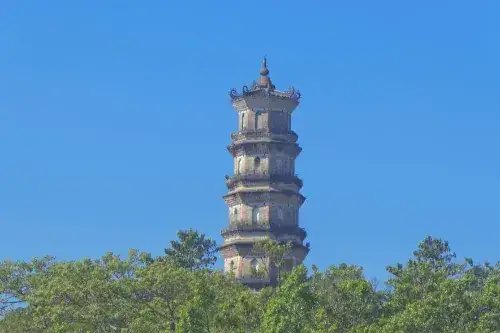
398 Neolithic sites, 87 ancient kiln sites, 179 ancient tombs, 206 ancient buildings, and 140 modern revolutionary sites. Notable landmarks include the Ye Jianying Memorial Park, Hakka Round-Dragon Houses, Qianfo Pagoda, and Lingguang Temple.
Scenic Spots
Major attractions: Yan Nan Fei Tea Fields (5A-level), Yinnashan Mountain, Ye Jianying Memorial Park, and the Meizhou Eighteen Sceneries. Rated among Guangdong's most popular self-driving tourism destinations.
Specialties and Cuisine
Specialties include Meizhou Golden Pomelo, Pingyuan Navel Oranges, Dabu Honey Pomelo, Hakka Rice Wine, local teas, preserved mustard greens (Meicai), and Hakka cuisine including Stuffed Tofu, Salt-Baked Chicken, and Braised Pork.
Notable Figures
Tang Dynasty to End of Qing
Huang Liao (Tang scholar), Lan Kui (Song scholar), Luo Mengjiao, Hou Anguo (Southern Song educator), and Cai Mengji (anti-Yuan hero).
Republic of China Era
Qiu Fengjia (Taiwan resistance leader), Xie Jinyuan (war hero), Yao Yuping (Northern Expedition commander), Luo Zhuoying (Expeditionary Force commander), and Huang Muxiao.
People's Republic of China
Marshal Ye Jianying — one of the Ten Marshals. Others include Gu Dacun (Dongjiang Red Army founder), Generals Zeng Guohua and Xiao Xiangrong, Ye Xuanping (CPPCC Vice Chairman), and Liu Fuzhi (former Procurator-General).
Overseas Chinese
Notable figures with Meizhou ancestry: Luo Fangbo (founder of Lanfang Republic in Borneo), Lee Kuan Yew (founding father of Singapore), Lee Hsien Loong (Singapore's third PM), Thaksin and Yingluck Shinawatra (former Thai PMs), and Paetongtarn Shinawatra (Thai PM). Over 7 million overseas Chinese trace roots to Meizhou.
Honorary Titles
Honors include National Historical and Cultural City, National Garden City, National Forest City, China Excellent Tourist City, UN Human Settlements "Excellent Example Award," World Longevity Capital, International Slow City, and Broadband China Demonstration City.
Travel information can change. Check current opening hours, reservations and entry requirements before you travel.
Traveller discussion
Start the conversation with a helpful tip or a question.