
Foshan City
Foshan CityFoshan City, abbreviated as "Chan," is a prefecture-level city and megacity under the jurisdiction of Guangdong Province. Located in the central part of Guangdong Province in the hinterland of the Pearl River Delta plain, it bord
Foshan City
Foshan City, abbreviated as "Chan," is a prefecture-level city and megacity under the jurisdiction of Guangdong Province. Located in the central part of Guangdong Province in the hinterland of the Pearl River Delta plain, it borders Guangzhou to the east, Zhaoqing to the west, Jiangmen and Zhongshan to the south, and Qingyuan to the north, in proximity to Shenzhen and the Hong Kong and Macau Special Administrative Regions. It features a southern subtropical monsoon humid climate with mild temperatures and abundant rainfall. As of March 2024, Foshan administers five districts with a total area of 3,797.72 square kilometers. As of the end of 2025, the city's permanent resident population was 9.7919 million. The municipal government is headquartered at No. 14 Lingnan Avenue, Chancheng District. Foshan's origins trace back to the Jin Dynasty, and it received its name during the Tang Dynasty. In the second year of the Zhenguan era of the Tang Dynasty (628 CE), ancient residents excavated three bronze Buddha statues within the city, which they interpreted as a sign of Buddhist significance, and accordingly erected a stone tablet renaming the place "Foshan" (Buddha Mountain). Foshan is one of the birthplaces and flourishing centers of Lingnan Cantonese culture, and is one of China's "Four Great Gatherings" and "Four Great Famous Towns." It boasts traditional cultural elements including Cantonese Opera, ceramics, paper-cutting, and Autumn Color festivities, and is known as the hometown of ceramic art, martial arts, and Cantonese Opera. It is a renowned city of dragon boat and dragon-lion culture in China, and the birthplace of Cantonese Opera. Foshan is designated by the State Council as an important node city in the Guangdong-Hong Kong-Macao Greater Bay Area, a national famous historical and cultural city, a national advanced manufacturing base, and a carrier city for international science and technology innovation centers. It is also one of the regions with the most developed private economy in China. In 2025, Foshan achieved a regional GDP of 1,315.735 billion yuan (approximately US$181.5 billion), representing a year-on-year increase of 0.2% at constant prices.
History
Administrative Divisions
Division Evolution
On February 15, 1950, the Sanshui County People's Government was established. On March 1, the Nanhai County People's Government was established. On March 20, the Shunde County People's Government was established. On July 1, Foshan was reclassified from a city to a town under the jurisdiction of Nanhai County.
On June 26, 1951, Foshan Town was reclassified from a town to a city.
In June 1954, the CCP Yuezhong Regional Committee and the Yuezhong Administrative Office relocated from Jiangmen to No. 10 Dafu Road in Foshan. The Yuezhong Administrative Office governed 24 counties, one city (Shiqi), and two province-administered cities (Jiangmen and Foshan).
In February 1956, the CCP Foshan Regional Committee and Foshan Special District were established, governing 13 counties, one city (Shiqi), and two province-administered cities (Foshan and Jiangmen).
In 1958, Foshan and Jiangmen were reclassified as county-level cities under Foshan Special District. From November 1958 to January 1959, Foshan Special District was briefly renamed Guangzhou Special District.
In 1970, Foshan Special District was renamed Foshan Region, governing 12 counties as well as the cities of Foshan and Jiangmen.
In 1983, Foshan Region was dissolved and merged with Foshan City to form the new prefecture-level Foshan City, governing five counties: Zhongshan, Nanhai, Shunde, Gaoming, and Sanshui.
In June 1984, Foshan administered Fenjiang District (renamed Chengqu District in 1986), Shiwan District, and the counties of Nanhai, Shunde, Gaoming, and Sanshui, while administering Zhongshan City on behalf of the province.
From 1992 to 1994, Shunde, Nanhai, Sanshui, and Gaoming successively converted from counties to county-level cities under Foshan's administration.
In December 2002, the State Council approved the establishment of five districts in Foshan: Chancheng, Nanhai, Shunde, Sanshui, and Gaoming.
On October 31, 2025, nine administrative villages from Jiaotang Town in Gaoyao District of Zhaoqing City were transferred to the jurisdiction of Genghe Town in Foshan's Gaoming District.
Division Details
As of March 2024, Foshan City administers five municipal districts: Chancheng District, Shunde District, Nanhai District, Sanshui District, and Gaoming District. The municipal government is headquartered at No. 14 Lingnan Avenue, Chancheng District.
Geography
Location
Foshan City is located in the central-southern part of Guangdong Province, in the hinterland of the Pearl River Delta, along the lower reaches of the Xi River. It borders Guangzhou to the east, Zhaoqing to the west, Jiangmen and Zhongshan to the south, and Qingyuan to the north, in proximity to Shenzhen and the Hong Kong and Macau Special Administrative Regions. The city's geographic coordinates range from 22 degrees 38 minutes to 23 degrees 34 minutes north latitude and 112 degrees 23 minutes to 113 degrees 24 minutes east longitude, with an administrative area of 3,797.79 square kilometers.
Climate
Foshan features a mild climate with abundant rainfall and spring-like conditions year-round. It has a subtropical monsoon humid climate with an annual average temperature of 23.2 degrees Celsius. Since ancient times, it has been a fertile land of fish and rice.
Hydrology
Foshan is traversed throughout its territory by the Xi River, Bei River, and their tributaries, all part of the Pearl River system, making it a typical delta river network region.
Population
As of the end of 2023, Foshan had a permanent resident population of 9.6154 million, of which 9.1725 million were urban residents, representing an urbanization rate of 95.39%. The registered population was 5.0907 million, with a birth rate of 10.42 per thousand, a death rate of 6.39 per thousand, and a natural growth rate of 4.03 per thousand.
As of the end of 2024, Foshan's permanent resident population was 9.6989 million, with an urbanization rate of 95.64%. The registered population was 5.2774 million.
As of the end of 2025, Foshan's permanent resident population was 9.7919 million, an increase of 93,000 from the previous year.
Politics
Economy
Overview
During the Tang and Song dynasties, Foshan's handicraft industry, commerce, and culture were already flourishing. By the Ming and Qing dynasties, it had developed into a prominent Lingnan town, known alongside Beijing, Hankou, and Suzhou as the "Four Great Gatherings of the World," and alongside Hankou, Jingdezhen, and Zhuxian Town as China's "Four Great Famous Towns." Its ceramics, textiles, foundry, and medicine industries were preeminent in southern China. In the late Qing Dynasty, Foshan pioneered modernization, becoming one of the birthplaces of China's modern national industry, establishing the country's first modern silk reeling factory and first match factory. Foshan's lion head crafting, lion dancing, and lantern arts are outstanding. Southern-style lion dancing originated in Guangdong, with Foshan as its birthplace, earning the reputation of "King of Lion Kings." Foshan's foundry industry began during the Western Han Dynasty, and by the Ming Dynasty, its casting technology had reached remarkable levels, making it the metallurgical center of southern China.
In 2023, Foshan's regional GDP reached 1,327.614 billion yuan (approximately US$183.1 billion), up 5.0% year-on-year. The primary industry's value-added was 22.878 billion yuan (approximately US$3.2 billion), up 4.7%; the secondary industry's value-added was 751.372 billion yuan (approximately US$103.6 billion), up 6.2%; and the tertiary industry's value-added was 553.364 billion yuan (approximately US$76.3 billion), up 3.3%. The three-industry structure was 1.7:56.6:41.7. The modern service industry's value-added was 336.134 billion yuan (approximately US$46.4 billion), up 3.2%.
In 2023, Foshan's local general public budget revenue was 80.046 billion yuan (approximately US$11.0 billion), up 0.4%, of which tax revenue was 46.426 billion yuan (approximately US$6.4 billion), up 3.5%. Local general public budget expenditure was 98.273 billion yuan (approximately US$13.6 billion), down 3.8%.
In 2023, Foshan's fixed asset investment decreased by 9.9% year-on-year, with project investment up 12.4% and real estate development investment down 34.8%. Infrastructure investment grew 5.4%, and private investment fell 16.2%.
During the 14th Five-Year Plan period, Foshan's economic total grew from 1 trillion yuan to 1.3 trillion yuan, crossing three 100-billion-yuan thresholds. All five of its districts rank among China's top 100 districts by comprehensive strength, with Shunde and Nanhai consistently ranking first and second. Of the six towns in China with GDP exceeding 100 billion yuan, Foshan's Shishan Town and Beijiao Town account for two. Foshan has cultivated multiple 100-billion-yuan industrial clusters, with over 10,000 above-scale industrial enterprises. The city has promoted digital transformation for 80% of above-scale industrial enterprises and was selected as a national new industrialization industry demonstration base. Advanced manufacturing's share of above-scale industrial value-added rose from 50.2% to 55.7%.
Primary Industry
Foshan applies modern industrial production concepts and technological means to transform traditional agriculture into sightseeing, ecological, urban, and export-oriented agriculture. Shunde District is known as "China's Eel Hometown." Gaoming District's "Heshui Yam" and Sanshui District's "Leping Snow Pear Melon" have been awarded national geographical indication protection marks.
In 2023, Foshan's grain crop planting area was 145,100 mu (approximately 9,673 hectares), up 3.6%. Annual grain output was 50,800 tons, up 2.6%. Vegetable and edible fungi output was 866,800 tons, up 1.8%. Orchard fruit output was 44,700 tons, up 8.2%.
In 2023, Foshan's pork, beef, mutton, and poultry meat output was 175,000 tons, up 1.5%. Aquatic product output was 812,200 tons, up 5.1%. Year-end live pig inventory was 505,300 head, down 9.4%.
Secondary Industry
Foshan's economic development is supported by ten major industries: home appliances, opto-mechatronics integration, electronic information and equipment manufacturing, ceramics and other building materials, textile and garments, metal materials processing and products, plastic products, chemicals and pharmaceuticals, food and beverages, and household goods manufacturing. These ten industries account for over 80% of total industrial output. "Made in Foshan" enjoys worldwide reputation. The private economy is an important force in Foshan's economy and a primary characteristic distinguishing it from other cities.
In 2023, Foshan's total industrial value-added grew 6.1% year-on-year. Above-scale industrial value-added grew 6.6%. High-tech manufacturing value-added grew 2.9%. Advanced manufacturing value-added grew 7.6%, accounting for 52.0% of above-scale industrial value-added. Annual construction industry value-added was 42.849 billion yuan (approximately US$5.9 billion), up 7.9%.
Tertiary Industry
Foshan is one of the important commercial and trade centers in the Pearl River Delta Economic Zone and a national logistics demonstration city. Leveraging its advantageous industries, Foshan has developed a headquarters economy, with well-known enterprises including Midea, Vanward Group, Dongpeng Ceramics, and Xishan Furniture establishing headquarters buildings. Foshan is one of China's six "Brands Capitals," with 46 China Well-Known Trademarks and 65 China Famous Brand Products.
In 2023, Foshan completed postal and telecommunications business totaling 34.141 billion yuan (approximately US$4.7 billion), up 11.2%. Foshan received 55.8542 million tourists, up 65.6%, with total tourism revenue of 53.035 billion yuan (approximately US$7.3 billion), up 86.6%. Total retail sales of consumer goods reached 373.448 billion yuan (approximately US$51.5 billion), up 3.7%.
Transportation
In 2023, Foshan completed passenger transport of 23.4873 million persons via highway and waterway, up 32.0%. Freight transport totaled 280.8983 million tons, up 7.3%. Major ports handled 102.0347 million tons of cargo throughput, up 19.2%, with container throughput of 3.4713 million TEU, up 7.7%. Year-end civilian vehicle ownership was 3.638 million, up 6.1%.
Highways
Railways
Shipping
As of March 2023, Foshan has 93 ports and wharves, 78 navigable rivers, and 1,075 kilometers of navigable waterways. Foshan Port is a major inland river port in China and an important hub of the comprehensive transportation system. Shunde Passenger Port is Foshan's waterway cross-border passenger port, operational since January 1998 and resumed service in March 2023.
Aviation
As of March 2023, Foshan has the 4C-class Foshan Shadi Airport, with plans to construct the 4F-class Pearl River Delta Hub (New Guangzhou) Airport.
Public Transportation
Foshan's first subway line was the Guangfo Line, which opened in 2010. Foshan Metro Line 2 began operations on December 28, 2021. Foshan Metro Line 3's initial section opened on December 28, 2022, with the full line through-service beginning on June 18, 2026. The total investment for Lines 2 and 3 was 49.81 billion yuan (approximately US$6.9 billion).
Foshan's public bus system is operated by multiple companies, with fares ranging from 2 to 16 yuan. Taxi fares start at 8 yuan for the first 2 kilometers, then 2.8 yuan per kilometer up to 12 kilometers, and 4.2 yuan per kilometer thereafter. Foshan also has a comprehensive public bicycle rental system with multiple stations across the city.
Social Affairs
Education
As of the end of 2023, Foshan had 14 regular higher education institutions with 157,100 total students; 68 regular senior high schools with 142,500 total students; 175 junior high schools with 295,400 total students; 430 primary schools with 731,900 total students; and 1,130 kindergartens with 338,900 children. The gross enrollment rate for school-age children was 101.84%, and primary school graduation advancement rate was 100%.
Science and Technology
Foshan is among the first batch of national intellectual property strong city demonstration cities. As of March 2023, Foshan had partnerships with 78 research institutions including the Chinese Academy of Sciences, the Chinese Academy of Engineering, and Tsinghua University. It had 8,700 national high-tech enterprises, 1,445 provincial-level specialized and sophisticated enterprises, and 29 provincial enterprise key laboratories. By 2023, the city had 10,300 high-tech enterprises, with 87,421 patent grants including 11,314 invention patent grants, and 163 China Well-Known Trademarks.
Culture
As of the end of 2023, Foshan had 6 cultural centers, 30 museums, and 71 provincial-level or above cultural heritage protection units. It had 6 public libraries at or above the district level with a total collection of 9.1084 million volumes. Radio and television program coverage both reached 100% of the population.
Healthcare
As of the end of 2023, Foshan had 3,083 health institutions, including 148 hospitals. Health institutions had 42,248 beds, with 71,693 health technicians including 26,308 licensed physicians and 33,335 registered nurses.
Sports
Foshan is a "Martial Arts City" and the primary birthplace of southern-style Chinese martial arts. By the early Ming Dynasty, Foshan's martial arts were already widespread. During the late Qing and early Republic periods, numerous martial arts schools and masters with international influence emerged. Styles including Choy Li Fut, Hung Gar, and Wing Chun all trace their roots to Foshan. Martial arts masters Wong Fei-hung, Wing Chun grandmaster Leung Jan, Ip Man, and film star Bruce Lee all had ancestral roots or lineage connections in Foshan. In 2004, Foshan was awarded the title of "Martial Arts City."
As of the end of 2023, Foshan had 29.14 million square meters of sports venues, with 2.77 square meters per capita. Foshan athletes participated in 7 international competitions, winning 11 medals, and 17 domestic events, winning 26 medals.
Media and Communications
Foshan's first newspaper, the Fenjiang Daily, was established in 1912. Between 1918 and 1949, 12 newspapers appeared in Foshan. On October 31, 2019, Foshan was selected as one of the first 5G commercial cities.
Social Security
As of the end of 2023, Foshan had 5.3239 million people enrolled in basic pension insurance, 3.2954 million in unemployment insurance, and 6.5938 million in basic medical insurance. Urban and rural minimum living allowance assistance covered 9,900 persons, with assistance totaling 141.6138 million yuan (approximately US$19.5 million).
History and Culture
Origin of the Name
Foshan was anciently known as "Jihua Village." During the second year of the Long'an era of the Eastern Jin Dynasty (398 CE), a monk named Dabiyashe from the Kingdom of Jibin (present-day Kashmir) brought two bronze Buddha statues to this place and built a Buddhist temple on Tapo Hill. After he returned to his homeland, the temple collapsed and the area reverted to barren hillside.
In the second year of the Zhenguan era of the Tang Dynasty (628 CE), a radiant light appeared on Tapo Hill. Villagers gathered and excavated the site, unearthing three bronze Buddha statues. When the statues were moved aside, a clear spring gushed forth. According to inscriptions on a stele, they learned that monks from the Kingdom of Jibin had previously built a temple and preached Buddhism there. The villagers dug a well, rebuilt a temple to enshrine the three Buddha statues, and declared this "the Mountain of Buddha," renaming Jihua Village as "Foshan." This gave rise to the saying: "Before there was Foshan, there was first Tapo."
Cantonese Culture
Foshan is a city with a rich immigrant heritage. Since the Qin Dynasty, continuous waves of migrants settled in the Lingnan region. During the Ming and Qing dynasties, prominent immigrant families such as the Huo family of Shitou, the Li Daiwen family, and the Huang Shijun family of Shunde brought their metallurgical and ceramic skills to Foshan, forming the foundation of its early manufacturing industry.
By the Ming and Qing dynasties, Foshan's ceramics, textiles, foundry, and pharmaceutical industries reached their peak, making it a famous distribution center. It was known alongside Beijing, Hankou, and Suzhou as the "Four Great Gatherings," and alongside Hankou, Jingdezhen, and Zhuxian Town as China's "Four Great Famous Towns." During the Kangxi to Daoguang reigns of the Qing Dynasty, Foshan Town was at its most prosperous, with over 200 handicraft trades and more than 3,000 commodity types. In the late Qing Dynasty, Foshan pioneered modernization, becoming one of the birthplaces of China's modern national industry.
Cultural Heritage Sites
Intangible Cultural Heritage
As of May 2024, Foshan possesses 15 national-level, 56 provincial-level, and 144 municipal-level intangible cultural heritage representative projects, with 15 national-level, 56 provincial-level or above, and 224 municipal-level or above representative inheritors. The leading categories are traditional crafts (36.1%), folk customs (20.1%), and traditional sports, recreation, and acrobatics (13.2%).
Dialect
Scenic Spots
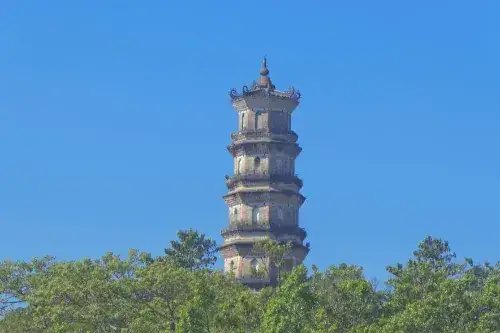
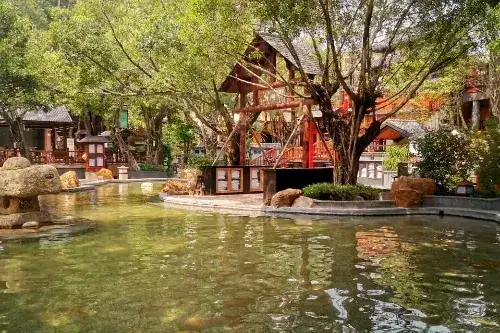
Foshan features a dense river network and beautiful ecological environment, making it a distinctive Lingnan water town. The "Eight New Scenes of Foshan" include the Foshan Ancestral Temple, Xiqiao Mountain, Nanfeng Ancient Kiln, Qinghui Garden, Zaomu Mountain, Nanguo Taoyuan, Chencun Flower World, and Sanshui Lotus World. The Foshan Ancestral Temple, originally built during the Yuanfeng era of the Song Dynasty (1078-1085), integrates ancient ceramics, woodcarving, casting, and architectural art, and is hailed as the "Palace of Oriental Art." Xiqiao Mountain in Nanhai is a national-level scenic area. Qinghui Garden in Shunde and Liang Garden in Foshan are two of the four great gardens of Guangdong from the Qing Dynasty. Zaomu Mountain in Gaoming is Foshan's highest peak. Other cultural attractions include Lingnan Tiandi (Donghua Lane), the former residence of Kang Youwei, Baolin Temple, Lubao Ancestral Temple, Daqitou Ancient Village, the Wong Fei-hung Memorial Hall, and the Bruce Lee Memorial Hall.
The Eight New Scenes of Foshan are: Emerald Layers of Xiqiao (Xiqiao Mountain, Nanhai), Sacred Realm of the Ancestral Temple (Foshan Ancestral Temple), Elegant Beauty of Qinghui (Qinghui Garden, Shunde), Passing the Flame of the Ancient Kiln (Nanfeng Ancient Kiln, Chancheng), Floral Sea Wonder (Shunde Flower World), Lotus Fragrance Among Clouds and Water (Sanshui Lotus World), Cloud-Piercing Zaomu (Zaomu Mountain, Gaoming), and Southern Peach Garden (Nanguo Taoyuan, Nanhai).
Local Cuisine
Foshan is a "Cuisine Capital" of the Pearl River Delta and one of the birthplaces of Cantonese cuisine. It specializes in Guangfu-style Cantonese cooking, known for rich ingredients, precise selection, exquisite techniques, and balanced flavors — clear but not bland, fresh but not common, tender but not raw, and oily but not greasy. Shunde was designated as a UNESCO City of Gastronomy.
Foshan offers many local snacks, including Foshan braised trotters, Daliang wild chicken rolls, Daliang bengsha (crispy pastry), ginger milk pudding, fried milk, double-skin milk pudding, Nanhai raw fish, Jiujiang fried sesame balls, Xiqiao flatbread, Foshan nine-layer cake, Shiwan fish fillets, Foshan Zhuhou sauce, Yingji wonton noodles, and Gaoming rice noodles. Many of these snacks are widely renowned.
Notable Figures
Sister Cities
Honors
In October 2025, Foshan was awarded the title of National Model City for Rule of Law Government Construction.
Travel information can change. Check current opening hours, reservations and entry requirements before you travel.
Traveller discussion
Start the conversation with a helpful tip or a question.