
Zhuhai City
Zhuhai CityZhuhai City is a prefecture-level city in Guangdong Province on the western bank of the Pearl River Estuary. It has 146 islands, a southern subtropical maritime monsoon climate, 1,725.07 square kilometers of land, and 2.5185 mill
Zhuhai City
Zhuhai City is a prefecture-level city in Guangdong Province on the western bank of the Pearl River Estuary. It has 146 islands, a southern subtropical maritime monsoon climate, 1,725.07 square kilometers of land, and 2.5185 million residents as of end-2024. Zhuhai is one of China's earliest Special Economic Zones and the only mainland city connected by land to both Hong Kong and Macau. It is China's second-largest port city after Shenzhen with 10 national first-class ports. In 2025, GDP reached 457.31 billion yuan (approximately $63 billion USD), up 2.7%.
History
Pre-Qin and Han Dynasties
Human habitation dates to the Neolithic period. During the Warring States period, the area belonged to the Baiyue people. After Qin Shi Huang unified China in 214 BCE, it came under Nanhai Commandery, and under the Han Dynasty (111 BCE), it was part of Panyu County.
Wei, Jin, and Southern and Northern Dynasties
In 331 CE, the area was placed under Dongguan Commandery, renamed under the Liu Song dynasty in 420 CE.
Sui, Tang, Song, and Yuan Dynasties
In 757 CE, Xiangshan Town was established. In 1152 CE, Xiangshan County was created under Guangzhou Prefecture. The Battle of Yamen (1279 CE), the largest naval battle in ancient Chinese history, took place in Zhuhai waters.
Ming and Qing Dynasties
In 1370 CE, the Ming government designated Langbai'ao (present-day Nanshui Town) as a foreign trade port. In 1743 CE, the Qing Dynasty established a maritime defense office at Qianshan Fortress to manage Macau affairs.
Republic of China
In 1925, Xiangshan County was renamed Zhongshan County in honor of Sun Yat-sen. The Xiangzhou Mutiny occurred that April; Ye Jianying suppressed the rebellion. Japanese forces invaded in March 1940.
After the Founding of the People's Republic of China
Zhuhai County was established in 1953, upgraded to a city in 1979, and the Special Economic Zone was established in 1980 (initially 6.81 sq km, expanded to the entire city in 2010). Doumen and Jinwan districts were established in 2001.
Administrative Divisions
Zhuhai administers 3 districts: Xiangzhou, Doumen, and Jinwan. The municipal government is at No. 2 Renmin East Road, Shishan Subdistrict, Xiangzhou District.
Geography
Location
Zhuhai is on the western bank of the Pearl River Estuary, facing the South China Sea. It borders Macau by land and is 36 nautical miles from Hong Kong by water. The Hong Kong-Zhuhai-Macau Bridge made it the only mainland city connected by land to both. It borders Jiangmen and Zhongshan, 140 kilometers from Guangzhou.
Climate
Average annual temperature is 22.5°C with 80% relative humidity. Summers are hot (July averaging 28.6°C); winters mild (January averaging 14.5°C). Annual precipitation averages 2,039.5 mm, mostly in summer. Rainy season runs April–September.
Geology
Quaternary deposits are widely developed with sporadic Paleozoic and Mesozoic outcrops covering 759.09 square kilometers. The mainland belongs to the Neocathaysian second uplift belt; islands are part of the NE-trending Wanshan uplift belt.
Topography
The terrain features block-faulted mountains and subsiding plains with 146 islands and a 166.32-kilometer coastline. Granite hills dominate at 100–300 meters; the highest point is Fenghuang Mountain on Erzhou Island at 473 meters.
Hydrology
Major waterways include the Modaomen, Jitimen, Hutiaomen, and Qianshan channels—branches of the Xijiang (West River), whose annual runoff of 238 billion cubic meters accounts for 77.1% of the Pearl River's total flow.
Soil
Three categories: paddy soil (primary farmland at 846,238 mu), natural soil (lateritic red earth, coastal sand, tidal flats), and dryland soil. Lateritic red earth covers 597,669 mu.
Natural Disasters
Typhoons are the most destructive hazard, affecting the city except January–April. In June 2022, severe flooding occurred along major rivers with flood peaks exceeding 20-year return periods.
Natural Resources
Water Resources
As of 2022, surface water resources totaled 1.751 billion cubic meters with 41.3 billion cubic meters of inbound water. The city has 59 reservoirs with 155 million cubic meters total capacity.
Mineral Resources
Twenty-five mineral types at 158 sites, mainly construction granite, sea sand, mineral water, and geothermal resources. Stone reserves reach 23 billion cubic meters. Quartz sand at Jinding contains 27.69 million tons with silica above 96%.
Land Resources
The third national land survey recorded 9,018 hectares of wetlands, 6,637 hectares of cultivated land, and 45,514 hectares of forest.
Marine Resources
Tidal flats cover 20,300 hectares (12.69% of land area), mostly mudflats. Marine waters support nearly 200 commercial fish species. The 146 islands have 543.01 kilometers of coastline—the most islands of any Guangdong city.
Biological Resources
Vegetation comprises 556 species across 145 families, predominantly tropical. Thirty nationally protected plant species include the Class I protected water pine. The city hosts 423 terrestrial vertebrate species including 9 Class I protected animals such as the Chinese white dolphin. The Pearl River Estuary Chinese White Dolphin National Nature Reserve is China's largest habitat with over 2,000 individuals.
Politics
Zhuhai operates under China's prefecture-level city governance system with the Municipal People's Congress as legislature and the Municipal People's Government as executive.
Population
Population Size
As of end-2024, the resident population was 2.5185 million, up 24,400. Urbanization rate reached 90.91%. Birth rate was 9.26‰, death rate 3.03‰, natural growth rate 6.22‰.
Ethnic Groups
As of end-2021, Zhuhai had 54 ethnic minorities totaling 187,500, with Zhuang, Tujia, Yao, Miao, and Manchu being the largest.
Religion
As of end-2021, Zhuhai had 11 registered religious sites (2 Buddhist, 1 Islamic, 1 Catholic, 7 Protestant) serving approximately 52,600 believers.
Economy
Overview
In 2024, GDP reached 447.91 billion yuan (approximately $61.8 billion USD), up 3.5%. The primary, secondary, and tertiary sectors contributed 7.36, 190.49, and 250.05 billion yuan respectively. Per capita disposable income was 67,315 yuan (approximately $9,285 USD).
Primary Industry
Led by grain farming and marine aquaculture. In 2024, agricultural output reached 13.38 billion yuan (approximately $1.85 billion USD), up 4.1%. Innovations include the world's first megawatt-scale floating wave energy device "Nankun" and the aquaculture vessel "Jiuzhou No. 1."
Secondary Industry
Led by biomedicine, next-generation IT, new energy, and integrated circuits. In 2024, above-scale industrial value-added grew 9.0% with the "4+3" industries growing 10.7%. Zhuhai pioneered the "maritime new infrastructure" concept in 2025.
Tertiary Industry
Tourism is the focus, emphasizing rural tourism and leisure agriculture. In 2022, the city received 226,100 inbound tourists generating 11.41 billion yuan (approximately $1.57 billion USD). In 2024, retail sales reached 108.47 billion yuan (approximately $14.96 billion USD) and foreign direct investment was $935 million USD.
Economic Functional Zones
Zhuhai has 9 industrial parks including 3 national-level zones: the Economic and Technological Development Zone (based at Gaolan Port), the High-Tech Industrial Development Zone (139 sq km, focused on software and IC design), and Sanzao Technology Industrial Park (aviation and biomedicine).
Society
Education
As of 2020, 91.58% of the population was educated with 11.46 average years of schooling. By September 2023, Zhuhai had 710 schools with 614,500 students. Thirteen universities enrolled 131,200 students.
Healthcare
As of end-2023, Zhuhai had 1,161 medical institutions with 13,446 beds, 9,490 licensed physicians, and 11,552 registered nurses. No Class A infectious diseases were reported.
Science and Technology
In 2023, 24,551 patents were granted including 7,892 invention patents. Effective patents reached 149,321 (147.70 per 10,000 people). The city had 2,657 high-tech enterprises.
Culture
As of end-2023, Zhuhai had 7 performing troupes, 4 public libraries, 11 museums, and 4 art galleries. Radio and TV coverage both reached 100%.
Sports
In 2023, athletes won 1 Asian and 3 national championships. At the 16th Guangdong Provincial Games, 797 athletes won 16.25 gold, 19 silver, and 20.50 bronze medals. The Zhuhai Sports Center, built in 1998, covers 700,000 square meters.
Social Security
In 2023, 45,464 new urban jobs were created. Basic pension insurance covered 1.5786 million people; medical insurance covered 2.4028 million. The city had 730,283 registered volunteers.
Environmental Protection
As of 2023, air quality met all six major standards for four consecutive years, with 335 days of good air quality. PM2.5 and PM10 concentrations led the province. Zhuhai ranked 10th among national key cities.
Transportation
Overview
Zhuhai has 10 national first-class ports (5 land, 5 water), making it China's second-largest port city.
Highways
As of end-2023, total highway mileage reached 1,525.97 kilometers including 248.38 kilometers of expressways. Eight expressways serve the city, including the Beijing-Zhuhai and Guangzhou-Zhuhai Western Expressways.
Railways
The Guangzhou-Zhuhai freight and intercity railways opened in 2012. Direct services to Beijing and Guilin launched in 2015. By 2019, urban rail mileage reached 86.5 kilometers with 5 million monthly passengers.
Ports
Jiuzhou Port opened in 1982; Gaolan Port (renamed Zhuhai Port) began in 1988. By 2019, cargo throughput reached 138 million tons with 168 berths including 29 above-10,000-ton berths. Jiuzhou Port is China's largest water passenger port.
Aviation
Zhuhai Airport, opened in 1995 in Jinwan District, has a 4,000-meter runway meeting ICAO 4E standards. Passenger throughput grew from 254,000 in 1995 to 12.28 million in 2019, ranking 35th nationally.
Public Transportation
As of end-2022, Zhuhai had 970,600 motor vehicles. The city operates 209 bus routes including double-decker sightseeing buses and tourist routes passing the Hong Kong-Zhuhai-Macau Bridge port and the Fisher Girl Statue.
History and Culture
Overview
Zhuhai's culture belongs to the Xiangshan tradition shared with Zhongshan and Macau. The city has 73 cultural heritage sites including 3 national-level (Baojing Bay Ruins, Chen Fang Residence, Sanzao Island Japanese War Crime Relics). Four national-level intangible cultural heritage items: Doumen Water Wedding, Mud Fish Trapping, Sanzao Crane Dance, and One-Finger Zen Massage.
Local Culture
A fusion of Baiyue, Central Plains, and overseas influences. Tanka (boat people) culture is prominent in Doumen District. Hakka culture is significant with 98 villages and 360,000 residents comprising one-quarter of the population.
Dialects
Yue (Cantonese), Hakka, and Min dialects are spoken, with Cantonese predominant across Xiangzhou, Hengqin, Wanshan, and Doumen.
Cuisine
Specialties include Nanping crispy grass carp, fresh oysters and oyster sauce, and premium crabs from Nanshui and Qi'ao islands.
Customs
Fishing families hang prized fish on the bow at New Year for bountiful harvests. Qingming tomb-sweeping is called "baishan." Dragon boat racing has been held since 1955. The Double Ninth Festival features mountain climbing and nine-layer cakes.
Art
Folk songs include saltwater songs and Sanzao-specific songs. The Sanzao Crane Dance (200–300 years of history) was listed as national intangible cultural heritage in 2011.
Historical Sites
Key sites include the Baojing Bay Ruins (rock carvings dating 4,000–2,000 years), the Chen Fang Residence (1891, blending Western and Lingnan styles), and the Sanzao Island Japanese War Crime Relics.
Intangible Cultural Heritage
Forty-four items registered, including 4 national-level: Doumen Water Wedding, Mud Fish Trapping (originating 1765), Sanzao Crane Dance (700+ years), and One-Finger Zen Massage.
Origin of the Name
"Zhuhai" (Pearl Sea) derives from either the pearl-producing waters or the city's location where the Pearl River meets the South China Sea, with 146 islands scattered like pearls.
City Symbols
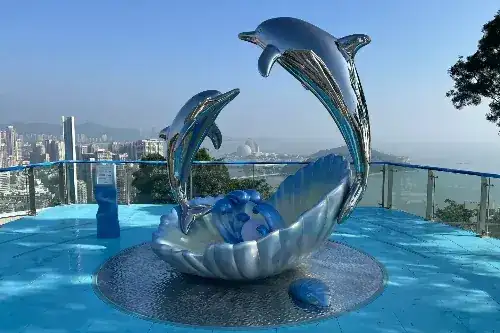
The city flower is bougainvillea, the city tree is the Hong Kong orchid tree (Bauhinia blakeana), the city bird is the seagull, and the city mascot is the Chinese white dolphin (designated 2024).
Scenic Spots
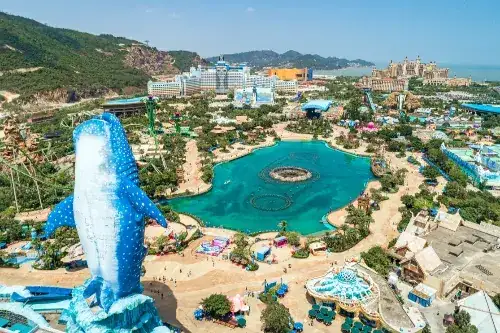
Zhuhai has 6 AAAA-level scenic spots (including New Yuanming Palace, Dong'ao Island Tourist Resort, and Wai Lingding Island Resort) and 3 AAA-level spots (including Guishan Island).
Sister Cities
As of August 2024, Zhuhai had 16 pairs of international sister cities.
Famous Figures
Notable figures include Chen Fang, a prominent overseas Chinese businessman and diplomat in Hawaii, and Ye Jianying, who suppressed the 1925 Xiangzhou Mutiny.
Major Honors
Zhuhai is the only city selected for the "Top 40 National Tourist Destinations" based on overall urban landscape. It has received National Civilized City (2015), National Garden City, National Forest City, UN Habitat Scroll of Honour, and "China's Happiest City" honors. In 2025, it was named a National Double Support Model City.
Travel information can change. Check current opening hours, reservations and entry requirements before you travel.
Traveller discussion
Start the conversation with a helpful tip or a question.