
Huaihua City
Huaihua CityHuaihua, also known as "Hecheng" (Crane City), historically called "Hezhou" and "Wuxi," is a prefecture-level city in Hunan Province. Located in the southwestern part of Hunan between the Wuling and Xuefeng mountain ranges, it s
Huaihua City
Huaihua, also known as "Hecheng" (Crane City), historically called "Hezhou" and "Wuxi," is a prefecture-level city in Hunan Province. Located in the southwestern part of Hunan between the Wuling and Xuefeng mountain ranges, it sits in the transition zone between the central Asian subtropical climate region and the Jiangnan climate region, with four distinct seasons and short periods of severe cold or heat. The total area is 27,564 square kilometers. As of April 2026, Huaihua administers 1 municipal district, 10 counties, and 1 county-level city. As of end-2025, the resident population was 4.3839 million. Historically known as the "Gateway to Guizhou and Yunnan" and the "Throat of All Chu," Huaihua is the site of the Central Red Army's Tongdao strategic turn, the WWII victory surrender acceptance site, and the birthplace of hybrid rice. It is a national comprehensive transportation hub and a key node city for the Western Land-Sea New Corridor and the Belt and Road Initiative. In 2025, Huaihua's GDP reached 219.155 billion yuan (approximately $30.2 billion), up 5.7% year-on-year, with a three-sector ratio of 13.8:31.5:54.7.
History
Huaihua has a long history, known in ancient times as the "Land of Jing and Chu." Various ethnic groups have inhabited the area since the Neolithic Age. During the Spring and Autumn period, it belonged to the Wuzhong territory of Chu. During the Warring States period, it was part of Qianzhong Commandery of Chu. After Qin unified China, Qianzhong Commandery was established here. During the Western Han, it was Wuling Commandery. The Tang Dynasty established Qianzhong Circuit with Chenzhou as a base, administering six prefectures. The Song Dynasty set up Luxi and Nanyang commanderies under Jinghu North Circuit, with over 30 prefectures. The Yuan Dynasty established Chenzhou, Yuanzhou, and Jingzhou routes under Huguang Province. The Ming Dynasty set up one prefecture and two sub-prefectures. The Qing Dynasty had 2 prefectures, 1 department, and 1 sub-prefecture. During the Republic of China, it belonged to the 9th and 10th administrative districts. After the PRC was founded, Huaihua was divided into Huitong and Yuanling special districts. In 1952, the Yuanling special district was merged into the Zhijiang special district, forming the prototype of modern Huaihua. It was renamed Qianyang Special District in 1953, Qianyang Region in 1968, and Huaihua Region in 1981. In 1998, the Huaihua Region was abolished and the prefecture-level Huaihua City was established.
Administrative Divisions
Division History
In 1998, Huaihua City administered 12 counties (cities, districts) and one management committee, including Hecheng District, Hongjiang City, Zhongfang County, Yuanling County, Chenxi County, Xupu County, Huitong County, Mayang Miao Autonomous County, Xinhuang Dong Autonomous County, Zhijiang Dong Autonomous County, Jingzhou Miao-Dong Autonomous County, Tongdao Dong Autonomous County, and the Hongjiang District Management Committee.
Division Details
As of April 2026, Huaihua administers 1 municipal district, 10 counties, and 1 county-level city: Hecheng District, Hongjiang City, Zhongfang County, Yuanling County, Chenxi County, Xupu County, Huitong County, Mayang Miao Autonomous County, Xinhuang Dong Autonomous County, Zhijiang Dong Autonomous County, Jingzhou Miao-Dong Autonomous County, and Tongdao Dong Autonomous County. It also has 1 management district, 1 national-level high-tech zone, and 1 international land port economic development zone. Below these are 90 townships (including 19 ethnic townships), 103 towns, and 11 sub-districts, with 317 communities and 2,455 villages. The municipal government is seated at No. 2 Fuqian Middle Road, Hecheng District.
Geography
Location and Extent
Huaihua lies in southwestern Hunan between the Wuling and Xuefeng mountain ranges, with the Yuan River flowing north through the entire territory. Covering 27,564 square kilometers (353 km north-south, 229 km east-west), it is the largest prefecture-level city in Hunan by area. It borders Guangxi (Guilin, Liuzhou) to the south, Guizhou (Tongren, Qiandongnan) to the west, and the cities of Shaoyang, Loudi, Yiyang, Changde, Zhangjiajie, and Xiangxi Tujia-Miao Autonomous Prefecture within Hunan.
Geology
Huaihua sits in the transition zone between the Upper Yangtze Block and the Nanhua Rift Trough. Strata are well-developed with frequent tectonic activity, forming a fault system dominated by NE and NNE deep faults.
Topography
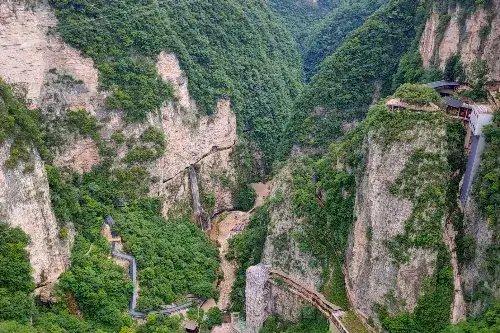
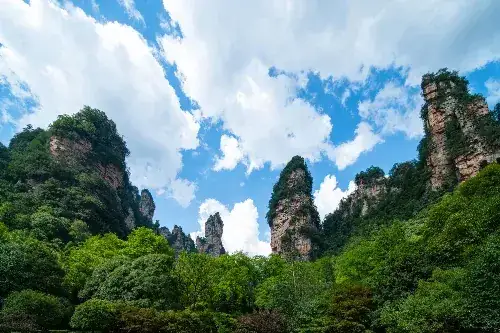
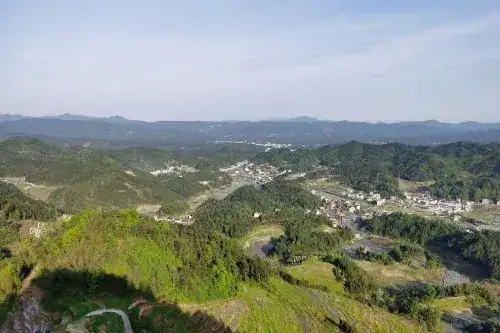
The terrain features overlapping mountains and hills with complex landforms. The Xuefeng Mountains arc across the southeast; the Wuling Mountains extend through the northwest. The highest point is Subaoding at 1,934 m; the lowest is Jieshou in Yuanling at 45 m. Mountains cover 70.5% of the total area, hills and mounds 17.9%, plains 4.2%, and water bodies 2.7%.
Climate
Huaihua is in the transition zone between the central Asian subtropical and Jiangnan climate regions, with four distinct seasons. Spring features variable weather; summer is hot under subtropical high pressure with a concentrated plum rain season; autumn sees reduced rainfall but lingering heat with occasional drought; winter brings cold air invasions with rain, snow, and ice.
Hydrology
The Yuan River main stream and its tributaries—the Chen, Xu, and other streams—form the city's hydrological system, with 183 streams exceeding 1 square kilometer in catchment area. The water systems divide into four major categories flowing through different parts of the city.
Natural Resources
Water Resources
Average annual precipitation totals 2.964 billion cubic meters, with evaporation of 1.495 billion cubic meters. Surface runoff averages 1.525 billion cubic meters annually. Total water resources amount to 2.8306 billion cubic meters, including 26.59 billion cubic meters of river inflow. Theoretical hydropower potential is 386,000 kW, with 196,900 kW developable.
Plant Resources
Huaihua has over 1,000 woody plant species, including 200+ timber species, 96 economic forest species, 19 medicinal species, 50+ ornamental species, and 20+ bamboo species, plus 400+ medicinal herbs and various mosses, ferns, and fungi.
Animal Resources
The city hosts 21 mammal species, 34 bird species, 13 snake species, various reptiles and amphibians, 17 fish species, 66 arthropod species, and numerous mollusks and worms.
Mineral Resources
Huaihua has 11 categories and 45 types of proven mineral deposits. Gold, copper, and phosphorus reserves rank 1st, 3rd, and 4th in Hunan respectively, while stone coal, silica sand, and barite reserves rank among the top nationally.
Population
As of end-2025, the resident population was 4.3839 million, down 0.7%. Urban population was 2.2774 million (up 1.3%); rural population 2.1065 million (down 2.9%). The urbanization rate reached 51.95%, up 1.06 percentage points.
Politics
Huaihua's political system follows the standard Chinese governance structure for prefecture-level cities, with a municipal Party committee, People's Congress, and People's Government overseeing the administrative divisions.
Economy
Overview
In 2025, Huaihua's GDP reached 219.155 billion yuan (approximately $30.2 billion), up 5.7%. The primary sector added 30.286 billion yuan ($4.2 billion, up 4.4%), the secondary sector 68.969 billion yuan ($9.5 billion, up 6.3%), and the tertiary sector 119.900 billion yuan ($16.5 billion, up 5.7%). Per capita GDP was 49,809 yuan ($6,900, up 6.7%). Fixed asset investment grew 3.6%. Local general public budget revenue was 12.594 billion yuan ($1.7 billion, up 3.1%); expenditure was 54.058 billion yuan ($7.5 billion, down 3.2%). Per capita disposable income was 27,708 yuan ($3,820, up 6.5%), with urban at 39,667 yuan ($5,473) and rural at 17,494 yuan ($2,413).
Primary Industry
In 2025, total agricultural, forestry, animal husbandry, and fishery output value was 54.291 billion yuan ($7.5 billion, up 4.5%). Grain output was 1.9909 million tons (up 0.9%). Hog slaughter reached 3.852 million head (up 1.33%); meat output was 332,000 tons (up 1.93%).
Secondary Industry
In 2025, industrial value-added reached 56.405 billion yuan ($7.8 billion, up 5.7%). Above-scale industrial value-added grew 7.9%. Construction value-added was 12.752 billion yuan ($1.8 billion, up 5.5%).
Tertiary Industry
In 2025, wholesale and retail trade value-added was 19.748 billion yuan ($2.7 billion, up 4.3%); transport, storage, and postal services 11.275 billion yuan ($1.6 billion, up 7.2%); accommodation and catering 4.772 billion yuan ($660 million, up 9.9%); finance 10.541 billion yuan ($1.5 billion, up 1.1%); and real estate 12.333 billion yuan ($1.7 billion, down 0.3%). Total retail sales of consumer goods reached 81.282 billion yuan ($11.2 billion, up 4.6%). Foreign trade totaled 11.23 billion yuan ($1.55 billion, down 18.4%), with imports of 1.69 billion yuan ($233 million) and exports of 9.55 billion yuan ($1.32 billion). Tourist spending reached 68.578 billion yuan ($9.5 billion, up 12.7%). Financial institution deposits reached 372.330 billion yuan ($51.3 billion, up 10.85%); loans reached 263.566 billion yuan ($36.3 billion, up 9.64%).
Social Services
Science and Technology
In 2025, Huaihua had 17 provincial engineering technology research centers, 4 provincial key laboratories, 1,237 authorized patents (including 282 invention patents), and 118 inspection and testing institutions.
Education
As of end-2025, Huaihua had 5 regular universities. Higher education graduates numbered 15,100, secondary vocational graduates 15,900, senior high school graduates 31,000, and primary school graduates 65,100. School-age children enrollment rate was 100%.
Culture
Huaihua has 6 performing arts groups, 15 cultural centers, 14 public libraries, 15 museums, 16 national-level intangible cultural heritage projects, and 68 provincial-level ones. Radio coverage reached 99.56% and TV coverage 99.77%.
Healthcare
In 2025, Huaihua had 4,754 health institutions including 142 hospitals and 2,931 village clinics, with 26,553 hospital beds and 41,000 health professionals (16,000 practicing physicians, 19,000 registered nurses).
Sports
The city held 401 fitness programs with 2.0936 million regular participants. It won 3 world championships, 1 Asian championship, and 8 national championships. There were 15,673 sports venues citywide.
Social Security
In 2025, 39,400 new urban jobs were created (up 4.9%), with urban surveyed unemployment at 5.2%. Basic pension insurance covered 2.6687 million urban-rural residents; basic medical insurance covered 4.2942 million people. Minimum living allowances were provided to 11,800 urban residents and 113,500 rural residents.
Transportation
Overview
Huaihua is a national comprehensive transportation hub. Through the Huaihua International Land Port, the city has opened 4 international corridors (China-Laos, China-Vietnam, China-Myanmar, etc.), 4 major sea export ports, and 98 domestic and international transport routes. In 2025, rail freight reached 1.8409 million tons (up 31.21%), highway freight 91.3061 million tons (up 2%), and water freight 5.8725 million tons (up 2.3%). Civil aviation freight was 178,000 tons (down 6.1%).
Highways
National highways 209 and 320 intersect in the urban area. As of October 2024, total highway mileage reached 21,006 km, including 862 km of expressways. Seven expressways are in operation, including the Shanghai-Kunming, Baotou-Maoming, and Hangzhou-Ruifeng routes.
Railways
The Shanghai-Kunming (Xiangqian), Jiaoliu, and Chongqing-Huaihua railways converge in Huaihua in a star pattern. Total railway mileage reaches 1,001.42 km. Huaihua West Station is one of nine national hub marshaling yards. High-speed rail mileage is 178 km with 4 stations.
Aviation
Huaihua Zhijiang Airport, originally a WWII Allied Far East strategic airfield, has been restored as a modern civil airport. It operates 7 routes connecting 12 major cities including Beijing, Sanya, Xi'an, Haikou, Hangzhou, Lijiang, Shenzhen, Taiyuan, Kunming, and Nanjing, with an annual throughput of 400,000 passengers.
Historical Culture
Origin of the Name
The name "Huaihua" dates to the Song Dynasty, derived from the policy of "huairou guihua" (pacification and assimilation) applied to ethnic minority areas—"huai" meaning to pacify, and "hua" meaning to transform or civilize.
Historical and Cultural Heritage
The Gaomiao Culture site dates Chinese civilization back 7,800 years, making Huaihua one of the birthplaces of southern Chinese agrarian civilization. The poet Qu Yuan was exiled to the Yuan River basin here, composing works including "Shejiang" and "Lisao." Wang Changling wrote famous verses here. The area is a revolutionary old base, hometown of Xiang Jingyu, Su Yu, and Teng Daiyuan. Huaihua ranks first in Hunan for traditional villages.
Local Dialects
Huaihua dialects belong to the Southwestern Mandarin group. Variants include Huaihua dialect (urban center), Anjiang dialect (Southwestern Mandarin with Xiang features), and Shaodong dialect (Xiang Chinese, spoken by merchants from Shaodong).
City Symbols
In June 2023, the osmanthus tree was designated as the city tree and camellia as the city flower. Osmanthus symbolizes nobility, purity, and auspiciousness; camellia, one of China's ten famous flowers, blooms in winter with long-lasting, beautiful flowers.
Cultural Heritage Sites
As of September 2022, Huaihua has 23 national key cultural heritage protection units and 81 provincial-level ones.
Intangible Cultural Heritage
Huaihua has 16 national-level and 39 provincial-level intangible cultural heritage projects, with 10 national-level and 33 provincial-level representative inheritors.
Folk Customs
Dong ethnic seating etiquette requires guests to observe specific customs—sitting with one's back to the ancestral shrine is disrespectful. Red-lacquered stools are reserved for new brides. Around the fire platform (huopu), guests should sit upright without spreading legs or crossing them. Banquet etiquette follows a sequence of tea (three rounds), wine (four rounds), and tobacco (eight pipes). Gan'ao fairs are traditional Northern Dong gatherings on mountain passes, often drawing over 10,000 participants. Lusheng dancing is organized by village in Jingzhou. Bajia Festival (2nd day of the 1st lunar month) celebrates the harvest among Yao people. Panwang Festival (16th day of the 10th lunar month) honors the legendary Yao ancestor. Traditional attire features distinctive ethnic styles—Bai people favor white clothing; Dong people have characteristic formal wear. Jewelry of gold, silver, copper, and gemstones is widely worn, with ear-piercing customs for girls from age 12.
Scenic Sites
Overview
Notable sites include the WWII Surrender Memorial in Zhijiang, the Su Yu Memorial in Huitong, the Xiang Jingyu Memorial in Xupu, Furong Pavilion in Qiancheng Ancient City, Hongjiang Ancient Commercial City, and Yuantou Ancient Dong Village. As of September 2022, Huaihua has 6 Chinese Historical and Cultural Villages, 4 provincial historical cities, 4 famous towns, and 169 traditional Chinese villages. As of January 2025, the city has 63 graded tourist attractions, including 18 4A-level and 44 3A-level sites.
Main Attractions
Key attractions include the Zhijiang Surrender Memorial, Hongjiang Ancient Commercial City, Furong Pavilion, the Gaomiao Cultural Site, and various traditional Dong and Miao villages scattered across the prefecture.
Local Specialties
Huaihua is known for local delicacies and agricultural products, including hybrid rice varieties, tea, citrus fruits, and traditional ethnic foods reflecting the region's Miao, Dong, and Yao culinary traditions.
Famous People
Notable figures from Huaihua include Xiang Jingyu (early CPC revolutionary and women's rights pioneer), Su Yu (prominent military commander and strategist), and Teng Daiyuan (revolutionary and politician who served as Minister of Railways).
Honorary Titles
Huaihua has received multiple national designations as a transportation hub, logistics center, and cultural heritage site, reflecting its strategic importance and rich historical legacy.
Travel information can change. Check current opening hours, reservations and entry requirements before you travel.
Traveller discussion
Start the conversation with a helpful tip or a question.