
Jingzhou City
Jingzhou CityJingzhou City, historically known as Jiangling, Yingdu, and Nanjun, is a prefecture-level city in Hubei Province. Located in south-central Hubei along the middle Yangtze River in the heart of the Jianghan Plain, it borders Wuha
Jingzhou City
Jingzhou City, historically known as Jiangling, Yingdu, and Nanjun, is a prefecture-level city in Hubei Province. Located in south-central Hubei along the middle Yangtze River in the heart of the Jianghan Plain, it borders Wuhan to the east, Hunan Province to the south, Yichang to the west, and Jingmen, Qianjiang, and Xiantao to the north. The total area is 14,100 square kilometers. As of the end of 2025, the permanent population was 5.0829 million, administering 2 districts, 2 counties, and 4 county-level cities. The local dialect belongs to the Southwestern Mandarin Huguang group. Jingzhou has a northern subtropical monsoon humid climate with distinct seasons, abundant heat, and plentiful rainfall. The terrain slopes from west to east, transitioning from low mountains and hills to plains. In 689 BCE, the State of Chu moved its capital to Ying (present-day Jinan City in Jingzhou District). After the Qin unified China in 221 BCE, the area belonged to Nanjun. In 1364, Jingzhou Prefecture was established. In 1994, the area was reorganized as Jingsha City, renamed Jingzhou City in 1996. Jingzhou sits at the core intersection of the Yangtze River Economic Belt and the Er-Guang axis, long reputed as the "Land of Fish and Rice" and "China's Granary." It is a national comprehensive agricultural production base and the birthplace of Chu culture, a gathering place of Three Kingdoms culture, and a showcase of Yangtze River culture. In 2025, Jingzhou's GDP reached 371.234 billion yuan (approximately 51.6 billion US dollars).
Origin of the Name
Jingzhou was historically called Jiangling, Yingdu, and Nanjun. The name derives from the "Tribute of Yu" chapter of the Book of Documents, one of the ancient Nine Provinces, named after the Jingshan Mountains. Jing was an alternative name for the State of Chu, as Chu was founded at Jingshan. Shashi, originally called Jin or Jiangjin, served as an important commercial port of Jiangling County.
Historical Evolution
Pre-Qin Period
During the late Paleolithic period, approximately 50,000 to 10,000 years ago, early humans inhabited the Jigongshan site in the northeastern suburbs of Jingzhou. During the Neolithic period, the Sanmiao people developed the Daxi culture (6000-5000 BCE), establishing moated settlements and producing lacquerware and bamboo mats. The Qujialing culture (5000-4600 BCE) saw the construction of Yinxiangcheng. In 689 BCE, King Wen of Chu moved the capital to Ying (present-day Jinan City in Jingzhou District), where Chu maintained its capital for over 400 years.
Qin and Han to Northern and Southern Dynasties
After the Qin unified China in 221 BCE, Dangyang County was established under Nanjun. During the Han Dynasty, Jingzhou belonged to Nanjun. In 106 BCE, Emperor Wu established the Jingzhou Inspectorate, governing seven commanderies and 117 counties. During the Three Kingdoms period, Jingzhou was divided among Wei, Shu, and Wu, eventually falling to Wu. In 352 CE, Jingzhou's seat was fixed at Jiangling. Several Northern and Southern Dynasties regimes established capitals at Jingzhou.
Sui, Tang to Song and Yuan Period
The Sui Dynasty saw several administrative reorganizations. During the Tang Dynasty, the area belonged to the Shannan Circuit, and in 760 CE, Jiangling was designated the Southern Capital. During the Five Dynasties period (925 CE), Gao Jixing established the Jingnan Kingdom at Jiangling. Under the Song Dynasty, the area was divided into Jingnan North and South Circuits. Under the Yuan Dynasty, it became the Zhongxing Circuit, and in 1364, Zhu Yuanzhang redesignated it as Jingzhou Prefecture.
Ming and Qing Dynasties
During the Ming Dynasty, Jingzhou Prefecture underwent several administrative reassignments. In the Qing Dynasty, the Shangjingnan Circuit was established in 1670, later renamed the Jingyi Circuit in 1735 and again in 1904.
Republic of China Period
In 1912, Jingzhou Prefecture was abolished, and its counties came under the Jingyi Circuit. After several reorganizations, the Jingzhou Administrative Area Inspector's Office was established in July 1949, headquartered at Jingzhou Town in Jiangling County, governing eight counties. Shashi Town was separated from Jiangling County to form Shashi City.
After the Founding of the People's Republic of China
In 1951, Honghu County was established from parts of four neighboring counties. Shashi City was placed under Jingzhou's jurisdiction in 1955. In 1979, Shashi was elevated to a prefecture-level city. In 1986 and 1987, Shishou and Honghu became county-level cities. In 1994, Jingzhou Prefecture, Shashi City, and Jiangling County were merged to form Jingsha City, renamed Jingzhou City in 1996. In 1998, Jiangling District was converted to Jiangling County. In 2018, the Jingzhou High-tech Industrial Park was upgraded to a national-level zone. In 2023, Jingzhou was classified as a third-tier city.
Physical Geography
Location and Territory
Jingzhou is located in south-central Hubei, between 111 degrees 15 minutes to 114 degrees 5 minutes east longitude and 29 degrees 26 minutes to 31 degrees 37 minutes north latitude. The maximum east-west span is approximately 274.8 km, the north-south span about 130.2 km, with a total area of 14,100 square kilometers.
Climate
Jingzhou has a northern subtropical monsoon humid climate with four distinct seasons, abundant thermal resources, and plentiful rainfall. The average annual temperature ranges from 16.2 to 16.6 degrees Celsius. Annual precipitation is 1,100-1,300 mm, with a frost-free period of 250-267 days. The plum rain season typically runs from mid-June to mid-July.
Geology
Jingzhou lies within the Lianghu Plain structural unit on the Yangtze Paraplatform. Since the Tertiary period, crustal movements have been dominated by overall vertical movement, trending toward stability. There is no historical record of destructive earthquakes.
Topography and Landforms
Jingzhou lies on the western edge of China's third terrain step and is the main body of the Jianghan Plain. The terrain slopes from high in the west to low in the east. The highest point is Dalingshan in Songzi at 815.1 meters; the lowest is at Shatao Lake in Honghu at 18 meters. Plains account for 78.8% of the area, terraces 18.6%, hills 1.8%, and low mountains 0.8%.
Hydrology and Water Conservancy
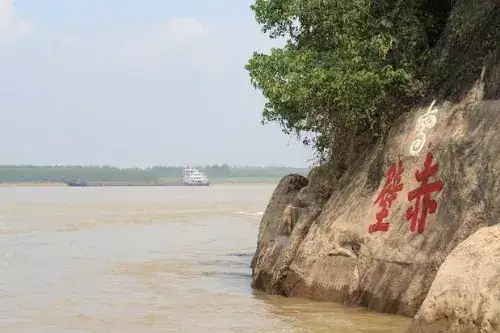
Jingzhou has nearly 100 rivers, all part of the Yangtze system, including the Songzi, Hudu, Ouchi, and Tiaoxian rivers. Honghu Lake, at 30,800 hectares, is the largest lake in Hubei. The Jingjiang section of the Yangtze spans 347.2 km. As of 2022, the city had 2,104.85 km of Grade 3+ levees. The Jingjiang Flood Diversion Project, built in 1952, has a storage capacity of 5.4 billion cubic meters.
Soil
Jingzhou's soils are formed from river alluvium and Quaternary clay deposits. The city has 7 soil types, 14 subtypes, 43 soil genera, and 200 soil species across 563,580 hectares.
Natural Disasters
Jingzhou is prone to meteorological disasters including drought, storms, and floods. In July 2015, heavy rainfall affected 23,524 people with direct losses of 41.99 million yuan (approximately 5.8 million US dollars). In July 2020, severe flooding affected 453,522 people across 59 townships, causing 86,272 hectares of crop damage and direct losses of 690.68 million yuan (approximately 96 million US dollars).
Natural Resources
Water Resources
Jingzhou has abundant, high-quality water resources. The total water area is 353,550 hectares, representing 25.13% of the city's territory. In 2022, total water resources amounted to 6.47456 billion cubic meters. Total water supply was 4.2689 billion cubic meters, with agricultural use accounting for 81.8%, industrial use 6.4%, and domestic use 11.8%.
Mineral Resources
Jingzhou has 35 proven mineable mineral types, with 13 having industrial reserves and 20 currently exploited. Major minerals include petroleum, coal, rock salt, brine, mirabilite, pyrite, barite, marble, granite, limestone, clay, and bentonite.
Biological Resources
Jingzhou possesses rich biological resources. Forest coverage reached 25.88% with standing timber volume of 15.48 million cubic meters. The city has 1,077 plant species across 162 families, including nationally protected dawn redwood and ginkgo. Wildlife includes 542 vertebrate species, with 11 under national first-class protection, including the milu deer and Yangtze sturgeon. The city has 5 nature reserves totaling 85,879 hectares.
Administrative Divisions
As of 2025, Jingzhou administers 2 districts (Jingzhou District and Shashi District), 2 counties (Jiangling County and Gong'an County), and 4 county-level cities (Songzi, Shishou, Jianli, and Honghu), plus 3 functional zones. The municipal government is located at 262 Jiangjin West Road, Shashi District.
Demographic Overview
Population
As of the end of 2025, the permanent population was 5.0829 million, with 3.0914 million urban and 1.9915 million rural residents, yielding an urbanization rate of 60.82%. The Seventh National Population Census showed males at 50.94% and females at 49.06%, with a sex ratio of 103.82.
Ethnic Groups
Jingzhou has 52 ethnic minorities totaling 47,500 people, with Tujia, Hui, Mongolian, and Manchu being the largest groups. The city has 2 minority townships and 5 minority villages.
Language
The primary dialect belongs to the Southwestern Mandarin Huguang group.
Religion
Five major religions coexist in Jingzhou: Buddhism, Taoism, Islam, Catholicism, and Protestantism. As of 2019, there were over 500 registered religious venues and more than 800 registered clergy. Taoism was among the earliest religions established in the area, with the Shishou Nanyue Mountain Temple dating to the Eastern Han Dynasty. Buddhism arrived in 171 CE, Catholicism in 1603, and Protestantism in 1861.
Politics
The city operates under the standard prefecture-level municipal governance structure with People's Congress, People's Government, and Political Consultative Conference.
Economy
Overview
Jingzhou sits at the core intersection of the Yangtze River Economic Belt and the Er-Guang axis, and is the core area of the national Hubei Jingzhou Industrial Transfer Demonstration Zone. In 2025, Jingzhou's GDP reached 371.234 billion yuan (approximately 51.6 billion US dollars), up 6.3% year-on-year. The industrial structure was 17.9:35.2:46.9 for primary, secondary, and tertiary sectors. Per capita GDP was 72,745 yuan (approximately 10,100 US dollars). Total fiscal revenue reached 29.12 billion yuan (approximately 4.04 billion US dollars). Fixed asset investment grew 5.8%. Per capita disposable income was 38,684 yuan (approximately 5,400 US dollars), with urban income at 46,713 yuan (approximately 6,500 US dollars) and rural income at 27,658 yuan (approximately 3,850 US dollars).
Primary Industry
Jingzhou is a major national production base for grain, cotton, oil, pork, and fish, focusing on freshwater fish, crayfish, meat products, and aquatic vegetables. Grain output consistently exceeds 9 billion jin (4.5 million tons). In 2025, agricultural, forestry, animal husbandry, and fishery value-added reached 73.044 billion yuan (approximately 10.1 billion US dollars), up 4.1%. Total grain output was 4.5818 million tons, and crayfish production reached 595,500 tons.
Secondary Industry
Jingzhou is an important industrial and textile base in south-central China, with agricultural product processing, textile and apparel, intelligent equipment, and modern chemicals as leading industries. In 2025, the secondary industry value-added reached 130.725 billion yuan (approximately 18.2 billion US dollars), up 6.5%. There were 1,811 above-scale industrial enterprises, with industrial value-added growing 9.2%.
Tertiary Industry
The tertiary industry encompasses retail, hospitality, finance, cultural tourism, modern logistics, and real estate. Cultural tourism is one of six 50-billion-yuan advantage industries. In 2025, tertiary industry value-added reached 174.252 billion yuan (approximately 24.2 billion US dollars), up 7.1%. Total retail sales of consumer goods reached 202.257 billion yuan (approximately 28.1 billion US dollars), up 4.1%. Goods import-export totaled 34.22 billion yuan (approximately 4.75 billion US dollars), up 38.6%. Actual foreign investment reached 41.32 million US dollars, up 10.9%.
Economic Functional Zones
The Jingzhou Jinan Ecological and Cultural Tourism Zone, established in 2010, covers approximately 220 square kilometers with 139 immovable cultural relics. The Jingzhou High-tech Zone spans 131.3 square kilometers, focusing on modern food, petroleum equipment, and bio-agriculture industries. The Jingzhou Economic and Technological Development Zone, established in 1992, was approved as a national-level zone in 2011.
Social Services
Education
As of 2025, Jingzhou had 1,254 schools of all types, including 7 higher education institutions, 13 secondary vocational schools, 49 regular high schools, and 604 kindergartens. Total enrollment was 779,000 students with 62,000 faculty and staff.
Healthcare
Jingzhou had 3,076 medical and health institutions as of 2025, including 86 hospitals and 107 health centers, with 41,470 health professionals and 37,434 beds. Key hospitals include Jingzhou First People's Hospital, Jingzhou Central Hospital, and Jingzhou Traditional Chinese Medicine Hospital, all Grade 3A facilities.
Science and Technology
In 2025, Jingzhou secured 255 provincial and above science and technology projects, with technology contract turnover of 33.818 billion yuan (approximately 4.7 billion US dollars), up 22.1%. Patent grants totaled 4,036, including 571 invention patents.
Culture
Jingzhou has 9 mass art and cultural centers, 8 public libraries, and 12 museums. The Jingzhou Library, built in 1956, is a national first-class library with over 600,000 volumes. The city hosts over 1,000 cultural performances annually.
Sports
Jingzhou has produced Olympic badminton champions including Ji Xinpeng and Chen Long. The city has earned 2 Olympic gold medals and 15 world championship titles. As of 2025, there were 20 public sports stadiums. Jingzhou athletes won 77 gold medals at provincial and above competitions.
Social Security
As of 2025, 1.5281 million people participated in urban employee basic pension insurance, 2.5721 million in urban-rural resident basic pension, and 4.2932 million in basic medical insurance.
Environmental Protection
In 2025, air quality compliance rates ranged from 82.3% to 91.2% across districts, with 307 good-air days in the city center. PM2.5 averaged 42 micrograms per cubic meter, down 4.5%. Of 30 monitored river cross-sections, 96.67% met Class II-III water quality standards.
Transportation
Overview
Jingzhou is a key node on the north-south corridor, an important highway hub, and a major Yangtze River port city. The city has formed a "one horizontal, three vertical" railway network and a "one port, ten zones" port system, with expressways covering all counties and districts.
Highways
As of 2022, the highway network comprised 8 expressways, 4 national highways, and 26 provincial highways, with 574 km of expressways. Five Yangtze River bridges have been built. As of 2025, total highway mileage reached 25,766.73 km, including 723.5 km of expressways.
Bridges
Six Yangtze River bridges have been completed, including the Jingzhou Yangtze Bridge and Jingyue Yangtze Bridge, with two more under construction.
Railways
The railway network includes the Shanghai-Wuhan-Chengdu high-speed railway, Jiaozuo-Liuzhou Railway, Haoji Railway, and Jingsha Railway, with 219 km of operational track. The Jingzhou Railway Station is the largest prefecture-level station on the Han-Yi Railway, with a building area of 49,859 square meters.
Aviation
The Jingzhou Shashi Airport, a Grade 4C regional airport opened in 2018, has a 2,600-meter runway and offers direct flights to 17 cities including Beijing, Shanghai, and Guangzhou.
Water Transport
Jingzhou has 483 km of Yangtze River "golden waterway" and 651 km of quality shoreline. The Jingzhou Port is one of China's 28 major inland ports, with 91 berths and a design throughput of 69.27 million tons. In 2023, port cargo throughput reached 80.11 million tons.
Public Transit
As of 2020, central urban bus stop coverage within 500 meters reached 90%. The city operates 68 bus routes and dedicated airport shuttle services connecting key hotels and transportation hubs.
Culture
Overview
Jingzhou has been a cultural center of the middle Yangtze since ancient times, as the birthplace of Chu culture, a gathering place of Three Kingdoms culture, and a showcase of Yangtze River culture. As the "Ancient Capital of Chu and Famous City of the Three Kingdoms," 20 Chu kings established their capital here for 411 years.
Cuisine
Local specialties include Jingzhou fish cake, fish balls, thousand-sheet pork, eel dishes, pearl glutinous rice balls, Jiangling eight-treasure rice, Gong'an beef, Songzi chicken, Shishou Bijia fish maw, Honghu lotus root, and Honghu wild duck. Popular snacks include morning noodles, Gong'an flatbread, and rice balls.
Customs
The Guandi Temple Fair is held annually, featuring dragon lanterns, lotus boats, and archery. The annual China Jingzhou International Dragon Boat Festival is a signature cultural event, with dragon boat racing documented as early as the Sui Dynasty.
Arts
Jingzhou Flower Drum Opera is a national-level intangible cultural heritage, evolving from folk performances during the late Ming Dynasty. Han Embroidery originated in Jingzhou, using over 40 needlework techniques with distinctive Chu cultural characteristics.
Regional Symbols
In 2016, the city designated ginkgo and redbud as city trees, and lotus and wintersweet as city flowers. A ginkgo tree at Zhanghua Temple is nearly 1,420 years old.
Cultural Spirit
Guan Yu guarded Jingzhou for ten years, and his spirit of loyalty, righteousness, benevolence, and courage made him the revered "Martial Sage." The ancient city walls, built during the Three Kingdoms period, are praised as "an invaluable intact jade in southern China."
Historical Relics
As of 2024, Jingzhou has 4,081 immovable cultural relics, including 15 national key protected units and 61 provincial protected units, with over 200,000 museum collections.
Intangible Cultural Heritage
As of 2023, Jingzhou had 8 national-level and 39 provincial-level intangible cultural heritage items, including drum singing, Mashan folk songs, Jinghe Opera, and lacquerware decoration techniques.
Scenic Attractions
Overview
Jingzhou, also called Jiangling City, is a National Historical and Cultural City and the birthplace of Chu culture. Famous Three Kingdoms stories such as "Liu Bei Borrowing Jingzhou" and "Guan Yu Losing Jingzhou" took place here. As of 2024, the city had 25 A-level tourist attractions, including 9 at the 4A level and 16 at the 3A level. Attractions follow a "one city, multiple areas" pattern centered on the ancient city historical tourism zone.
Major Attractions
Key attractions include the Jingzhou Ancient City Walls, Dongmen Scenic Area, Jinhuang Plaza, Guandi Temple, Jingzhou Museum, Zhanghua Temple, and Baling Mountain National Forest Park.
External Exchange
Jingzhou participates in regional economic cooperation frameworks including the Yangtze River Economic Belt, the middle Yangtze city cluster, and the Dongting Lake Ecological Economic Zone.
Notable Figures
Notable figures from Jingzhou include the Ming Dynasty statesman Zhang Juzheng, the poet Yuan Zhongdao, and Olympic badminton champions Ji Xinpeng and Chen Long.
Major Honors
Jingzhou has been designated as a National Historical and Cultural City, a National Garden City, and is recognized as the "Cradle of Badminton Champions."
Travel information can change. Check current opening hours, reservations and entry requirements before you travel.
Traveller discussion
Start the conversation with a helpful tip or a question.