
Zhumadian City
Zhumadian CityZhumadian, a prefecture-level city in Henan Province, also known historically as Runing, Caizhou, and Tianzhong, is located in the central-southern part of Henan. It borders Fuyang (Anhui) to the east, Nanyang to the west, Zho
Zhumadian City
Zhumadian, a prefecture-level city in Henan Province, also known historically as Runing, Caizhou, and Tianzhong, is located in the central-southern part of Henan. It borders Fuyang (Anhui) to the east, Nanyang to the west, Zhoukou, Pingdingshan, and Luohe to the north, and Xinyang to the south. The city features a continental monsoon semi-humid climate with abundant sunshine and diverse terrain including mountains, hills, uplands, and plains. Straddling the Huai River and Yangtze River basins, it covers a total area of 15,083 square kilometers. As of 2025, Zhumadian administers 1 district and 9 counties with a permanent population of 6.659 million. Named after a royal post station established in its history, the city is known as the "Granary of the Central Plains," "Oil Storehouse of Central China," and "Kingdom of Sesame." It possesses three advantage industrial clusters: grain processing, oilseed processing, and meat product processing. The city birthed diverse cultural traditions including Pangu culture, Leizu culture, post station culture, chariot culture, iron smelting and sword casting culture, and the Butterfly Lovers culture. It nurtured historical figures such as Han Fei and Li Si. The Beijing-Guangzhou Railway and Beijing-Shenzhen High-Speed Railway run north-south, while nine expressways and six national highways traverse the city. In 2025, Zhumadian achieved a GDP of 350.164 billion yuan (approximately $48.3 billion), a year-on-year increase of 6.0%.
Name Origin
Ancient Post Station Theory
In the first year of Tianshun in the Ming Dynasty (1457), the An and Zhang families built houses in the area, adopting the name of the neighboring ancient Zhuma (ramie) village. In 1474, Prince Chongjian established his estate there. Due to transportation and administrative needs, a post station was set up at Zhuma, and the name was phonetically adapted to "Zhumadian" (literally "station-horse-shop"), which has been used ever since.
Astronomical Theory
Zhumadian is regarded as the birthplace of the Chinese "dragon-horse spirit." According to the Suiping County Gazetteer (1759), the ancient state of Fangzi (present-day Suiping) corresponded to the Fang Star in heaven, which represented the celestial horse. Thus, the Fang territory was considered the station of the celestial horse, and Zhumadian was the "shop where the heavenly horse was stationed."
Historical Evolution
Pre-Qin Period
During the Xia Dynasty, the area included the lands of Cai (modern Shangcai), Lu (modern Xincai), Zhi (modern Pingyu), and the activity area of Baihuang's clan (modern Xiping). Under the nine-province system, it belonged to Yuzhou. During the Western Zhou Dynasty, the region was divided among several vassal states including Cai, Shen, Jiang, Dao, Fang, Bai, and Bi. By the Eastern Zhou period, these states were conquered by Chu, with parts of Xiping and Biyang belonging to Han during the Warring States period.
Qin and Han Dynasties
During the Qin Dynasty, the area was governed under Yingchuan, Nanyang, and Chu commanderies, with Shangcai, Xincai, and Pingyu counties established. During the Western Han (206 BCE–8 CE), Runan Commandery was established, governing 16 counties in the area. Wang Mang renamed Xincai as Xinqian in 9 CE, which was restored during the Eastern Han (25–220 CE).
Three Kingdoms to Northern and Southern Dynasties
During the Three Kingdoms period, the area belonged to Wei's Runan and Nanyang commanderies. The Western Jin established Runan Principality, while the Eastern Jin and Sixteen Kingdoms saw the area change hands among Later Zhao, Former Yan, Former Qin, and Later Qin. During the Southern and Northern Dynasties, administrative divisions shifted frequently, with the Northern Wei adding several commanderies.
Sui, Tang, and Five Dynasties
The Sui Dynasty established Runan and Huaian commanderies. The Tang Dynasty reorganized the area into circuit, prefecture, and county levels, renaming Runan Commandery as Yuzhou and Huaian as Xianzhou, later changed to Caizhou in 762 CE.
Song and Yuan Dynasties
During the Northern Song, Caizhou and Tangzhou were established. Queshan County was named in 1012. The Yuan Dynasty elevated Caizhou to Runing Prefecture in 1293, with the area under Runing and Nanyang prefectures.
Ming and Qing Dynasties
During the Ming Dynasty (1368–1644), the area was under Runing and Nanyang prefectures. In the Qing Dynasty (1644–1911), Zhenyang County was renamed Zhengyang County in 1723 to avoid the taboo of Emperor Yongzheng's name.
Republic of China Period
After the Republic of China was established, the area was under the Henan Military Governor's Office. In 1913, Ruyang County was renamed Runan County. In 1932, the Eighth Administrative District of Henan was established, governing seven counties. The Communist Party established the Yu'nan Anti-Japanese Base Area. In March 1949, the entire area was liberated.
After the Founding of the People's Republic of China
In 1951, Pingyu County was carved from eastern Runan County. In 1965, Zhumadian Prefecture was established, governing nine counties. In 2000, the State Council approved the conversion of Zhumadian Prefecture into a prefecture-level city, with the former Zhumadian city becoming Yicheng District.
Administrative Divisions
As of 2025, Zhumadian administers 1 district (Yicheng District) and 9 counties: Suiping, Xiping, Shangcai, Runan, Pingyu, Xincai, Zhengyang, Queshan, and Biyang. The city also has 3 provincial-level functional zones and 10 provincial industrial clusters. The municipal government is located at No. 56 Kaiyuan Avenue, Jinhe Subdistrict, Yicheng District.
Physical Geography
Location and Extent
Zhumadian is located in central-southern Henan, between 32°18'–33°35'N latitude and 113°10'–115°12'E longitude. It spans 191.5 km east to west and 137.5 km north to south, covering 15,083 square kilometers (8.9% of Henan's total area).
Climate
Situated in the transition zone between subtropical and warm temperate zones, Zhumadian has a continental monsoon semi-humid climate with four distinct seasons. The annual average temperature ranges from 14.7°C to 15.4°C, with July being the hottest month (27.1–27.5°C) and January the coldest (1.0–1.8°C). Annual precipitation averages 850–980 mm, concentrated mainly in summer (42–52% of annual total). The frost-free period lasts 220–231 days.
Geology
Zhumadian sits on the southern margin of the North China Platform, with a basement of pre-Sinian metamorphic rocks. The terrain evolved through marine transgressions, tectonic uplift, and Quaternary loess deposition, forming its current geological features.
Topography
The city features mountains (12.9%, 1,950 sq km), hills (10.9%, 1,642 sq km), uplands (7.6%, 1,144 sq km), and plains (68.6%, 10,347 sq km). The terrain descends from west to east, with Baiyun Mountain in Biyang County as the highest peak at 983 meters. The lowest point is 32 meters above sea level in the east.
Hydrology and Water Conservancy
The city straddles the Huai River and Yangtze River basins. The eastern area (13,415 sq km) belongs to the Huai River basin, and the western area (1,680 sq km) to the Yangtze's Han River system. There are 50 rivers with catchment areas exceeding 100 sq km. The city has 14 large and medium-sized reservoirs, including Banqiao, Baoshan, Songjiachang, and Suyahu reservoirs.
Soil
Zhumadian's soils cover 1,217,652 hectares (80.64% of total area), comprising seven soil types. Yellow-cinnamon soil is the most extensive (41.67%), followed by shajiang black soil (32.66%), and alluvial soil (11.62%).
Natural Disasters
Due to its geographical position, Zhumadian is prone to droughts, torrential rains, hail, and tornadoes. In August 1975, Typhoon Nina brought catastrophic rainfall, causing the Banqiao and Shiman reservoirs to collapse in what became known as the "75·8 Flood Disaster," devastating the region and disrupting the Beijing-Guangzhou Railway.
Natural Resources
Water Resources
In 2022, total water resources amounted to 2.437 billion cubic meters, 49.9% below the multi-year average. Total water supply was 1.016 billion cubic meters, with groundwater accounting for 64.9%.
Land Resources
As of 2018, Zhumadian's total land area was 1,364,444 hectares, including 845,899 hectares of arable land. The land is divided into four zones: western low mountain-hill area, central urban-development area, northern sloping plain area, and southern undulating plain area.
Mineral Resources
The city has discovered 54 mineral types, with proven reserves for 15. Notable reserves include rutile (over 50 million tons), coal (137 million tons), petroleum (21.46 million tons), and limestone (over 500 million tons). Chemical limestone reserves rank first in Henan Province. In 2020, the mining industry's total output value was 1.805 billion yuan.
Biological Resources
Zhumadian has 846 vascular plant species across 131 families, including nationally protected species like ginkgo and dawn redwood. The fauna includes nearly 2,000 species, with protected wildlife such as the white stork, giant salamander, and golden pheasant. The city hosts one provincial nature reserve (Suyahu Wetland), one national geopark (Chaya Mountain), and nine forest parks.
Politics
Zhumadian's political structure follows the standard prefecture-level city governance model, with the Municipal People's Congress, Municipal Government, and Chinese People's Political Consultative Conference.
Population
Population Size
As of 2025, the permanent population was 6.659 million, with 3.2476 million urban and 3.4114 million rural residents. The urbanization rate was 48.77%. The birth rate was 6.24‰, death rate 9.69‰, and natural growth rate -3.46‰.
Ethnic Groups
Zhumadian is a multi-ethnic city predominantly Han Chinese. The Hui people were among the earliest minorities to settle, followed by Manchu. As of 2020, 43 ethnic minorities totaled 92,000 people, with Liqiao Hui Town (Xincai) and Caizhai Hui Township (Xiping) as the two ethnic townships.
Language
Local dialects belong to the Cailu subgroup of Henan Central Plains Mandarin (with Biyang using the Nanlu subgroup). The dialect preserves rich archaic vocabulary.
Religion
Five major religions are practiced: Buddhism, Taoism, Islam, Catholicism, and Christianity. As of 2020, over 150,000 believers worshiped at 446 registered venues with 793 clergy. Buddhism arrived in 180 CE, Taoism during the Han Dynasty, Islam during the Tang Dynasty, Catholicism after the Opium War, and Christianity later, first in Shangcai.
Economy
Overview
Zhumadian is a node city between China's two major centers, Zhengzhou and Wuhan. As a major agricultural and rapidly industrializing city, it is known as the "Granary of the Central Plains." Manufacturing is the core industry, with grain processing, oilseed processing, and meat processing as three advantage clusters. In 2025, GDP reached 350.164 billion yuan (approximately $48.3 billion), up 6.0%. The primary, secondary, and tertiary sectors accounted for 15.5%, 32.1%, and 52.4% respectively. General public budget revenue was 21.404 billion yuan (approximately $3.0 billion). Urban per capita disposable income was 39,376 yuan (approximately $5,431), and rural per capita disposable income was 19,602 yuan (approximately $2,704).
Primary Industry
Zhumadian has 10 national grain-producing counties and 8 oilseed-producing counties. Annual grain output exceeds 16 billion jin (80 million tons), with wheat output comprising 1/7 of Henan's and 1/26 of the national total. Zhengyang, Pingyu, and Biyang are the nation's top producers of peanuts, sesame, and shiitake mushrooms respectively. In 2025, grain output was 8.085 million tons, oilseed 1.701 million tons, and meat 991,800 tons.
Secondary Industry
Centered on manufacturing, particularly agricultural and food processing, the city has developed grain, feed, oilseed, meat, and aquatic product processing industries. In 2025, above-scale industrial value-added grew 8.2%, with food manufacturing up 34.1%, automobile manufacturing up 32.7%, and pharmaceuticals up 22.0%. Construction output reached 37.923 billion yuan.
Tertiary Industry
The tertiary sector is dominated by traditional services, with real estate, business services, IT, cultural tourism, and modern logistics as key industries. In 2025, retail sales reached 144.426 billion yuan (approximately $19.9 billion), up 6.1%. Import-export totaled 5.41 billion yuan (approximately $746 million). The city received 64.2 million tourists with tourism revenue of 44.085 billion yuan (approximately $6.1 billion). Financial institution deposits reached 654.847 billion yuan (approximately $90.3 billion).
Economic Functional Zones
The Zhumadian Economic Development Zone, established in June 1992, has become the city's new urban area with 268,000 residents and a 2023 GDP of 12.683 billion yuan. The Zhumadian High-Tech Industrial Development Zone focuses on chemical, pharmaceutical, and new materials industries, with cluster outputs of 20 billion, 10 billion, and 5 billion yuan respectively.
Social Services
Education
As of 2025, Zhumadian had 3,396 schools with 1.5079 million students, including 1,808 primary schools, 311 middle schools, 70 high schools, and 4 higher education institutions. The "two exemptions and one subsidy" program allocated 1.425 billion yuan, assisting 577,800 students.
Science and Technology
The city received 5 provincial science awards and 1,877 authorized patents in 2025, with technology contract transactions reaching 9.0 billion yuan.
Cultural Affairs
The city has 11 performing troupes, 11 cultural centers, 11 public libraries, 14 museums, and 18 national-level cultural heritage sites. Radio and TV coverage exceeds 99.7%. Zhumadian Daily, founded in 1986, is the city's official newspaper.
Healthcare
As of 2025, Zhumadian had 4,837 health institutions, including 477 hospitals, 62,100 medical personnel, and 51,100 beds.
Sports
In 2025, the city won 72 gold medals in provincial and higher-level competitions, a 35.8% increase.
Social Security
In 2025, 70,300 new urban jobs were created, and 4.944 million people participated in basic pension insurance. The city provided minimum living allowances to 290,000 urban and 285,000 rural residents, with welfare institutions housing 6,300 people.
Transportation
Overview
Zhumadian sits at the junction of China's north-south and east-west corridors, described as the "center of the Central Plains." It is a node city between Zhengzhou and Wuhan.
Highways
Six national highways (G106, G107, G230, G240, G328, G345) total 718.7 km, and 22 provincial roads span 1,980 km. Nine expressways traverse the city, with 876.5 km of expressway open. In 2025, highway freight turnover was 56.13 billion ton-km, and passenger volume was 47.79 million.
Railways
The Beijing-Guangzhou Railway and Beijing-Shenzhen High-Speed Railway run north-south through the city. The rail network covers 267.8 km with 14 stations. Zhumadian Station, built in 1897, was renovated in 2017 with an 11,998-square-meter station building.
Aviation
The Pingyu General Airport is an A2-level general aviation facility with a 1B flight area rating, covering 1,040.5 mu (approximately 69 hectares). Construction began in 2018 but was suspended from 2020 to 2023 due to funding issues.
Water Transport
Historically unnavigable, the Hong and Ru rivers are now being developed as part of Henan's waterway network, with four planned routes totaling 297 km.
Public Transit
Zhumadian has 1,693 urban transit vehicles and 83 bus routes, with 1,039 vehicles in the central urban area. All new vehicles are 100% new-energy and air-conditioned, with 500-meter stop coverage at 100%.
Culture and History
Overview
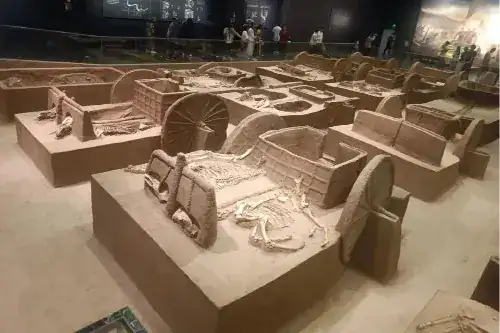
Zhumadian is an important birthplace of Chinese civilization, producing Pangu culture, Leizu culture, post station culture, chariot culture, iron smelting and sword casting culture, the Butterfly Lovers culture, and Chongyang culture. Queshan's Zhugou was the former seat of the Central Plains Bureau of the CPC Central Committee, known as "Little Yan'an." It is the hometown of anti-Japanese hero General Yang Jingyu and the site of the decisive Leigang Battle.
Festivals and Customs
The Biyang Wangdian large-scale float performance is a folk art form combining theatrical styling and acrobatic entertainment, with over 400 years of history.
City Symbols
In December 2014, camphor tree was designated the city tree and crape myrtle the city flower.
Cultural Heritage Sites
Zhumadian has 18 national-level cultural heritage protection sites, ranking in Henan's top tier. Notable sites include the Runlou Site (Shang dynasty, Zhengyang) and the Runing Stone Bridge (Ming dynasty, Runan).
Intangible Cultural Heritage
Notable items include Xiping wedding customs, Biyang Red Lantern Dance, Queshan iron flower fireworks (national-level), Xiping large brass instruments (national-level), Tangxi sword casting technique (national-level), hook embroidery, and the Butterfly Lovers legend (national-level). In 2007, Ma Township in Runan was renamed Liangzhu Town after the legend.
Scenic Attractions
Overview
As of 2023, Zhumadian has 39 A-level tourist attractions, including 1 national 5A-level, 5 national 4A-level, and 33 3A/2A-level sites.
Key Attractions
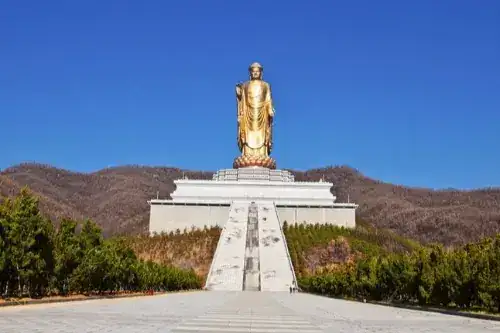
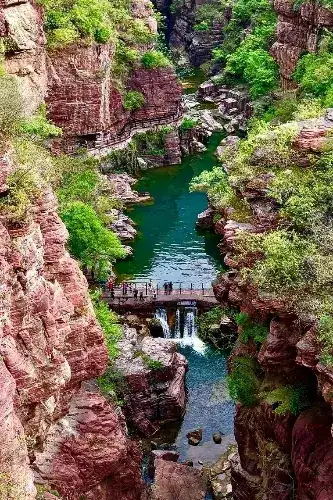
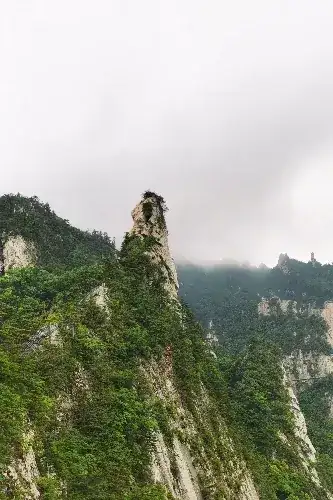
Chaya Mountain, 25 km west of Suiping, is a national 5A-level scenic area, national geopark, and national forest park, known for its granite landscape with over 200 scenic spots. Other key attractions include Baoshan Lake (national forest park), Mount Le (national 4A-level), the former residence of General Yang Jingyu, Zhugou Revolution Memorial, Jinding Mountain, and Nanhai Zen Temple — the largest Buddhist temple in Asia by building scale, featuring the world's largest indoor Buddha statue.
Local Specialties and Cuisine
Zhumadian's cuisine reflects Henan culinary traditions with local characteristics, emphasizing fresh, seasonal ingredients. Notable dishes include Biyang five-spice donkey meat, Caizhou beef jerky, and local noodle dishes. Taqiao braised pig trotters and Weigong spicy half-trotters have been recognized as intangible cultural heritage.
Notable Figures
Zhumadian has nurtured numerous historical figures, including the legalist philosopher Han Fei and the statesman Li Si during the Qin Dynasty, as well as modern revolutionary leaders and anti-Japanese hero General Yang Jingyu.
Major Honors
Zhumadian has received numerous honors, including recognition as a major agricultural production base and cultural heritage city in Henan Province.
Travel information can change. Check current opening hours, reservations and entry requirements before you travel.
Traveller discussion
Start the conversation with a helpful tip or a question.