
Zhengzhou
ZhengzhouZhengzhou, abbreviated "Zheng," is a prefecture-level city and the capital of Henan Province. Known historically as "the Center of Heaven and Earth" and also called Shangdu (Shang Capital) or the Green City, it is located in centra
Zhengzhou
Zhengzhou, abbreviated "Zheng," is a prefecture-level city and the capital of Henan Province. Known historically as "the Center of Heaven and Earth" and also called Shangdu (Shang Capital) or the Green City, it is located in central-northern Henan at the boundary between the middle and lower reaches of the Yellow River. The terrain slopes from southwest to northeast, with a temperate continental monsoon climate and 124 rivers spanning the Yellow River and Huai River basins. The total area is 7,567 square kilometers. As of the end of 2025, Zhengzhou administers 6 districts, 1 county, and 5 county-level cities, with a permanent population of 13.138 million.
Zhengzhou is a National Famous Historical and Cultural City, an important birthplace of Chinese civilization, and one of China's Eight Great Ancient Capitals, having served as a capital for 355 years. It has 2 World Heritage properties (12 sites), 83 National Key Cultural Relic Protection Units, 149 provincial-level protection units, and 6 items on the National Intangible Cultural Heritage list. The city is a national comprehensive transportation hub with 2 terminals, 2 runways, 162 routes, 6 railway stations, 6 high-speed rail lines, 13 metro lines, 11 expressways, and 37 BRT routes. It has been designated a National Center City, an international comprehensive transportation hub, a central China advanced manufacturing base, and a regional science and technology innovation highland. The six leading industries are electronic information, automobiles, equipment manufacturing, new materials, modern food, and aluminum processing. In 2025, Zhengzhou achieved a regional GDP of 1,524.46 billion yuan (approximately $210 billion), up 5.4%.
History
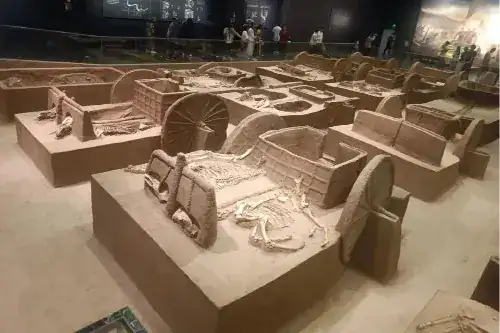
In antiquity, the Zhengzhou area belonged to Yuzhou, one of the Nine Provinces. During the era of the Yellow Emperor, cities already existed here. The Xishan Ancient City, dating back approximately 5,300 years, has the earliest known city walls in China and the title "First City of China." The Shang Dynasty established its founding capital here over 3,600 years ago at Bodu, where 7 kilometers of Shang-era city walls still survive. After the Western Zhou, the State of Guan was established here. During the Spring and Autumn period, the State of Zheng moved its capital to Xinzheng, and in 375 BC the State of Han conquered Zheng, with Xinzheng serving as the capital of both states for over 500 years.
During the Sui Dynasty (583 AD), the area was officially named "Zhengzhou," and in 596 AD the prefectural seat moved to Guancheng, beginning its era as the region's political center. In March 1928, Zhengzhou was formally established as a city, one of the first 19 nationwide and the first in Henan. On October 22, 1948, the People's Liberation Army liberated Zhengzhou. In 1954, the provincial capital moved from Kaifeng to Zhengzhou.
Administrative Divisions
As of the end of 2025, Zhengzhou administers 6 districts (Zhongyuan, Erqi, Jinshui, Guancheng Hui, Huiji, and Shangjie), 1 county (Zhongmu), and 5 county-level cities (Xingyang, Gongyi, Dengfeng, Xinmi, and Xinzheng), plus the Zhengzhou Airport Economy Comprehensive Experimental Zone, Zhengdong New Area, and two national-level development zones.
Geography
Location and Topography
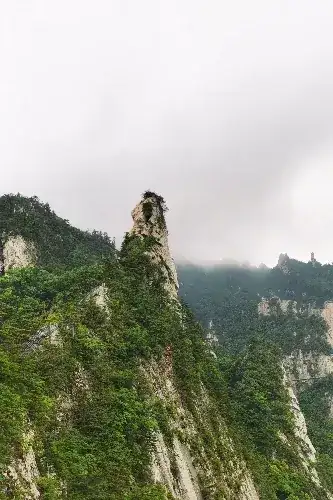
Located between 112°42′–114°14′E and 34°16′–34°58′N, Zhengzhou borders Kaifeng to the east, Xuchang and Pingdingshan to the south, Luoyang to the west across Songshan, and Xinxiang and Jiaozuo to the north across the Yellow River. The terrain slopes from southwest to northeast, with the highest point at Yuzhai Peak (1,512 m) and lowest at Shaogang (75 m). Mountainous areas account for 31.9% of the total area, hills 30.3%, and plains 37.8%.
Climate
Zhengzhou has a temperate continental monsoon climate with four distinct seasons. The average annual temperature is 14.7°C, with January averaging 0.5°C and July 27.1°C. Annual precipitation averages 632.4 mm, concentrated from June to August.
Hydrology
The city has 124 rivers across two basins: the Yellow River basin (27% of area) and the Huai River basin (73%). The Yellow River flows 150 km through the city. The Huai River's tributaries within the city include the Ying River, Jialu River, and Yunliang River.
Natural Resources
Zhengzhou has 36 proven mineral types including coal (72.12 billion tons), bauxite (2.49 billion tons), and refractory clay. Flora comprises approximately 184 families, 900 genera, and over 1,900 species.
Population
The Seventh National Census (2020) recorded 12.6 million residents, up 46.07% from 2010, with 78.40% urbanization. As of 2025, the population reached 13.138 million with an urbanization rate of 81.52%.
Economy
Overview
In 2025, regional GDP reached 1,524.46 billion yuan (approximately $210 billion), up 5.4%. The primary sector contributed 18.99 billion yuan (1.2%), secondary 557.68 billion (36.6%), and tertiary 947.78 billion (62.2%). Per capita GDP was 116,264 yuan (approximately $16,000). General public budget revenue was 118.13 billion yuan. Per capita disposable income was 48,021 yuan (approximately $6,600).
Primary Industry
In 2025, grain was sown across 297,760 hectares with total output of 1.5111 million tons. Agricultural output value was 29.29 billion yuan, up 4.0%. Vegetable production was 2.113 million tons, meat 127,000 tons, and aquatic products 65,000 tons.
Secondary Industry
Above-scale industrial value-added grew 9.0%, with mining up 18.1%, manufacturing 9.4%, and utilities 2.5%. Leading industries grew 9.7%, with automobile manufacturing up 11.9%, electrical equipment 17.9%, and electronics 16.4%. Construction output was 621.97 billion yuan.
Tertiary Industry
The Zhengzhou Commodity Exchange, established in 1993, was one of China's earliest futures exchanges. In 2025, wholesale and retail contributed 133.87 billion yuan, finance 160.65 billion yuan (up 8.7%), and transportation-postal-warehousing 100 billion yuan. Zhengzhou Xinzheng International Airport handled 1.033 million tons of cargo (up 25.2%) and 29.19 million passengers. Total retail sales reached 662.94 billion yuan, and import-export value was 650.18 billion yuan (up 16.8%). Financial deposits reached 3,550.57 billion yuan and loans 4,166.05 billion yuan.
Industrial Development Zones
The Zhengzhou Economic and Technological Development Zone (est. 1993, national-level since 2000) has three hundred-billion-yuan-scale industries. The Zhengzhou High-tech Industrial Development Zone (est. 1988) hosts 564 high-tech enterprises. The China (Henan) Free Trade Zone Zhengzhou Area and the Zhengzhou Airport Economy Comprehensive Experimental Zone — China's first national-level aviation economy pilot zone — focus on aviation logistics and modern industries.
Social Affairs
Science and Technology
Zhengzhou is home to China's 7th National Supercomputing Center and the Zhongyuan Science and Technology City (16.4 km², focusing on AI, cloud computing, 5G, and biomedicine). The city has 6 national engineering technology research centers, 17 national key laboratories, and 27 national enterprise technology centers. Technology contract transactions reached 100.25 billion yuan in 2025.
Education
The city has 2 "Double First-Class" universities and 6 provincial characteristic universities. As of 2025, graduate enrollment was 27,700 with 80,000 students in study, and undergraduate enrollment was 445,200 with 1.45 million students.
Healthcare
Zhengzhou has 6,653 medical institutions including 281 hospitals and 11.89 million beds, with 158,500 health technicians. It has the most comprehensive regional medical center layout in China.
Culture and Sports
The city hosts 14 art troupes, 14 cultural centers, 14 public libraries, and 59 museums. The Shaolin Temple here is the birthplace of Shaolin martial arts. The city hosted the 2019 ITTF World Tour Finals and WTA Zhengzhou Open. Henan Football Club (est. 1994) is one of China's most historically representative football clubs.
Transportation
Zhengzhou is a national comprehensive transportation hub. By 2024, its 5-hour high-speed rail network reached 123 cities directly (136 with transfers).
Rail
The railway hub sits at the intersection of the Beijing-Guangzhou and Lanzhou-Lianyungang trunk lines, known as the "heart of railways." The "rice-shaped" high-speed rail network radiates to Wanzhou, Jinan, Hefei, and Taiyuan. Zhengzhou is also a China-Europe Railway Express junction.
Aviation
Zhengzhou has three civil airports. Zhengzhou Xinzheng International Airport, one of China's eight regional hub airports with 4E and 4F runways, handled 825,100 tons of cargo (up 35.8%) and 28.51 million passengers in 2024.
Public Transit
Zhengzhou Metro (13 lines, 450 km, ranking 10th nationally) opened in 2013. The BRT system is China's largest with 72 lines and 800,000+ daily riders. The city launched China's first 5G autonomous bus route in 2020.
Historical Culture
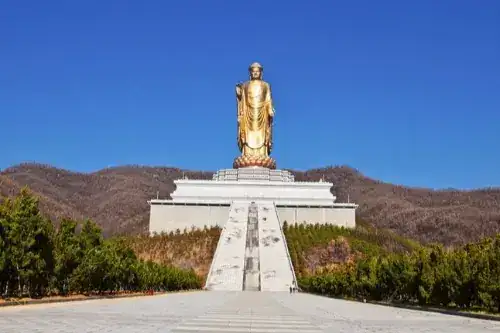
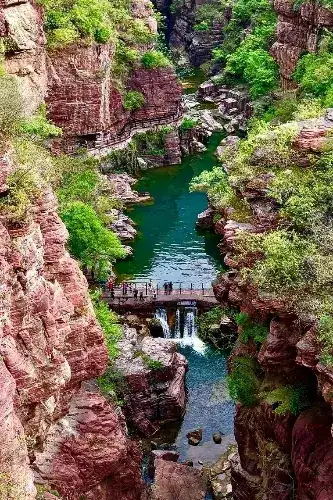
The Chinese rose was designated city flower in 1983 and the sycamore city tree in 2007. Signature cuisine includes Zhengzhou braised noodles. Notable festivals include the Yellow Emperor's Hometown Ancestor Worship Ceremony and the International Shaolin Martial Arts Festival. The city has 83 national key cultural relic protection units and 6 national intangible cultural heritage items. Major attractions include the Shaolin Temple, Songshan (UNESCO Global Geopark), the Yellow Emperor's Hometown, the Yellow River Cultural Park, the ancient astronomical observatory, Zhongyue Temple, and Songyang Academy.
Notable Figures
Historical figures associated with Zhengzhou include the Yellow Emperor, Xu You, Zichan, Liezi, Han Feizi, Chen Sheng, Du Fu, Zheng Qian, Bai Juyi, and Li Jie.
Honors
Zhengzhou has received numerous national designations including National Famous Historical and Cultural City (1994), National Garden City (2006), National Forest City (2014), National Bus City (2018), 5G Pilot City (2018), National Ecological Garden City (2020), Beta-level Global City (2020), International Comprehensive Transportation Hub City (2022), National Health City (2022), National Intellectual Property Demonstration City (2022), National Food Safety Demonstration City (2023), and New First-Tier City (2023). In 2025, it was awarded the National Double Support Model City designation.
Travel information can change. Check current opening hours, reservations and entry requirements before you travel.
Traveller discussion
Start the conversation with a helpful tip or a question.