
Weihai City
Weihai CityWeihai City, a prefecture-level city under Shandong Province, is located at the eastern tip of the Shandong Peninsula in eastern China, between 36°41′–37°35′N and 121°11′–122°42′E. It features a northern temperate monsoon contine
Weihai City
Weihai City, a prefecture-level city under Shandong Province, is located at the eastern tip of the Shandong Peninsula in eastern China, between 36°41′–37°35′N and 121°11′–122°42′E. It features a northern temperate monsoon continental climate with distinct seasonal changes. The total area is 5,822.52 square kilometers. As of the end of 2023, Weihai administers two municipal districts and two county-level cities. As of the end of 2024, the resident population was 2.9146 million. Weihai has a long history dating to the mid-Neolithic period. During the Xia, Shang, and Zhou dynasties, the area was inhabited by the Yuyi (eastern Yi tribes). In 568 CE, Wendeng County was established. In 1398, Weihaiwei was founded to defend against wokou (Japanese pirate) incursions, the name meaning "awe-inspiring the sea frontier." On June 15, 1987, Weihai was elevated to a prefecture-level city. Weihai is designated by the State Council as a regional center city of the Shandong Peninsula, an important marine industry base, and a coastal tourism city. The city has 51 national A-level or above scenic areas, including two AAAAA-level sites (Liugong Island and Huaxia City). It is the birthplace of China's first modern navy, the Beiyang Navy, and the site of the Sino-Japanese War naval battles. It was one of the "Seven Sons" returned to China after foreign occupation. Weihai was among the first batch of Chinese coastal open cities, the first National Sanitary City, and one of the first National Agricultural Product Quality Safety Cities. In 2025, Weihai's GDP reached 389.609 billion yuan (approximately $53.7 billion USD), growing 5.8% at constant prices.
History
Pre-Qin Period
Weihai has a long history. Archaeological evidence from ancient cultural sites shows human habitation dating back to the Neolithic Age. According to the Records of the Grand Historian (Shiji), the area belonged to Qingzhou and was inhabited by the Yuyi and Laiyi tribes during the Xia, Shang, and Zhou dynasties.
Spring and Autumn Period
The area successively belonged to the Laizi State and the eastern Lai territory of the Qi State. After Qi conquered Lai, the region became known as Donglai (Eastern Lai).
Qin Dynasty
In 221 BCE, Qin Shi Huang unified the six states and established the commandery-county system. The area first belonged to Qi Commandery, then to Jiaodong Commandery, as part of Chui County.
Han, Wei, and Three Kingdoms
During the Han dynasty, the area belonged to Donglai Commandery in Qingzhou. Three counties were established within the current city limits: Buye, Changyang, and Yuli. During the Three Kingdoms period, the area belonged to the Wei dynasty's Donglai Commandery, with Changyang County established.
Western Jin and Northern and Southern Dynasties
In the early Jin dynasty, Changyang County was merged into Changguang County. In 568 CE, the Northern Qi established Wendeng County, which then encompassed the entire current city territory.
Sui, Tang, and Five Dynasties
The area was part of Dengzhou, with Wendeng County established. During the Tang dynasty, Dengzhou was established and abolished several times. The southwest part belonged to Muping County and the rest to Wendeng County for over a thousand years.
Song, Jin, and Yuan Dynasties
During the Song dynasty, the area was part of Dengzhou under Jingdong East Circuit. The Jin dynasty established Ninghai Prefecture in 1182, governing Muping and Wendeng counties. Under the Yuan dynasty, Ninghai Prefecture was directly subordinate to the Secretariat.
Ming and Qing Dynasties
In 1398, to defend against wokou pirates, three military garrisons (wei) were established: Weihai, Chengshan, and Jinghai. Weihaiwei was built in 1403, its name meaning "awe-inspiring the eastern sea." In 1735, Chengshanwei was abolished and Rongcheng County was established. In 1898, Britain forcibly leased Weihaiwei.
Republic of China Period
In 1913, the province-dao-county system was implemented. In 1930, Weihaiwei was recovered and designated as the Weihaiwei Administrative Region, directly under the Executive Yuan. During the war years, the area underwent various administrative reorganizations.
After the Founding of the PRC
In May 1950, the Wendeng Special District was established. In 1956, the area was transferred to Laiyang Special District, then to Yantai Special District in 1958. On June 15, 1987, Weihai was elevated to a prefecture-level city, with the former county-level Weihai City becoming Huancui District. Rongcheng, Wendeng, and Rushan counties were transferred from Yantai to Weihai. In 2014, Wendeng City was converted to Wendeng District.
Administrative Divisions
As of the end of 2023, Weihai administers two districts and two county-level cities: Huancui District, Wendeng District, Rongcheng City, and Rushan City. It also has three national-level development zones and one provincial-level development zone: Weihai Torch High-tech Industrial Development Zone, Weihai Economic and Technological Development Zone, Weihai Lingang Economic and Technological Development Zone, and Weihai Nanhai Economic Development Zone. The city has 48 towns, 24 sub-districts, 2,373 villages, and 390 communities. The municipal government is located at No. 1 Xinwei Road, Huancui District.
Physical Geography
Location and Extent
Weihai is located at the eastern tip of the Shandong Peninsula, between 36°41′–37°35′N and 121°11′–122°42′E. It faces the Yellow Sea to the north, east, and south, faces the Liaodong Peninsula to the north and the Korean Peninsula across the sea to the east, and borders Yantai to the west. The maximum east-west span is 135 km, the maximum north-south span is 81 km, with a total area of 5,822.52 square kilometers and a coastline of 968 km.
Geology
Weihai sits at the eastern end of the Jiaobei block uplift. Exposed strata range from the Late Archean Jiaodong Group to the Cretaceous and Quaternary systems. Major structures include the Rushan-Weihai anticlinorium and various fault systems trending north-south, northeast, and northwest.
Topography
Weihai is a gently undulating hilly region. Except for the main peak of Kunyu Mountain (Taibo Top, 923 m), most hills are below 700 m, with the majority being rolling hills of 200–300 m. Low mountains account for 15.77% of the total land area, hills 52.38%, plains 27.56%, islands 0.28%, and tidal flats 4.01%.
Climate
Weihai has a northern temperate monsoon continental climate at mid-latitude, with abundant rainfall, moderate temperatures, and mild conditions influenced by the ocean. The annual average temperature is 12.5°C, with average sunshine of 2,417.6 hours. In 2024, the average temperature was 13.9°C, 1.4°C above normal. The multi-year average precipitation is 770.6 mm.
Hydrology
Weihai's rivers belong to the peninsular marginal water system, characterized by short courses and swift flows. There are over 1,000 rivers, with 35 having catchment areas of 50 square kilometers or more. The three major rivers—Muzhu River (1,092 km², 64 km), Rushan River (1,039 km², 78 km), and Huanglei River (635 km², 71 km)—flow through Wendeng and Rushan, with a total catchment of 2,766 km², or 47.7% of the city's land area.
Soil
Weihai has seven soil types: brown earth, fluvo-aquic soil, saline soil, aeolian sandy soil, cinnamon soil, paddy soil, and mountain meadow soil. Brown earth is the most widespread, covering 83.5% of the total soil area, followed by fluvo-aquic soil at 13.2%. The soil is generally slightly acidic with a pH of 6.5–7.
Maritime Waters
Weihai is surrounded by the Yellow Sea on three sides, with a total coastline of 968 km, approximately one-third of Shandong's total and one-eighteenth of China's. The nearshore sea area totals 11,300 square kilometers. There are 35 major bays and 185 islands of various sizes. The total sea-use area is 455,000 hectares.
Natural Resources
Water Resources
With no major rivers, Weihai's water resources come mainly from atmospheric precipitation. The multi-year average precipitation is 764.2 mm. The total water resources amount to 1.64944 billion cubic meters.
Land Resources
The total land area is 582,300 hectares, including 451,600 hectares of agricultural land, 94,400 hectares of construction land, and 36,300 hectares of unused land. Cultivated land covers 163,800 hectares, with 143,600 hectares of permanent basic farmland.
Biological Resources
Weihai has abundant marine biological resources. The average marine biomass is 353 g/m² with an average density of 586 individuals/m². There are 779 species of biological resources, including 647 animal species and 132 plant species. Marine animals include over 100 fish species, various shrimp and crab species, and shellfish such as scallops, abalone, and oysters. On land, mammals include sika deer, foxes, and leopard cats. Over 250 bird species have been recorded, with migratory and passage birds comprising over 70%. Rongcheng has been designated "China's Hometown of Whooper Swans" and "China's Hometown of Black-tailed Gulls." There are 516 species of woody plants across 75 families.
Mineral Resources
Weihai has identified 49 mineral species, with 30 having proven reserves. These include energy minerals (geothermal), metallic minerals (iron, titanium, copper, lead, zinc, molybdenum, gold, silver, beryllium, zirconium, hafnium), non-metallic minerals (pyrite, graphite, feldspar, kaolin, granite), and water-gas minerals (groundwater, mineral water).
Population and Ethnic Groups
According to the Seventh National Population Census (November 1, 2020), Weihai's resident population was 2,906,548, an increase of 101,777 (3.63%) from 2010, with an average annual growth rate of 0.36%. As of the end of 2024, the resident population was 2.9146 million, with 2.1445 million urban residents and an urbanization rate of 73.58%. The registered population was 2.5229 million.
Ethnic Composition
Weihai is home to 50 ethnic groups. As of the end of 2021, the minority registered population was 30,800. The five largest minority groups are Korean (10,900), Manchu (7,033), Mongol (3,428), Va (2,254), and Hui (1,761).
Politics
Weihai's political administration follows the standard Chinese governance structure, with a municipal Party committee, People's Congress, People's Government, and Chinese People's Political Consultative Conference.
Economy
Overview
In 2024, Weihai's GDP was 372.862 billion yuan (approximately $51.4 billion USD), growing 5.8% at comparable prices. The primary, secondary, and tertiary industries contributed 34.742 billion yuan (~$4.8 billion USD), 137.975 billion yuan (~$19.0 billion USD), and 200.145 billion yuan (~$27.6 billion USD), respectively, with an industrial structure of 9.3:37.0:53.7. Fixed asset investment grew 4.4%, with high-tech industry investment up 19.5%. General public budget revenue was 24.975 billion yuan (~$3.4 billion USD), up 5.2%. General public budget expenditure was 48.121 billion yuan (~$6.6 billion USD), up 11.8%.
Primary Industry
Weihai is a traditional producer of quality agricultural products. Key traditional crops include wheat, corn, and peanuts, while 12 specialty industries—apples, American ginseng, and figs—develop competitively. Apple cultivation covers 70,000 hectares with an annual output of 1.02 million tons. American ginseng is planted on 37,000 hectares, with annual production of 1,800 tons of dried ginseng, accounting for over 70% of national output. Fig cultivation covers 28,000 mu (1,867 hectares), making Weihai China's largest green-skin fig producing area. In 2024, the agricultural, forestry, animal husbandry, and fishery value-added reached 36.643 billion yuan. Total grain output was 764,500 tons, and aquatic products totaled 3.4157 million tons.
Secondary Industry
In 2024, value-added of above-scale industries grew 8.4%. Major growth sectors included computer and electronic equipment manufacturing (+20.1%), transport equipment manufacturing (+57%), and automobile manufacturing (+13.7%). Above-scale industrial enterprise revenue reached 282.136 billion yuan, with a profit margin of 6.7%. Construction value-added was 23.439 billion yuan, up 5.4%.
Tertiary Industry
In 2024, above-scale service industry revenue grew 9.6%. Total retail sales of consumer goods reached 144.696 billion yuan (~$19.9 billion USD), up 6.1%. Total foreign trade import and export reached 204.02 billion yuan (~$28.1 billion USD), up 1.6%, with exports of 161.81 billion yuan and imports of 42.20 billion yuan. Newly approved foreign investment projects numbered 219, with actual foreign investment of $607 million USD. By end of 2024, financial institution deposits in local and foreign currency totaled 719.002 billion yuan (~$99.2 billion USD), up 9.0%, and loans totaled 589.287 billion yuan (~$81.3 billion USD), up 10.2%. Insurance premium income was 14.412 billion yuan (~$2.0 billion USD), up 6.8%.
Social Services
Science and Technology
In 2024, Weihai registered 1,462 technology contracts with a transaction value of 17.063 billion yuan. Patent grants totaled 10,213, including 1,980 invention patents. The "Weihai No. 1" satellite was successfully launched. There were 2,980 national technology-based SMEs and 1,724 national high-tech enterprises.
Education
As of end of 2024, Weihai had 11 regular higher education institutions with 145,223 students; 10 secondary specialized schools with 17,663 students; 18 regular high schools with 38,018 students; 102 junior high schools with 99,592 students; 101 primary schools with 140,541 students; and 350 kindergartens with 57,371 children.
Culture
Weihai had 4 professional performing troupes, 5 libraries, 6 cultural centers, 15 museums, and 5 art galleries. There were 43 cinemas, 4 radio stations, and 5 television stations, with comprehensive coverage rates of 100% for both radio and television.
Healthcare
Weihai had 2,784 medical and health institutions, including 78 hospitals with 16,790 beds. Health professionals totaled 27,721, including 11,885 licensed physicians and 12,082 registered nurses.
Sports
In 2024, Weihai held 7,861 sports events. Athletes won 83.5 gold medals at the Shandong Provincial Championships. Five sports parks passed national review, and 110 new fitness venues were added.
Social Security
In 2024, 2.4489 million people participated in basic pension insurance, with the resident basic pension raised to 200 yuan per person per month. 2.5711 million people participated in basic medical insurance. Weihai had 170 elderly care institutions with 40,546 beds.
Transportation
Overview
As of end of 2024, Weihai's highway mileage totaled 6,843.68 km. Total passenger volume reached 17.0906 million person-trips, and freight volume totaled 23.1864 million tons. Port cargo throughput was 51.6244 million tons, and container throughput was 1.5466 million TEU, up 3.9%.
Aviation
Weihai Dashuipo International Airport is located in Wendeng District, 40 km from the city center. It is a 4D-level airport with a 2,600-meter runway and 20 aircraft stands, connecting to 38 cities.
Railways
Weihai has 137.5 km of local railway, 66.5 km of intercity railway, and 102 km of the Lai-Rong high-speed railway, with 11 passenger and freight stations serving the Qingrong intercity railway, Lai-Rong high-speed railway, and Taowei railway.
Water Transport
Weihai's ports, collectively known as Weihai Port, comprise the Weihai Bay, Nanhai, Shidao, Rushankou, and Longyanwan port areas, with 92 berths including 34 of 10,000-ton class or above, and 35 domestic and international shipping routes.
Highways
As of end of 2023, Weihai's highway mileage reached 6,993.14 km, including 1,340.12 km of trunk roads. Four expressways serve the city: G18 Rongwu Expressway, G1813 Weiqing Expressway, S11 Yanhai Expressway, and S16 Rongwei Expressway. National highways G206, G228, and G308 also pass through.
Public Transit
Weihai operates over 11,000 commercial passenger vehicles (including road transport, public transit, and taxis) and over 22,000 freight vehicles.
Culture and History
Intangible Cultural Heritage
Weihai's cultural heritage reflects its history as a coastal and military outpost, with traditions shaped by centuries of maritime commerce and cultural exchange.
Folk Customs
Weihai's folk customs have been enriched by immigration, shipping, and migration. The Mazu belief from southern China spread to the coast during the Yuan dynasty. The centuries-long migration to the northeast ("Chuang Guandong") brought northeastern customs back to Weihai, including legends of "Tuweiba Laoli" (the tailless dragon Li) and ginseng stories. Some Manchu customs from the Changbai Mountains that have disappeared in their place of origin are preserved in Weihai.
Dialect
The Weihai dialect belongs to the Jiaoliao Mandarin group within the Mandarin dialect family. Key phonological features include: distinction between sharp and flat sibilants; splitting of standard Chinese ts/ts'/s initials into two groups; Old Chinese ri-initial words mostly pronounced with zero initial; loss of the medial u in Duan-group syllables; partial merger of Xian-Shen and Shan-Zhen rhyme groups into n-final; and the irregular split of level-tone sonorant words into two pronunciation classes. Voiceless entering-tone words generally merge into the rising tone.
Scenic Attractions
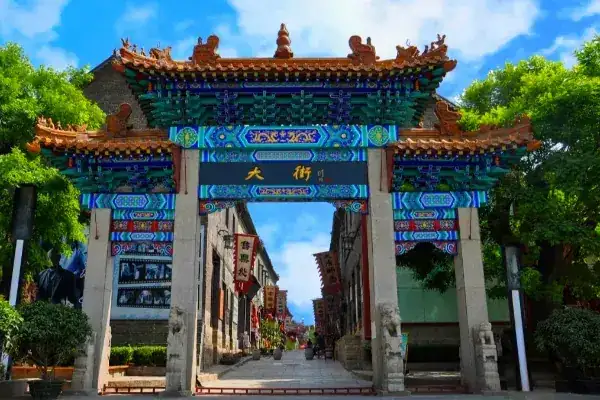
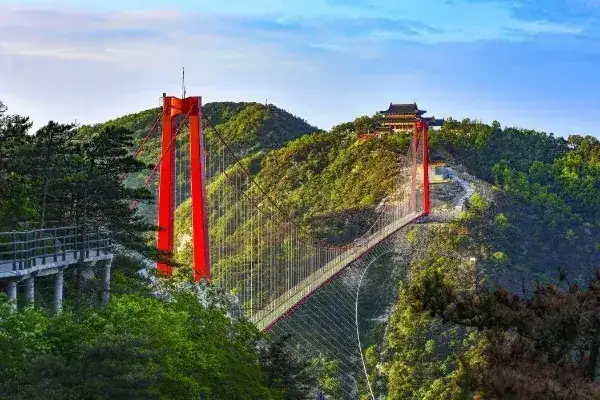
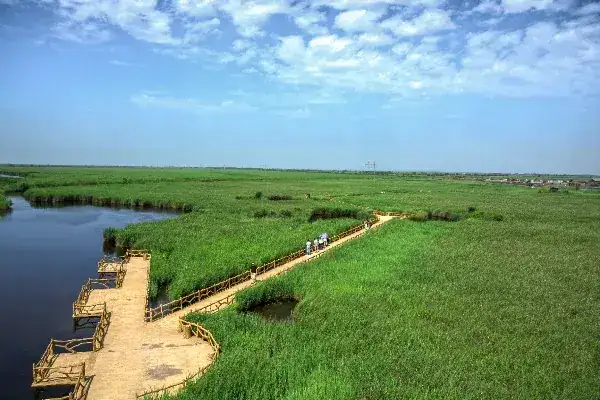
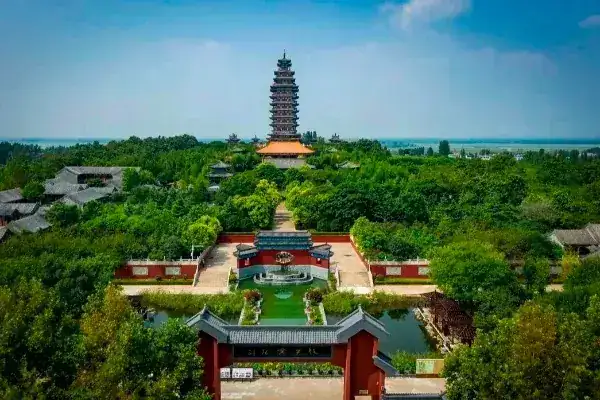
Weihai is a beautiful coastal city with rich tourism resources, including island coastlines, urban gardens, historical sites, and folk customs. The city has over 80 scenic spots, including 50 national A-level or above sites. Two AAAAA-level sites are Liugong Island and Huaxia City. The nearly 1,000-km coastline features clear water, pine forests, and 168 islands. Notable attractions include Liugong Island (a "maritime forest park"), Hailv Island (known as the "Kingdom of Seagulls"), Chengshantou (the "Eastern Cape of Good Hope"), and Rushan Silver Beach. Weihai has nine of the Jiaodong Peninsula's 14 hot springs.
Notable Figures
Over Weihai's 500-year history, many notable figures have emerged. During the First Sino-Japanese War, patriotic officers of the Qing navy and army fought bravely. During the Xinhai Revolution, Weihai patriots sacrificed for the overthrow of the Qing dynasty. During the anti-Japanese war and the civil war, 1,075 people gave their lives, including one combat hero, one people's hero, and 57 famous revolutionary martyrs who received second-class merit or above.
Honorary Titles
Weihai has received numerous honorary titles, including China's first National Sanitary City, one of the first National Agricultural Product Quality Safety Cities, and various national recognitions for environmental quality, tourism, and social development.
Sister Cities
Weihai maintains sister city relationships with several international cities, fostering cultural and economic exchange.
Travel information can change. Check current opening hours, reservations and entry requirements before you travel.
Traveller discussion
Start the conversation with a helpful tip or a question.