
Jinan City
Jinan CityJinan City, abbreviated "Ji" and known as the "Spring City," is a prefecture-level city, provincial capital, and sub-provincial city in Shandong Province. located in central Shandong with Mount Tai to its south and the Yellow Rive
Jinan City
Jinan City, abbreviated "Ji" and known as the "Spring City," is a prefecture-level city, provincial capital, and sub-provincial city in Shandong Province. located in central Shandong with Mount Tai to its south and the Yellow River to its north. The terrain descends from south to north at the junction of low mountain-hill regions and the northwestern alluvial plain. Jinan has a warm temperate continental monsoon climate with four distinct seasons and abundant sunshine, and is renowned for its numerous springs, earning the title of "natural karst spring museum." Total area: 10,244.45 km². It administers 10 districts and 2 counties. As of end-2025, the permanent population was 9.616 million. Named for its location south of the ancient Jishui River, the area has been inhabited for 9,000 years. The "Longshan Culture," characterized by polished black pottery, was named after its 1928 discovery at Longshan Town. Jinan's city-founding history is among China's earliest, spanning over 3,500 years. Jinan City was formally established in July 1929 and became a sub-provincial city in February 1994. It is an important central city in the Yellow River basin, a national famous historical and cultural city, and a national comprehensive transportation hub. Its four pillar industries are big data and next-generation information technology, intelligent manufacturing and high-end equipment, premium steel and advanced materials, and biomedicine and health. Jinan is the birthplace of Lu cuisine. Famous attractions include Baotu Spring, Daming Lake, and Thousand Buddha Mountain. In 2025, GDP reached 1.421 trillion CNY (approximately $196 billion USD), up 5.4%.
Name Evolution
Jinan was named for its location south of the ancient Jishui River. In 164 BC, the Jinan Kingdom was established. The character "Luo," found on oracle bones at Anyang, is the earliest written record of Jinan, then called "Luo Yi." During the Warring States period, it was renamed "Lixia Yi," and in the early Han Dynasty, "Licheng County" — both derived from Lishan south of the city.
History
Pre-Qin Period
Archaeological evidence shows human settlement dating back 9,000 years. The Longshan Culture, characterized by polished black pottery, was named after its 1928 discovery at Longshan Town. During the Xia Dynasty, a sizable city existed near Chengziya. In the Shang and Zhou periods, the area belonged to the ancient State of Tan. During the Spring and Autumn and Warring States periods, Jinan was part of the State of Qi.
Qin-Han to Southern and Northern Dynasties
During the Qin, the area belonged to Jibei Commandery. In the Western Han, Jinan Commandery was established at Dongpingling. Emperor Wen of Han established the Jinan Kingdom in 164 BC. During the Wei-Jin and Southern-Northern Dynasties, Jinan changed hands frequently. The commandery seat moved to Licheng during the Western Jin, making downtown Jinan the administrative center for subsequent dynasties.
Sui-Tang to Song-Yuan Period
In the Sui Dynasty, Qi Prefecture governed Jinan with 10 counties. During the Tang, it was temporarily renamed Linzi and Jinan Commanderies. In the Northern Song, Qi Prefecture was elevated to Jinan Prefecture in 1116. During the Yuan, it became Jinan Route under the central Secretariat.
Ming-Qing Period
In the early Ming, Jinan Prefecture governed 4 prefectures and 26 counties. In 1376, the provincial administrative office moved from Qingzhou to Jinan, making it the provincial capital. The Qing maintained the Ming structure.
Republic of China Period
Jinan Prefecture was abolished and replaced with Daibei Circuit, renamed Jinan Circuit in 1914. In July 1929, Jinan City was formally established. In September 1948, the People's Liberation Army liberated Jinan, establishing it as a special municipality, reverting to Jinan City in May 1949.
After the Founding of the People's Republic of China
After 1949, various counties were gradually brought under Jinan's administration. In 1994, Jinan was designated a sub-provincial city. In December 2018, the State Council approved merging Laiwu into Jinan, creating Laiwu and Gangcheng districts. Jinan now has 10 districts and 2 counties.
Physical Geography
Location and Territory
Jinan is in central Shandong, between 36°02'-37°54'N and 116°21'-117°93'E, with Mount Tai to the south and the Yellow River to the north, bordering five cities. Total area: 10,244.45 km².
Climate
Jinan has a warm temperate continental monsoon climate with four distinct seasons. In 2023, average precipitation was 638.3 mm and temperature 15.4°C. Extreme weather was frequent, including 7 heavy rain days, 2 blizzard days, and 35 high-temperature days.
Geology
Strata range from Paleozoic limestone in the south to Cenozoic loose deposits in the north, at the junction of the Jiyang Depression and Luzhong Uplift within the North China Plate.
Topography and Landforms
The terrain descends from south to north, comprising low mountains, hills, plains, and low-lying areas along the Yellow River, dividable into three zones: northern Yellow River plain, central piedmont plain, and southern low mountain-hill zone.
Soil
Six soil types: brown earth, cinnamon soil, fluvo-aquic soil, shajiang black soil, paddy soil, and aeolian sandy soil, with brown earth and cinnamon soil predominant.
Hydrology
Known as the "Spring City," Jinan has ten major spring groups including Baotu, Black Tiger, Five Dragon Pool, Pearl, Bai, Baimai, Yuhe, Yongquan, Jiasha, and Hongfanchi. Major rivers include the Yellow River, Xiaoqing River, and Dawen River. Notable lakes include Daming Lake in Lixia District.
Natural Disasters
In 2023, Jinan experienced droughts, sandstorms, typhoon-induced flooding, and blizzards. Typhoon Doksuri brought record rainfall of 102.3 mm per hour, causing 33 waterlogging points. A December blizzard brought snow depths up to 12 cm, followed by extreme cold reaching -20.8°C.
Natural Resources
Water Resources
In 2022, total water resources were 340.20 million cubic meters. Large and medium reservoirs held a year-end total of 374 million cubic meters.
Land Resources
As of 2022, Jinan has 344,821 hectares of cultivated land, 101,941 hectares of orchard land, 248,283 hectares of forest, and 27,048 hectares of grassland. Transport land covers 30,654 hectares.
Mineral Resources
Jinan has rich mineral resources including high-quality limestone, dolomite, granite, iron, coal, refractory clay, copper, potassium, and platinum.
Biological Resources
As of May 2024, Jinan has 50 wild tree species across 11 families and 478 cultivated tree species across 72 families. The city has 331 terrestrial wildlife species including 302 bird species. Six species are under national Class I protection, including Baer's pochard, Siberian crane, Oriental stork, and golden eagle. Jinan has 42 nature reserves and parks.
Administrative Divisions
As of April 2024, Jinan administers 10 districts, 2 counties, 132 sub-districts, and 29 towns. The municipal government is at No. 1 Longding Avenue, Lixia District.
Population
Population Size
As of end-2025, the permanent population was 9.616 million, up 101,000 (1.1%). Urbanization rate reached 77.3%.
Ethnic Groups
Jinan is home to 55 ethnic groups, with the Han majority.
Language
The Jinan dialect belongs to the Ji-Lu Mandarin group, sharing most features with Standard Mandarin while retaining distinctive colloquial vocabulary.
Religion
Major religions have coexisted in Jinan for centuries under the influence of Qilu, Mount Tai, Confucian, and Yellow River cultures. Buddhism arrived during the Eastern Jin, Taoism during the Northern Wei, Islam during the early Yuan, Catholicism during the early Qing, and Christianity during the Qing Tongzhi era. The monk Zhu Senglang established Langgong Temple at the northern foot of Mount Tai in 351 AD. The Four-Gate Pagoda, built in 611 AD, is China's earliest surviving single-story pavilion-style Buddhist stupa.
Politics
Economy
Overview
Jinan is a northern advanced manufacturing base, commerce and logistics center, and regional innovation hub. In 2025, GDP reached 1.421 trillion CNY ($196 billion USD), up 5.4%. Primary, secondary, and tertiary industries contributed 44.22 billion CNY ($6.1 billion USD), 460.52 billion CNY ($63.5 billion USD), and 916.26 billion CNY ($126.4 billion USD) respectively, with a ratio of 3.1:32.4:64.5. In 2024, GDP was 1.3528 trillion CNY ($186.6 billion USD).
Primary Industry
Jinan has developed national geographic indication products including Zhangqiu green onions, Shanghe garlic, Pingyin roses, and donkey-hide gelatin. In 2025, total agricultural output was 82.2 billion CNY ($11.3 billion USD), up 4.3%. Grain output reached 3.058 million tons.
Secondary Industry
In 2025, above-scale industrial value added grew 6.9%. In 2024, above-scale industrial enterprises achieved revenues exceeding 1 trillion CNY for the first time, reaching 1.0189 trillion CNY ($140.5 billion USD).
Tertiary Industry
Jinan has vigorously developed cultural and creative industries and the convention and exhibition industry. In 2025, total retail sales reached 554.79 billion CNY ($76.5 billion USD), up 4.4%. In 2024, total goods trade reached 232.43 billion CNY ($32.1 billion USD).
Economic Functional Zones
Jinan is a convergence point for multiple national strategies, including the Shandong Pilot Zone for Replacing Old Growth Drivers, the Yellow River Ecological Protection strategy, and the China (Shandong) Free Trade Zone. The Jinan High-Tech Zone, approved in 1991, covers 291 km² across four areas.
Social Affairs
Education
In 2025, inclusive kindergarten coverage reached 95%, with public kindergartens enrolling 63% of children. The city launched 243 university-local cooperation projects.
Healthcare
As of end-2025, Jinan had 8,391 medical institutions including 357 hospitals, with 92,000 beds and 138,000 health professionals.
Media
Jinan Broadcasting and Television operates 8 radio frequencies and 7 TV channels, ranking among the top provincial capital city broadcasters nationwide.
Science and Technology
In 2025, technology contract transactions reached 102.5 billion CNY ($14.1 billion USD). R&D expenditure was 40.52 billion CNY ($5.6 billion USD), 3.00% of GDP. Effective invention patents per 10,000 people reached 87.2, up 17.8%.
Culture
Jinan has 11 state-owned performing arts troupes, 173 cultural centers, 13 public libraries, and 13 museums. There are 439+ cultural heritage sites above municipal level, including 30 at national level.
Sports
In 2025, the city organized over 12,000 fitness events with 1.562 million participants. Athletes won 440 gold medals at provincial level and above.
Environmental Protection
In 2025, the air quality composite index improved by 11.4%, with good-air days increasing by 42. Water quality at national monitoring sections ranked first in the province.
Social Security
As of end-2024, 4.716 million people participated in urban employee pension insurance. Social assistance funds totaling 1.66 billion CNY ($229 million USD) supported 258,000 disadvantaged residents.
Water Conservancy
To ensure urban water supply and maintain spring flow, Jinan has closed most groundwater wells in favor of surface water sources. Major reservoirs include Huangchao, Jinxiuchuan, Wohushan (south), and Yuqinghu (west, using Yellow River water).
Transportation
Overview
Jinan is a major transportation hub connecting eastern and northern China Jinan Yaoqiang International Airport is 23 km from downtown. As of end-2025, the rail transit network reached 217.9 km, ranking among China's top 20.
Highways
Major expressways include G2 (Beijing-Shanghai), G3 (Beijing-Taipei), G35 (Jinan-Guangzhou), G20 (Qingdao-Yinchuan), and G22 (Qingdao-Lanzhou). Total highway mileage was 18,425.4 km, including 890 km of expressway.
Railways
Jinan's "rice-shaped" high-speed rail network totaled 801 km including 411 km of high-speed rail, connecting 254 cities. The city has 12 operational and 6 planned high-speed rail stations.
Aviation
Jinan Yaoqiang International Airport, opened in 1992, has a 3,600 m runway. In 2024, it handled 20.01 million passenger trips (up 14%) and 154,000 tons of cargo (up 6.7%).
Water Transport
Jinan Port, at the center of the provincial city cluster economic circle, primarily handles freight. The main port and Zhangqiu port areas completed construction in June 2023.
Public Transportation
Jinan has 13 BRT lines, making it China's first city with a complete BRT network. As of 2024, the city had 780 bus routes totaling 16,529.2 km, carrying 590 million passengers. As of end-2025, the rail transit system had 8 lines totaling 248 km, with annual ridership of 116.399 million trips, up 21%.
Culture and Humanities
Overview
Jinan is the birthplace of Lu cuisine. The city's tree is the willow, and its flowers are the lotus and rose. Luju opera is a national intangible cultural heritage and Jinan's representative local opera.
Cuisine
Jinan cuisine emphasizes clean flavors with each dish distinct. Notable dishes include braised pork belly (bazi rou) and nine-turn large intestine, named for its resemblance to Taoist alchemical refinement. Other specialties include four-joy meatballs, Yellow River carp, and rose flower cakes.
Customs
Traditional customs include releasing river lanterns on the 30th of the seventh lunar month, the Thousand Buddha Mountain Temple Fair during the Double Ninth Festival (featuring persimmons), and the Jinan Medicine Market Fair, one of China's three major medicine fairs.
Folk Crafts
Pyrography (laohua) is an ancient art form dating to the Western Han Dynasty, using heated iron tools to create burn marks on wood. The Li family of Licheng was renowned for this craft during the Qing Guangxu period.
Local Specialties
Art
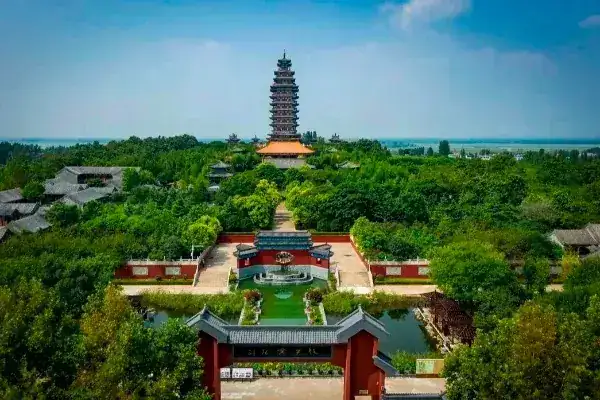
The Chaoran Tower, east of Daming Lake, dates to the Yuan Dynasty with over 700 years of history, known as the "first tower north of the Yangtze." The Qi Great Wall's Changqing section extends 64.16 km through Laiwu District.
City Symbols
In 1986, the willow was designated as Jinan's city tree, and the lotus as its city flower. In 2021, the rose was added as a second city flower.
Historical Sites
Jinan has 30 national-level, 171 provincial-level, and 236 municipal-level cultural heritage sites. The Four-Gate Pagoda, built during the Sui Dynasty over 1,400 years ago, is China's earliest surviving single-story pavilion-style stone pagoda.
Intangible Cultural Heritage
As of June 2024, Jinan has 1 UNESCO item, 13 national-level, 108 provincial-level, and 565 municipal-level intangible cultural heritage projects. Notable items include Jinan shadow puppetry (brought to Jinan in 1915), Laiwu Bangzi opera (over 200 years old), and Yangge, a representative folk dance of northern China.
Scenic Spots
Overview
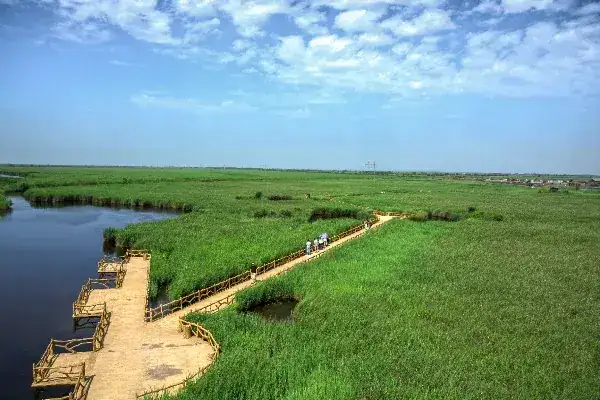
Historical Jinan had "Eight Scenes" and "Sixteen Scenes" traditions. The modern "Eight New Scenes of the Spring City" include Baotu Spring's soaring waters and Daming Lake's converging waves. Jinan has 89 A-level tourist attractions, including 1 at 5A and 19 at 4A level.
Key Attractions
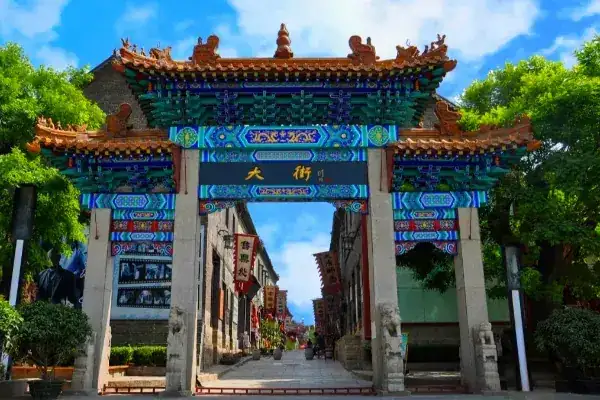
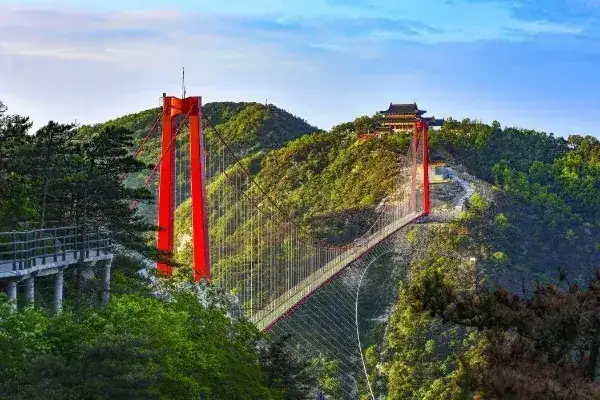
The "First Spring Under Heaven" Scenic Area in central Jinan comprises one river, one lake (Daming Lake), three spring groups (Baotu, Black Tiger, Five Dragon Pool), and four parks, covering 3.1 km² as a national 5A scenic area. Thousand Buddha Mountain covers 164.88 hectares with a peak of 285 m.
External Exchange
Consular Institutions
In April 2023, Cambodia opened a consulate general in Jinan, the first foreign consulate in the city and the fourth in Shandong Province after South Korea, Japan, and Thailand.
Friendly Cities
Jinan has established sister-city relations with cities worldwide and maintains friendly cooperation with numerous international partners.
Notable Figures
Many distinguished writers and scholars have lived in or visited Jinan, including Li Bai, Du Fu, Su Shi, Zeng Gong, Zhao Mengfu, Lao She, and Ji Xianlin, earning Jinan the reputation of having "many eminent scholars."
Major Honors
In October 2025, Jinan was named a National Model City for Rule-of-Law Government Construction.
Travel information can change. Check current opening hours, reservations and entry requirements before you travel.
Traveller discussion
Start the conversation with a helpful tip or a question.