
Ji'an City
Ji'an CityJi'an, historically known as Luling and Jizhou, is a prefecture-level city in Jiangxi Province, located in central Jiangxi along the middle reaches of the Ganjiang River. It borders Hunan Province to the west, embraces the central
Ji'an City
Ji'an, historically known as Luling and Jizhou, is a prefecture-level city in Jiangxi Province, located in central Jiangxi along the middle reaches of the Ganjiang River. It borders Hunan Province to the west, embraces the central section of the Luoxiao Mountains to the south, and occupies the fertile Jitai Plain. The terrain is predominantly mountains and hills, with a subtropical humid climate. Total area: 25,283 square kilometers. As of January 2025, the city administers 2 districts, 10 counties, and 1 county-level city. As of the end of 2025, the permanent resident population was 4,271,400. In the early Yuan Dynasty (1271–1368), it was renamed Ji'an, meaning "auspicious and peaceful." The prefecture-level city was established on May 11, 2000. Ji'an is an important city for the Jiangyou people, featuring Jinggang Mountain Scenic Area, Wugong Mountain, Bailuzhou Academy, Jizhou Kiln, and numerous ancient villages. Luling culture, created by the Jiangyou people of Ji'an, is a key pillar of Jiangyou culture. The city has received titles including China Excellent Tourism City, National Double Support Model City, National Forest City, National Garden City, and National Civilized City. In 2025, GDP was 310.57 billion yuan, up 5.7%.
History
During the Xia (c. 2070–1600 BCE) and Shang dynasties, the area belonged to the western part of Yangzhou and was inhabited by the Ganyue people. During the Zhou Dynasty (1046–256 BCE), it belonged successively to Wu, Yue, and Chu. In 221 BCE, the Qin Dynasty established Luling County under Jiujiang Commandery. During the Western Han Dynasty (206 BCE–9 CE), it was under Yuzhang Commandery. In 191 CE, the Eastern Han established Luling Commandery. In 590 CE, the Sui Dynasty (581–618) renamed it Jizhou. In 1277, the Yuan Dynasty established Ji'an Circuit, taking one character each from Jishui and Anfu—meaning "auspicious and peaceful." In 1362, the Ming Dynasty (1368–1644) established Ji'an Prefecture. On May 11, 2000, the State Council abolished Ji'an Prefecture and established the prefecture-level Ji'an City, creating Jizhou and Qingyuan districts, and merging Ninggang County into Jinggangshan City.
Administrative Divisions
As of January 2025: 2 districts (Jizhou, Qingyuan), 10 counties (Ji'an, Taihe, Wan'an, Suichuan, Yongxin, Yongfeng, Jishui, Xiajiang, Anfu, Xingan), 1 county-level city (Jinggangshan). Government: Jizhou District.
Geographical Environment
Location and Boundaries
Central-western Jiangxi, middle Ganjiang River, between 25°58′32″–27°57′50″N and 113°46′–115°56′E. North-south: 218 km; east-west: 208 km. Total area: 25,283 km².
Landforms
Predominantly mountains and hills, surrounded on three sides (east, south, west). The Ganjiang River flows north-south through the center, dividing the city into east and west. Seven landform types: mid-mountains (7.59%), low mountains (21.17%), high hills (17.86%), low hills (27.89%), ridges/terraces (7.53%), valley plains (17.37%), and basins (0.59%). The Jitai Plain is the largest and most economically developed. Two major mountain ranges: the Luoxiao Mountains (west of the Ganjiang, including Wugong, Wanyang, and Zhuguang ranges) and the Yushan Mountains (east). The highest peak is Nanfengmian (2,120.4m) in the Wanyang range—the second-highest in Jiangxi. The lowest point is at 25m where the Lijiang enters the Ganjiang.
Climate
Subtropical humid climate with distinct monsoon influence. Four distinct seasons, mild and humid, abundant sunshine, plentiful rainfall, long frost-free period. Average annual temperature: 18.3°C (January 6.2°C, July 29.5°C). Extreme maximum: 40.2°C; extreme minimum: -8.0°C. Average annual precipitation: 1,457.5 mm (concentrated in Q2 at 690.9 mm). Frost-free period averages 156 rainy days per year.
Hydrology
The Ganjiang River is the main stream, flowing 264 km through the city from south to north, with a basin of 26,251.7 km² (32.8% of the total Ganjiang basin). 733 tributaries with drainage areas exceeding 10 km². Eight major tributaries exceeding 1,000 km²: Heshui (9,098 km²), Wujiang (3,922), Lushui (3,394), Gujiang (3,082), Suichuanjiang (2,882), Shushui (1,301), Zhoushuishui (1,103), and Niuhoujiang (1,058).
Natural Resources
Water Resources
30 tributaries feed the Ganjiang. Total water resources: 22.42 billion m³. Theoretical hydropower: 2,503 kW; developable: 1.57 million kW. 1,265 reservoirs with 5 billion m³ maximum storage. Per capita surface water: 4,800 m³. Hydropower stations: Wan'an (500,000 kW), Shihutang navigation-power hub (120,000 kW), and Xiajiang (360,000 kW).
Plant Resources
3,513 wild plant species (11% of national total): 463 bryophytes, 335 ferns, 12 gymnosperms, 3,154 angiosperms. 55 national key protected species and 163 provincial protected species, including ginkgo, southern yew, Manglietia chinensis, dawn redwood, and orchid species.
Animal Resources
344 terrestrial wildlife species (16% of national total): 46 mammals, 229 birds, 39 reptiles, 29 amphibians. 8 national Class I protected species (leopard, clouded leopard, Cabot's tragopan, white-necked long-tailed pheasant, Chinese giant salamander) and 42 Class II protected species.
Mineral Resources
55 mineral types discovered (33% of provincial total), 800+ occurrences. 28 types with proven reserves, 21 listed on provincial reserves table. Main minerals: cement limestone, iron, tungsten, coal, rock salt, gypsum, fluorite. Provincial-leading reserves: iron, peat, gypsum, decorative granite.
Population
Population Numbers
As of end 2025: 4,271,400 (down 79,300). Urbanization rate: 56.59% (up 0.83 percentage points). Birth rate: 6.33‰; death rate: 7.98‰; natural growth rate: -1.65‰.
Ethnic Composition
Predominantly Han with multi-ethnic cohabitation. The She ethnic group (Blue surname) migrated from Shanghang, Fujian during the Tang Dynasty (618–907).
Politics
Economy
Overview
In 2025, GDP was 310.57 billion yuan (up 5.7%). Primary: 27.63 billion (up 3.6%); secondary: 130.38 billion (up 5.5%); tertiary: 152.56 billion (up 6.4%). Structure: 8.9:42.0:49.1. Per capita GDP: 72,040 yuan (up 7.1%). Non-public economy: 203.33 billion (65.5% of GDP). General public budget revenue: 21.83 billion (up 2.2%). Fixed asset investment grew 3.9%. Per capita disposable income: 37,282 yuan (up 5.3%); urban: 51,150 yuan; rural: 23,731 yuan.
Primary Industry
In 2025: agricultural output 55.6 billion yuan (up 4.1%). Grain output: 3.796 million tonnes (up 1.7%). Fruits: 1.306 million tonnes (up 6.8%). Aquatic products: 270,000 tonnes (up 5.3%). Pig slaughter: 4.496 million; inventory: 2.794 million. Total agricultural machinery power: 4.796 million kW.
Secondary Industry
In 2025: 2,350 above-designated-size enterprises, industrial value added grew 7.4%. Mining grew 35.5%, manufacturing 7.1%. Revenue: 399.14 billion (up 2.7%); profits: 30.1 billion (down 8.7%). 13 industrial parks with 2,334 enterprises, revenue 381.13 billion (up 3.8%). Construction: 644 qualified enterprises, output 50.46 billion (up 1.5%).
Tertiary Industry
In 2025: retail sales 125.77 billion (up 4.9%). Import/export: 33.19 billion (down 7.4%); exports: 28.08 billion (down 2.3%). Actual foreign investment: 97.87 million USD. Express delivery: 272.79 million parcels (up 13.2%). Financial deposits: 572.49 billion; loans: 450.35 billion. Tourism: visitors +5.0%, revenue +18.2%. Real estate investment: down 21.5%.
Social Undertakings
Science and Technology
In 2025: 694 invention patents authorized, 32 PCT applications, 3,514 valid invention patents (7.86 per 10,000 people, up 21.2%).
Education
In 2025: 1 university (Jinggangshan University, 28,126 students), 2 vocational colleges, 28 secondary vocational schools, 64 general high schools, 283 junior high schools, 417 primary schools, 737 kindergartens. Special education: 10 schools.
Culture
As of end 2025: 11 state-owned performing troupes, 14 cultural centers, 5 art galleries, 15 public libraries, 20 museums, 11 radio stations, 13 TV transmitter towers. 100% broadcast and TV coverage. National Class I libraries: Ji'an City, Jizhou District, Qingyuan District, Ji'an County, Xingan County.
Sports
In 2025: 168 athletes qualified at provincial youth competitions. 12 gold, 2 silver, 5 bronze at international and national competitions.
Social Security
In 2025: 54,500 new urban jobs. Employee pension: 1.094 million; institutional pension: 184,000; resident pension: 2.408 million; work injury: 599,000; employee medical: 508,000; resident medical: 4.033 million. 196 elderly care institutions. 27,102 urban and 183,642 rural minimum living allowance recipients.
Transportation
Highways
Expressways: Ganyue, G45 Daguang (Wuji section), Taijing, G72 Quannan (Shiji section), Jingmiao, and Yijingsui expressways. As of end 2025: total highway mileage 31,000 km (947 km expressways). 1.409 million motor vehicles (740,000 automobiles). Jinggangshan Airport operates flights to 12 major cities including Beijing, Shanghai, and Shenzhen.
Railways
Beijing-Kowloon Railway (reaches Beijing, Shanghai, Shenzhen, Xiamen), Haoji Railway, Chang-Gan High-Speed Railway. In 2025: railway passengers 17.366 million (up 3.0%); freight 5.455 million tonnes (down 16.6%).
Shipping
The Ganjiang waterway runs through the city. In 2025: waterway freight 35.939 million tonnes; freight turnover 84.2 billion ton-km.
Historical Culture
Cultural Heritage
Ji'an is the cultural homeland of Luling culture. Historically known as "half of Suzhou's grandeur," it was famed for producing the most jinshi (imperial examination graduates) in China. In the Ming Dynasty (1368–1644), the top three scholars in both the 1400 and 1404 imperial examinations were all from Ji'an—a "double championship" unique in Chinese examination history. The city boasts the reputation: "nine scholars in one family, father-son top-three graduates, uncle-nephew runners-up, two prime ministers across the river, three top scholars within five li." Luling culture encompasses academy culture, religious culture, agricultural culture, handicraft culture, and merchant culture.
Folk Activities
Dragon boat racing during the Dragon Boat Festival has been a tradition since the Southern Tang Dynasty (937–975), held at Lingbo Ferry (now Dama Tou Ferry).
Local Dialect
Ji'an dialect (also called Luling dialect) belongs to the Gan Chinese, Jicha sub-group. It has two sub-dialects: the Ji'an sub-group (Jizhou, Qingyuan, Ji'an County, Jishui, Xiajiang, Taihe, Wan'an, Yongfeng) and the Yongxin sub-group (Suichuan, Anfu, Yongxin, Lianhua, Jinggangshan, plus parts of Hunan). Hakka Chinese is spoken in parts of Yongfeng, Ji'an County, Taihe, Wan'an, Suichuan, Jinggangshan, and Yongxin.
Scenic Spots
Jinggang Mountain is known as "the Number One Mountain Under Heaven"—the first national key scenic area and the birthplace of the Chinese revolution's first rural revolutionary base (1927). Wugong Mountain, Qingyuan Mountain, Yushe Mountain, and Baishuixian are provincial scenic areas. The Jizhou Kiln is the world's largest and best-preserved ancient kiln site.
Natural Scenery
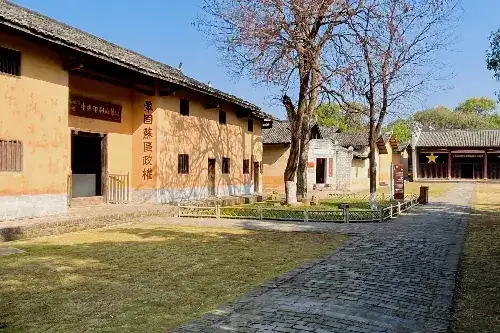
Jinggang Mountain Scenic Area: The "Cradle of the Chinese Revolution"—where Mao Zedong and Zhu De established the first rural revolutionary base in 1927. 10 national-level protected revolutionary sites. Called "the Number One Mountain Under Heaven" by Zhu De. Includes the Jinggang Mountain Revolution Museum, martyr memorial tower, Beishan stele forest, Red Fourth Army headquarters, former residences of Mao Zedong and Zhu De, and the five major sentry posts (Huangyangjie, Tongmuling, Shuangmashi, Bamianshan, Zhushachong).
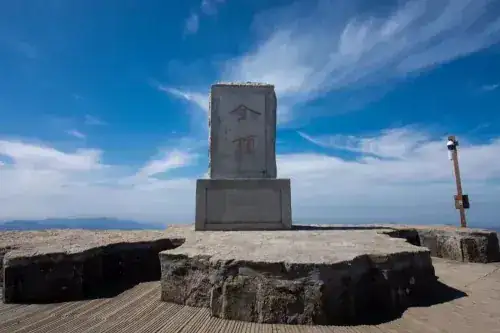
Wugong Mountain: In Anfu County, featuring three scenic areas: Santianmen, Guanyinyan, and Jinding (Golden Summit). Alpine meadow grasslands at high elevation—known as "grassland above the clouds."
Tanghu Hot Springs: In Suichuan County, surface temperature 84°C, natural flow 2,050 m³/day—the highest-temperature and largest-flow geothermal resource in Jiangxi.
Yushe Mountain: A Daoist sacred mountain in Xiajiang County with 32 named peaks, listed as the "17th Fa Le Cave Heaven" and "7th Yu Mu Blessed Land" in Tang Dynasty Daoist texts.
Luling Culture Ecological Park: A 5,000+ mu urban park showcasing Ji'an's traditional culture. Features include Wenxing Pagoda (originally built 1603), a 138m-high musical fountain, a 2,000-year-old camphor tree, and Jiangxi's largest Wanshou Palace.
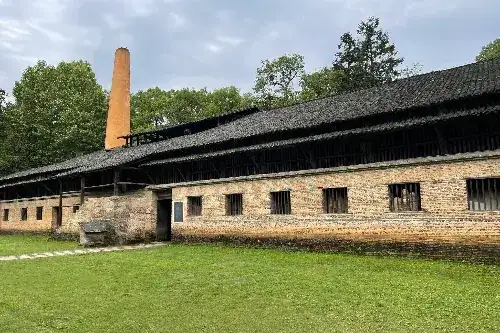
Jizhou Kiln: In Yonghe Town, 24 ancient kiln mounds across a 2 km² area—one of China's best-preserved ancient kiln sites.
Bailuzhou Academy: Founded in 1241 on Bailuzhou (Egret Islet) in the Ganjiang River. Built by Prefect Jiang Wanli to honor six Confucian masters including Zhu Xi. One of Jiangxi's four great academies, it produced Wen Tianxiang (the Song Dynasty patriot-statesman) and numerous other scholars.
Qingyuan Mountain Jingju Temple: Built in 741 CE, the Daoist/Buddhist site of Xingsi, founder of the Qingyuan school of Chan Buddhism. The temple gate bears calligraphy by Wen Tianxiang. The Qingyuan school influenced Japanese, Korean, and Southeast Asian Buddhism.
Famous Figures
From the Tang through Qing dynasties, Ji'an produced nearly 3,000 jinshi graduates and 52 top-three examination candidates (20 zhuangyuan). As a revolutionary base area, the city contributed enormously—50,000+ named revolutionary martyrs and 145 founding generals (ranking #1 among prefecture-level cities nationally).
Honorary Titles
National Health City (2012–2014), National Civilized City (2017), National Double Support Model City (2020, 2025), China Excellent Tourism City, National Forest City, National Garden City, National Volunteer Blood Donation Advanced City, China Top 100 Prefecture-Level Cities (#81 in 2019), National Urban Renewal Pilot City, Zero-Waste City Pilot, Ping'an China Construction Demonstration City.
Travel information can change. Check current opening hours, reservations and entry requirements before you travel.
Traveller discussion
Start the conversation with a helpful tip or a question.