
Ganzhou City
Ganzhou CityGanzhou, abbreviated as "Qian" and also called Qiancheng or Gannan, is a prefecture-level city in Jiangxi Province, a provincial sub-center city, Type II large city, and third-tier city. Located in southern Jiangxi at the southe
Ganzhou City
Ganzhou, abbreviated as "Qian" and also called Qiancheng or Gannan, is a prefecture-level city in Jiangxi Province, a provincial sub-center city, Type II large city, and third-tier city. Located in southern Jiangxi at the southern edge of the central subtropical zone, it has a subtropical hilly mountainous humid monsoon climate. The Zhang and Gong rivers converge in Ganzhou to form the Ganjiang River. Total area: 39,379.64 square kilometers—the largest prefecture-level city in Jiangxi by area (23.6% of the province). As of April 2026, the city administers 3 districts, 13 counties, and 2 county-level cities. As of the end of 2025, the permanent resident population was 8,956,200. Ganzhou is the "Holy Land of Yangming Learning," "World Tungsten Capital," "Rare Earth Kingdom," a key node city of the Belt and Road Initiative, a national comprehensive transportation hub, and a regional modernized central city connecting Jiangxi, Guangdong, Fujian, and Hunan. It is a revolutionary old area, former Central Soviet Area revitalization demonstration zone, and red cultural heritage innovation zone. In 2022, the State Council approved the "Ganzhou Revolutionary Old Area High-Quality Development Demonstration Zone Construction Plan." Ganzhou is known as the "Southern Song Dynasty City" and is a national-level Hakka Culture (Gannan) Ecological Reserve—the first stop of Hakka ancestors' southward migration from the Central Plains, the birthplace of the Hakka people, and one of their main settlements. Over 90% of the population is Hakka, giving it the title "Cradle of the Hakka People." The city has 600+ surviving Hakka enclosed houses (weiwu), called "the ancient Rome of the East." Six tourism brands: Red Capital, Hakka Cradle, Southern Song City, Ecological Home, World Orange Hometown, and Fengshui Holy Land. In 2025, GDP was 522.13 billion yuan, up 5.5%.
Name Origin
Ganzhou was anciently called "Qianzhou," derived from a tributary of the Ganjiang River called "Qianhua Water" (now the Gongjiang). In 1153, the Song Dynasty removed the "tiger head" radical from the character "Qian" (considered inauspicious after a military mutiny), keeping only the wen (literature) component, and combined it with the names of the Zhang and Gong rivers to create the character "Gan" (Gan)—hence "Ganzhou." An alternative theory links the character to the legendary "Gan Giant" from the Classic of Mountains and Seas.
History
Human habitation dates to the late Neolithic period (~5,000 years ago). The area was originally inhabited by the Baiyue people. In 214 BCE, the Qin Dynasty established Nanye County—the beginning of administrative governance in the Ganzhou area. In 201 BCE, the Western Han established Yuzhang Commandery with 3 counties in the Gannan area. In 236 CE, the Three Kingdoms Wu established the Southern Military Command. In 589, the Sui Dynasty (581–618) renamed it Qianzhou. In 1153, the Song Dynasty (960–1279) renamed it Ganzhou. In 1998, the State Council approved the conversion from Ganzhou Prefecture to the prefecture-level Ganzhou City, with the former county-level Ganzhou City becoming Zhanggong District. In 2013, Nankang became a district; in 2016, Ganxian became a district; in 2020, Longnan became a county-level city.
Administrative Divisions
As of April 2026: 3 districts (Zhanggong, Nankang, Ganxian), 13 counties (Xinfeng, Dayu, Shangyou, Chongyi, Anyuan, Dingnan, Quannan, Ningdu, Yudu, Xingguo, Huichang, Xunwu, Shicheng), 2 county-level cities (Ruijin, Longnan). 14 sub-districts, 150 towns, 132 townships, 628 communities, 3,436 villages. Government: Zhanggong District.
Geographical Environment
Location and Boundaries
Upper Ganjiang River, southern Jiangxi. Borders Fujian (Sanming, Longyan) to the east, Guangdong (Meizhou, Shaoguan) to the south, Hunan (Chenzhou) to the west, and Ji'an and Fuzhou (Jiangxi) to the north. Between 24°29′–27°09′N and 113°54′–116°38′E. North-south: 295 km; east-west: 219 km. Total area: 39,379.64 km². 423 km from Nanchang, 465 km from Guangzhou, 360 km from the Taiwan Strait.
Landforms
Surrounded by the Wuyi, Yushan, Zhuguang mountains and the Nanling range (Jiulianshan, Dayuling). The terrain is higher at the periphery and lower in the center, descending from south to north. Mountains and hills cover 80.98% (hills 61%, mountains 21.89%, with 50 red soil basins at 17%). 450 peaks above 1,000m. The highest is Qiyun Mountain's Dingguozhai (2,061m) at the junction of Chongyi, Shangyou, and Guidong (Hunan); the lowest at 82m in Ganxian's Hujiang Town.
Climate
Subtropical monsoon climate at the southern edge of the central subtropical zone. Characteristics: distinct seasons, mild climate, abundant heat, plentiful rainfall, short extreme heat/cold periods, long frost-free period. Average annual temperature: 19.8°C (Yudu highest at 20.8°C, Shicheng lowest at 19.1°C). Average annual precipitation: 1,318.9 mm (June peak: 254.3 mm average, 534.2 mm maximum). March–May: frequent cold-warm air convergence with severe weather. June: primary flood season. July–August: hot but without extreme heat. October–November: finest weather. Winter: late onset, light frost damage.
Hydrology
1,270 rivers of all sizes, total length 16,626.6 km, density 0.42 km/km². The Zhang and Gong rivers converge in Zhanggong District to form the Ganjiang, flowing north into Poyang Lake (Yangtze system). 100+ tributaries flow into the Pearl River's East River, North River, and the Hanjiang's Meijiang systems. Ganzhou is the source of both the Ganjiang and the East River.
Natural Resources
Water Resources
Multi-year average water resources: 33.57 billion m³ (per capita 3,900 m³, 70% above national average). Surface water: 32.753 billion m³; groundwater: 7.913 billion m³ (24.46% of total river flow). 53 hot springs (highest 79°C, largest flow at 50 L/s in Chongyi).
Forest Resources
31 forest parks (14.84 million hectares): 10 national (12.01 million ha), 21 provincial (2.83 million ha). Forest coverage: 76.2%.
Mineral Resources
62 mineral types: 10 non-ferrous, 10 rare metals (niobium, tantalum, rare earths, lithium, beryllium, zirconium, hafnium, rubidium, cesium, scandium), 4 precious metals (gold, silver, platinum, palladium), 4 ferrous (iron, manganese, titanium, vanadium), 25 non-metallic, and 5 fuel minerals. Ganzhou is the "World Tungsten Capital" and "Rare Earth Kingdom."
Biological Resources
2,298 plant species (220 families): 74 ferns, 29 gymnosperms, 2,195 angiosperms. 1,600–1,800+ woody species (134 families, 1,736 species). 124 rare/endangered species (40+ national Class I-III protected). 31 national key protected wild plant species (4 Class I, 27 Class II). Wildlife: 125 terrestrial protected animal species (48 national, 77 provincial). 336 economically valuable forest vertebrate species (29 orders, 86 families). 912 forest insect species (18 orders, 130 families), with 69 new species discovered.
Population
Population Numbers
As of end 2025: 8,956,200 (down 4,400). Urban: 5,397,800 (60.27% urbanization rate, up 1.39 percentage points). Birth rate: 6.20‰; death rate: 7.65‰; natural growth rate: -1.45‰.
Ethnic Composition
Predominantly Han. 41 ethnic minorities, with She being the largest. All 18 county-level areas have minority populations.
Politics
Economy
Overview
Ganzhou has 4 billion-yuan industrial clusters: modern home furnishing, non-ferrous metals and new materials, electronic information, and textiles/garments. It hosts Jiangxi's first central enterprise headquarters (China Rare Earth Group), and its rare earth new materials cluster became the province's first national advanced manufacturing cluster. In 2025, GDP was 522.13 billion yuan (up 5.5%). Primary: 49.97 billion (up 3.9%); secondary: 189.97 billion (up 6.9%); tertiary: 282.19 billion (up 4.8%). Fixed asset investment grew 4.6%. General public budget revenue: 33.39 billion (up 1.9%). Per capita disposable income: 33,813 yuan (up 5.2%); urban: 48,188 yuan; rural: 19,839 yuan.
Primary Industry
In 2025: agricultural output 81.214 billion yuan (up 4.3%). Grain sown area: 7.6642 million mu; grain output: 2.7334 million tonnes (up 1.5%). Vegetables: 5.0029 million tonnes; fruits: 3.0963 million tonnes (up 7.8%); tea: 6,600 tonnes. Meat: 838,400 tonnes; pork: 593,700 tonnes; pig inventory: 4.1076 million; slaughter: 7.0862 million.
Secondary Industry
In 2025: industrial value added 161.189 billion (up 8.4%). 3,117 above-designated-size enterprises, growing 9.2%. Manufacturing grew 11.4%; high-tech manufacturing grew 14.7% (31.3% of total); equipment manufacturing grew 15.0% (38.1% of total). Revenue: 561.22 billion (up 10.7%); profits: 27.058 billion (up 23.1%). Construction: 1,273 qualified enterprises, output 81.71 billion (up 2.7%).
Tertiary Industry
In 2025: service industry 282.195 billion (up 4.8%). Wholesale/retail: 51.632 billion (up 6.6%); financial: 31.533 billion (up 3.2%); real estate: 35.524 billion (up 2.2%). Retail sales: 235.242 billion (up 5.6%). Import/export: 127.205 billion (up 14.4%); exports: 79.124 billion (up 10.0%). Actual foreign investment: 93.2 million USD. Financial deposits: 935.236 billion (up 9.7%); loans: 975.443 billion (up 7.7%). Insurance premiums: 16.628 billion (up 4.8%). Tourism: 125 million domestic visitors (up 9.6%), revenue 130.461 billion (up 8.5%). Express delivery: 484.1255 million parcels (up 25.5%).
Social Undertakings
Science and Technology
As of end 2025: 2 national key laboratories, 19 provincial; 2 national engineering technology research centers, 29 provincial, 11 provincial technology innovation centers. Technology contracts: 9,191, valued at 38.062 billion yuan. 10,031 patents authorized (2,206 invention). 9,379 valid invention patents (up 25.7%). Chinese Academy of Sciences Ganjiang Innovation Institute located here.
Education
In 2025: 10,689 graduate students; 168,000 higher education students; 88,100 secondary vocational; 257,500 general high school; 423,400 junior high; 717,100 primary; 22,390 kindergarten. Nine-year compulsory education retention: 99.95%; high school gross enrollment: 96.68%.
Culture
As of end 2025: 20 cultural centers, 296 township cultural stations, 19 performing troupes, 20 public libraries (8.562 million books), 27 museums. National Class I libraries: Ganzhou City Library + 11 county/district libraries.
Healthcare
As of end 2025: 9,154 medical institutions (200 hospitals, 321 township health centers, 6,297 village clinics, 21 disease prevention centers, 21 maternal/child centers). 84,700 health workers (28,200 physicians, 44,600 nurses). 66,500 beds.
Sports
In 2025: 31 youth clubs (6 national, 13 provincial, 12 municipal). 614 top-3 finishes at major competitions. Ganzhou has 2 professional football clubs (Dingnan Gannan in China League One, Ganzhou Ruishi in China League Two). Ganzhou won the 2025 Jiangxi City Football Super League championship.
Social Security
In 2025: 72,100 new urban jobs. Employee pension: 2.16 million; resident pension: 4.1798 million; basic medical: 8.6289 million; unemployment: 708,200; work injury: 1.0858 million. 31,600 urban and 335,800 rural minimum living allowance recipients.
Environmental Protection
In 2025: air quality excellent 205 days, good 154 days, light pollution 6 days. Good rate: 98.4%. PM2.5: 21.3 μg/m³ (down 3.2%). All 26 national and 73 provincial monitoring sections achieved Class I-III water quality (100%).
Transportation
Ganzhou is positioned as a National Regional Center City and National Comprehensive Transportation Hub. Ganzhou International Land Port rated as a 5A-level land port. In 2025: highway freight 254.14 million tonnes (up 3.6%); 1.596 million civilian automobiles (1.501 million private).
Aviation
Ganzhou Huangjin Airport: 4D-level, Jiangxi's second-largest airport, in Fenggang Town. 28 routes to 32 cities (2024), 1.937 million passengers. Ganzhou Ruijin Airport: 4C-level, opened September 28, 2025, in Ruijin's Yeping Town.
Railways
Total railway operating mileage: 923 km (567 km conventional, 356 km 200+ km/h fast rail). Ganzhou West Station (HSR). In 2023: railway passengers 23.08 million (up 85.2%); freight 579,000 tonnes.
Highways
Expressway mileage: 1,842 km (1/4 of provincial total, #1 in Jiangxi). 39,613 km total highway mileage (about 1/5 of provincial total, #1 in Jiangxi). National highways 105, 323, 319, 206 form the trunk network. Expressways: G35 Jiguang, G45 Daguang, G76 Xiarong, G45 Daguang, G72 Quannan, S66 Ganzhao, G6011 Xinggan, S4503 Ganzhou Ring. Urban expressway: "Four horizontals, six verticals, one ring" (237.5 km total planned, 131.1 km completed by end 2025).
Waterways
Ganzhou Port (Wuyun Terminal): first 1,000-ton freight wharf opened December 2023, achieving Class III navigation from Ganzhou to Nanchang. Ganzhou-Guangdong Canal study passed review. Ganzhou Port is one of Jiangxi's 6 major ports, with 34 production berths (500-ton max capacity).
Public Transit
Ganzhou Public Transport Corporation (established October 1957): the only state-owned transit enterprise. 850 buses on 72 routes (as of 2018). 1,336 buses and 1,756 taxis (as of 2016).
Rail Transit
Ganzhou Metro plan (2017): 4 lines, 111 km total, 6 transfer stations, covering 1,165 km² of the central urban planning area (Zhanggong, Economic Development Zone, Rongjiang New Area, Ganxian, Nankang).
Historical Culture
Ganzhou is a National Famous Historical and Cultural City with 2,200+ years of urban history, historically a major political, economic, military, cultural, and transportation center in southern China. Wen Tianxiang, Zhou Dunyi, Hai Rui, Wang Yangming, Xin Qiji, and Chiang Ching-kuo all governed here. It is an important birthplace of Chan Buddhism, Neo-Confucianism, and Mind Learning (Xinxue). Xin Qiji's poem "Writing at Zaokou, Jiangxi," Zhou Dunyi's "On the Love of the Lotus," Mao Zedong's "Dabaidi," and Chen Yi's "Three Poems at Meiling" were all composed in Ganzhou.
Confucian Culture (Yangming Learning)
Wang Yangming pacified the Nanggan region and, after returning to Ganzhou, issued proclamations, established schools, implemented the "Ten-Household Card System" and "Nanggan Community Covenant," printed Confucian classics, and repaired Lianxi Academy (later renamed Yangming Academy). Ganzhou is the primary birthplace and transmission center of Yangming Mind Learning, with the richest collection of Wang Yangming's cultural relics: 9 steles, 22 academies/temples, 21 historic buildings, and 200+ literary works. Ganzhou Yangming Academy (No. 8 Xijin Road) is a professional institution for researching and transmitting Yangming's philosophy. Chongyi County built a museum to commemorate Wang Yangming.
Red Culture
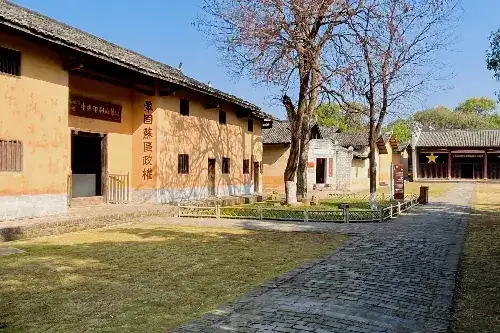
Ganzhou is a key birthplace of Mao Zedong Thought and a famous revolutionary old area. On November 7, 1931, the Chinese Soviet Republic was born in Ruijin's Yeping Village—"Red Capital" and "Cradle of the Republic." Mao Zedong, Zhu De, Zhou Enlai, and Deng Xiaoping all lived and fought here. The 25,000-li Long March started from here. The arduous Three-Year Guerrilla War was launched here. 108,000 named revolutionary martyrs (43% of Jiangxi's total, 7% of national total). Xingguo County alone had 23,719 martyrs—1.37 per kilometer of the Long March. 9 of 10 marshals and 7 of 10 senior generals lived and fought in the Gannan area. Ganzhou is one of China's 12 key red tourism areas.
Hakka Culture
Ganzhou is the first stop of the Hakka ancestors' southward migration, the birthplace of the Hakka people, and one of their main settlements. 95%+ of the population is Hakka—"Cradle of the Hakka People." 600+ surviving Hakka enclosed houses (weiwu)—"the ancient Rome of the East." Most representative: Guanxi Xinwei and Yanyi Wei (Longnan) and Dongsheng Wei (Anyuan). In 2013, the Ministry of Culture designated Ganzhou as a national-level "Hakka Culture (Gannan) Ecological Protection Experimental Zone."
Yao Culture
Quannan County's Yao flower-stick dance ("drumstick dance") originates from the "imperial audience" ritual—a traditional ethnic dance incorporating hunting, rice-sieving, tea-grinding, and bamboo-shoot-digging movements set to mountain songs.
Scenic Spots
Ganzhou has six tourism brands: Red Capital, Southern Song City, Hakka Cradle, Ecological Home, World Orange Hometown, and Fengshui Holy Land. The "Southern Song City" designation comes from being China's best-preserved Northern Song Dynasty city—walking through the ancient city is like visiting a "Song Dynasty Museum." Key attractions: Tongtian Rock ("First Grotto of Jiangnan"), the only surviving Song Dynasty inscribed-brick city wall, the ancient floating bridge (900+ years, 100 boats linked by iron chains), the ancient Fushou Gutter (China's only still-operational ancient sewer system), Bajing Tai (birthplace of the "Eight Views" cultural tradition), and Yugutai (where Xin Qiji composed his immortal poem).
Food Culture
Ganzhou navel oranges, Yudu roasted rolls, Hefeng pearl powder, Shayi board duck, Zishan soy sauce, Huichang dried tofu, Longnan chestnuts, Nankang sweet pomelos, Xunwu honey oranges, Xingguo grey geese, Hakka glutinous rice wine, Ningdu meatballs, Huangyuan rice cakes, and many other specialties. Famous dishes: Three-Cup Chicken, glutinous rice chicken, pan-fried duck, rice noodle fish, Ganzhou small-fried fish, fish cake, Hakka stuffed tofu, butterfly fish, Xingguo fish floss, bamboo-tube steamed intestines, folk clay pot soup, and "Four Stars Gazing at the Moon."
Sister Cities
Famous Figures
Honorary Titles
National Famous Historical and Cultural City (1994), China Excellent Tourism City (2003), China's Charming City (2008), World Orange Hometown, World Tungsten Capital, Rare Earth Kingdom, Hakka Cradle, National Civilized City, National Forest City, National Garden City, National Double Support Model City, World Fengshui Culture Origin, China Dinosaur Hometown, Hakka Culture (Gannan) Ecological Protection Experimental Zone, National Regional Center City, "Made in China 2025" Pilot Demonstration City, China Top 100 Cities (#84 in 2019, #88 in 2018), Chang'an Cup (2017, 2021), National Health City (2021), Zero-Waste City (2022), International Hakka Food City (2023), National Double Support Model City (2025).
Travel information can change. Check current opening hours, reservations and entry requirements before you travel.
Traveller discussion
Start the conversation with a helpful tip or a question.