
Yingtan City
Yingtan CityYingtan is a prefecture-level city in Jiangxi Province, named after the phrase "ripples swirl within, eagles dance above." It is an important member of the urban agglomeration in the middle reaches of the Yangtze River. Located
Yingtan City
Yingtan is a prefecture-level city in Jiangxi Province, named after the phrase "ripples swirl within, eagles dance above." It is an important member of the urban agglomeration in the middle reaches of the Yangtze River. Located in the transitional zone from the Wuyi Mountains to the Poyang Lake Plain, the terrain is higher in the southeast and lower in the northwest. The climate is subtropical humid monsoon, mild and temperate. Total area: 3,556.7 square kilometers. As of April 2026, the city administers 2 districts and 1 county-level city. As of the end of 2025, the permanent resident population was 1,145,000. In July 1983, Yingtan was elevated to a province-administered city. The city was an important ceramics production base during the mid-to-late Shang Dynasty (c. 1600–1046 BCE). The Shanghai-Kunming High-Speed Railway, Yingxia Line, Zhegan Line, and Wangan Line, along with the Shanghai-Kunming and Jiguang expressways and National Highways 320 and 206, intersect in a cross pattern through the urban area. Longhu Mountain within the city is the famous mountain depicted in the opening of the classic novel Water Margin—a World Natural Heritage Site, World Geopark, and national 5A tourist attraction. Taoist culture, heart-mind philosophy, Guiguzi culture, ancient Yue culture, and red revolutionary culture all converge here. Yingtan was also awarded the "China-Europe Green Smart City Award." In 2025, GDP was 145.941 billion yuan, up 6.2%.
History
Before the Western Zhou Dynasty (1046–771 BCE), the area belonged to Yangzhou. During the Spring and Autumn period (770–476 BCE), it was part of the Baiyue territory. During the Warring States period (475–221 BCE), it first belonged to Yue, then to Chu. In 221 BCE, the Qin Dynasty placed it under Jiujiang Commandery. In 201 BCE, the Western Han placed it under Yuhang County. In 194 CE, it was under Luling Commandery. In 210 CE, under Poyang Commandery.
In 291 CE, the Western Jin established Jinxing County from the Jinxing canton of Yuhang, covering present-day Yuehu District, Guixi City, and Yujiang District. In 313, it was renamed Xing'an County, but was soon abolished and restored to Yuhang's Jinxing canton. During the Southern Dynasties (560–566), Anren County was established. During the Sui Dynasty (581–618), Anren was abolished. In 765 CE, the Tang Dynasty (618–907) established Guixi County from the western part of Yiyang County and the northeastern part of Yugan County, which included the Yingtan ward (present-day Yuehu District). In 1864, during the Qing Dynasty (1644–1912), Yingtan was established as a town—the beginning of its town-level administration. From then until the Republic of China era, it remained a town under Guixi County. In 1914, Anren County was renamed Yujiang County (to avoid name duplication with Anren County in Hunan). On May 4, 1949, the area was liberated. In 1957, Yingtan Town was elevated from Guixi County to a county-level town. In 1979, it was established as a city. In July 1983, it was elevated to a prefecture-level city.
Administrative Divisions
In 1996, Guixi County became a county-level city. In May 2018, Yujiang County became Yujiang District. As of April 2026: 2 districts (Yuehu, Yujiang), 1 county-level city (Guixi), plus Longhu Mountain Scenic Area, Yingtan High-Tech Industrial Development Zone, and Xinjiang New Area. 34 towns/townships and 9 sub-districts. Government: Economic Building, Yuehu District.
Geographical Environment
Location and Boundaries
Yingtan is in northeastern Jiangxi, in the middle and lower reaches of the Xinjiang River, between 27°35′–28°41′N and 116°41′–117°30′E. It faces three deltas (Pearl River, Yangtze, and Minnan) and is an important channel connecting inland areas to the southeast coast. Total area: 3,556.7 km² (2.15% of Jiangxi). 143 km by rail from Nanchang.
Landforms
Transitional zone from the Wuyi Mountains to the Poyang Lake Plain, descending from southeast to northwest. Four landform zones: southeastern mid-mountains, northern mid-high hills, western mid-low hills, and the central Guixi Basin. The highest peak is Yangjikeng (1,540.9m) in Guixi's Zhangping Township; the lowest is at 16m in the Xinjiang River valley at Tuanhu Village, Yujiang District.
Climate
Subtropical humid monsoon climate with abundant rainfall, ample sunlight, long frost-free period, and four distinct seasons. Average annual temperature: 18°C. Extreme minimum: -9.3°C; extreme maximum: 41.0°C. Average humidity: 76%. Annual rainfall: 1,750 mm. Frost-free period: 262 days. Annual sunshine: 1,749.9 hours. Prevailing winds: easterly and northeasterly.
Hydrology
Rivers belong to the Poyang Lake system of the Yangtze basin. The Xinjiang River (72 km) is the largest, flowing through Guixi, Yuehu, and Yujiang. Main tributaries include the Baita, Luotang, Tongjia, Bailu, and Sili rivers. 12 second-class rivers (425 km total) and 3 third-class rivers (44.5 km total).
Natural Resources
Water Resources
Multi-year average surface water: 4.122 billion m³. Groundwater (shallow): 629 million m³. Total annual water supply: 1.069 billion m³ (1.047 billion surface + 22 million groundwater).
Mineral Resources
17 mineral types discovered: 4 metallic (placer gold, vein gold, silver, lead-zinc), 8 non-metallic (ceramic clay, silica, gypsum, limestone, refractory clay, talc, vein quartz, pitchstone), plus uranium and mineral water. Advantageous minerals: silver (5,454 tonnes retained), lead (1.558 million tonnes), zinc (2.233 million tonnes), gypsum (45.226 million tonnes). The silver-lead-zinc mine in Lengshui Town, Guixi, covers 35 km² with 9,400 tonnes of silver, 3.5 million tonnes of lead-zinc, and annual production of 23 tonnes of silver.
Animal Resources
364 vertebrate species (4 classes, 33 orders, 94 families): 18 fish, 33 amphibians, 56 reptiles, 207 birds, 50 mammals. 5 national Class I protected species (black muntjac, leopard, Chinese merganser, Cabot's tragopan, white-necked long-tailed pheasant) and 34 Class II protected species. 1,568 invertebrate species including 1,281 insect species.
Plant Resources
1,847 higher plant species (244 families, 848 genera): 266 bryophytes, 123 ferns, 13 gymnosperms, 1,445 angiosperms. 15 nationally protected wild plant species including southern yew, Bretschneidera sinensis, and Torreya grandis.
Population
As of the end of 2025: 1,145,000 (down 774). Urban: 788,000 (68.82% urbanization rate, up 1.26 percentage points). Birth rate: 5.06‰; death rate: 7.62‰. 34 ethnic minorities totaling ~4,600 (0.35%), with She being the largest (3,200+).
Politics
Economy
Overview
In 2025, GDP was 145.941 billion yuan (up 6.2%). Primary: 7.887 billion (up 2.7%); secondary: 74.536 billion (up 8.3%); tertiary: 63.518 billion (up 4.1%). Structure: 5.4:51.1:43.5. Per capita GDP: 127,413 yuan (~$17,838 USD). General public budget revenue: 11.833 billion (up 4.0%). Fixed asset investment grew 4.4%. Urban per capita disposable income: 50,424 yuan (up 4.4%); rural: 26,231 yuan (up 5.6%).
Primary Industry
In 2025: agricultural output 13.078 billion yuan (up 3.0%). Grain sown area: 125,700 hectares; grain output: 1.387 billion jin (693,500 tonnes), exceeding 1.3 billion jin for 15 consecutive years. Vegetables: 350,900 tonnes (up 4.5%); fruits: 85,800 tonnes; tea: 1,083 tonnes. Meat: 107,800 tonnes (down 7.7%). Pig slaughter: 1.1455 million; inventory: 620,200. Aquatic products: 62,600 tonnes (up 2.6%).
Secondary Industry
In 2025: above-designated-size industry grew 11.1%. Copper industry grew 12.3%, non-copper 3.8%. Non-ferrous metal smelting grew 22.8%, computer/communications 5.5%, metal products 10.0%. Industrial parks: 679 enterprises, revenue 459.363 billion (up 12.6%), profits 16.743 billion (up 20.8%). Construction: 161 qualified enterprises, output 9.975 billion (down 40.3%).
Tertiary Industry
In 2025: service industry 63.518 billion (up 4.1%). Wholesale/retail: 15.121 billion (up 5.2%); financial: 6.546 billion (up 6.8%); IT: 2.061 billion (up 6.1%); leasing/business services: 6.979 billion (up 10.2%). Retail sales: 36.707 billion (up 4.2%). Import/export: 53.322 billion (up 13.3%); exports: 15.099 billion (up 31.2%). Actual foreign investment: 64 million USD (up 27.9%). Financial deposits: 207.726 billion; loans: 229.733 billion. 3 A-share listed companies. Insurance premiums: 2.376 billion (up 3.9%).
Social Undertakings
Science and Technology
In 2025: 10 provincial science projects, 3 provincial science awards. 1,493 patents authorized (327 invention). 759 technology contracts valued at 9.067 billion yuan. 21 provincial engineering technology research centers (2 national), 6 provincial+ maker spaces (1 national). 573 technology-based SMEs, 285 high-tech enterprises.
Education
As of end 2025: 443 schools (3 higher education, 8 secondary vocational, 95 general secondary, 52 nine-year schools, 94 primary, 3 special education, 188 kindergartens). Students: 16,200 higher ed, 84,400 secondary, 77,900 primary, 22,700 kindergarten. 8078 secondary teachers, 3789 primary teachers.
Culture
As of end 2025: 5 museums (11,300 artifacts), 4 public libraries (820,200 books), 4 cultural centers, 45 cultural stations, 15 performing troupes. 100% broadcast and TV coverage.
Healthcare
As of end 2025: 1,024 medical institutions (33 hospitals, 36 health centers), 9,952 health workers (3,385 physicians, 5,256 nurses), 7,511 beds (5,725 in hospitals).
Sports
As of end 2025: 14 stadiums, 3 fitness centers. 180 citywide fitness events. 5,463 social sports instructors, 2,172 registered athletes. Hosted 3 national and 5 provincial events.
Social Security
In 2025: 17,971 new urban jobs, 14,309 rural labor transfers. Employee pension: 369,400; resident pension: 529,400; employee medical: 183,500; resident medical: 949,200; unemployment: 124,900; work injury: 163,000; maternity: 113,000. 5,756 urban and 30,473 rural minimum living allowance recipients. 878 new affordable housing units (100% commencement rate).
Transportation
Yingtan has rail, road, and water transport. Three railway trunk lines cross the city: Zhegan, Wangan, and Yingxia. Yingtan Station is a special-grade passenger station with 140+ daily train stops. Two expressways (Shanghai-Kunming 56 km, Jinan-Guangzhou 42 km) and two national highways (320 at 60.5 km, 206 at 50.0 km) serve the city. As of end 2025: total highway mileage 5,512.73 km (101.4 km expressways). 289,200 motor vehicles. 364 public buses, 505 taxis. 100% village bus coverage. In 2025: 10.4961 million passengers; 92.3324 million tonnes freight.
Historical Culture
Daoist Culture
Longhu Mountain is the birthplace of Chinese Daoism, where Zhang Daoling (the first Celestial Master) refined elixirs. According to the Longhu Mountain Annals, the 4th-generation Celestial Master Zhang Sheng returned here and built an ancestral shrine. The Orthodox Unity Temple (Zhengyi Guan) was originally built in 1105 and reconstructed multiple times through the Ming Dynasty (1368–1644). The Celestial Master's Mansion (Tianshi Fu) in Shangqing Town is the historical residence of the Celestial Masters, first built in 1368 and rebuilt multiple times, with surviving structures from the Ming and Qing dynasties.
Cultural Sites
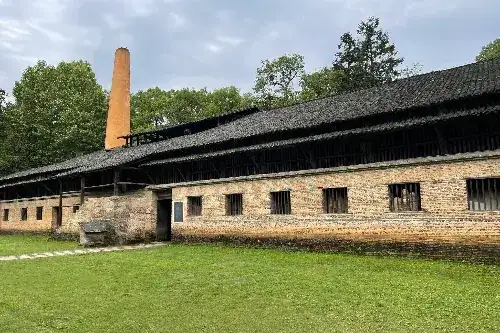
The Jiaoshan Kiln Site is a highly specialized ancient pottery production site from the Shang Dynasty, with counting symbols indicating large-scale production and exchange. Its excavation provides definitive kiln-source evidence for Shang Dynasty ceramics in the Fujian-Zhejiang-Jiangxi border region. The Celestial Master's Mansion is the historical residence of successive Celestial Masters of Daoism.
Scenic Spots
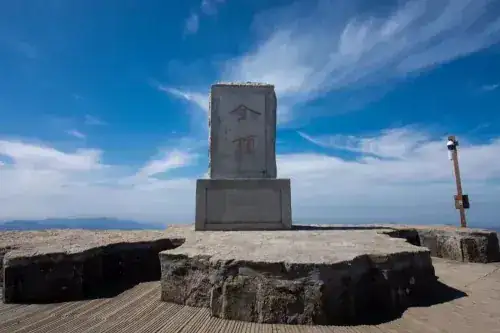
Longhu Mountain Cold Water Grand Canyon: 100 km² ecological tourism area on the upper Luxi River, with 20 km canyon (120m drop), 8 km rafting route (~90 minutes). Longhu Mountain Scenic Area: 16 km southwest of Yingtan, a World Natural Heritage Site, World Geopark, national 5A scenic area, and the ancestral mountain of Daoism. Four wonders: Danxia landform beauty, Daoist sage heritage, ancient Yue cliff burials, and yin-yang mystery. Other attractions include the Schistosomiasis Prevention Memorial Hall (national patriotism education base), Sanyang Cave, and Jiquan Peak.
Specialty Foods
"Longhu Mountain Daoist Dish" is the most distinctive dried vegetable in Jiangxi—sour, sweet, crisp, salty, and spicy. Guixi Nacai (pressed vegetables), Guixi Dengxin Cake (a 400-year-old brand from the Ming Dynasty), Yujiang dried eggplant (500+ years history, won the 1997 Jiangxi New Product Gold Award), and palace-style walnut pastry cakes. In April 2018, Yingtan was designated "Hometown of Chinese-style Pastries (Walnut Cakes)" at the first China (Yingtan) Chinese-style Pastry Expo.
Famous Figures
Zou Taofen (1895–1944), a renowned cultural standard-bearer after Lu Xun, was from Yujiang. His former residence remains well-preserved.
Honorary Titles
China Excellent Tourism City, National Science and Technology Progress Advanced City, National Forest City, National Garden City, National Intellectual Property Pilot City, China's Top 100 Foreign Trade Cities, National Double Support Model City (2025).
Travel information can change. Check current opening hours, reservations and entry requirements before you travel.
Traveller discussion
Start the conversation with a helpful tip or a question.