
Jingdezhen City
Jingdezhen CityJingdezhen is a prefecture-level city in Jiangxi Province, located in the northeastern part of the province. It borders Dongzhi County (Anhui) to the northwest, Wannian County to the south, Poyang County to the west, Qimen Co
Jingdezhen City
Jingdezhen is a prefecture-level city in Jiangxi Province, located in the northeastern part of the province. It borders Dongzhi County (Anhui) to the northwest, Wannian County to the south, Poyang County to the west, Qimen County (Anhui) to the northeast, and Wuyuan County to the southeast. Total area: 5,256 square kilometers. As of October 2022, the city administers 2 municipal districts, 1 county-level city, and 1 county. As of the end of 2024, the permanent resident population was 1,617,983, with an urbanization rate of 67.92%. Jingdezhen was established as a town during the Eastern Jin Dynasty (317–420), initially called "Changnan," later renamed "Xinping." In 1004 CE, during the Jingde reign of Emperor Zhenzong of the Northern Song Dynasty (960–1279), it was named "Jingdezhen" after the emperor's reign name, and the name has been used ever since. Jingdezhen is the "Porcelain Capital of the World," the cradle of China's helicopter industry, one of the first National Famous Historical and Cultural Cities, the World City of Handicraft and Folk Art, and a National Ecological Civilization Demonstration City. On July 25, 2026, the "Jingdezhen Historic Porcelain Industry Sites" were inscribed on the UNESCO World Heritage List. In 2025, GDP was 118.963 billion yuan, down 0.7%.
History
The area belonged to the Chu State during the pre-Qin period. During the Qin Dynasty (221–206 BCE), it was under Jiujiang Commandery. During the Han Dynasty (206 BCE–220 CE), it was under Yuzhang Commandery's Poyang County. The town was established during the Eastern Jin Dynasty, initially called "Changnan," later renamed "Xinping," under Jiangzhou. In 621 CE, the Tang Dynasty (618–907) established Xinping County. In 742, it was renamed Fuliang. In 1004, during the Jingde reign of Emperor Zhenzong, the town was named "Jingdezhen" after the reign name, under Fuliang County of Raozhou. The name has been used continuously since then. In 1949, Jingdezhen was liberated and separated from Fuliang County to become a city. In 1953, it was designated a province-administered city of Jiangxi.
Administrative Divisions
Divisional History
In 1960, Fuliang County was abolished and incorporated into the city. In 1983, Leping County was placed under Jingdezhen. In 1988, Fuliang County was restored. In 1992, Leping County became a county-level city. In 2019, the Jingdezhen National Ceramic Culture Inheritance and Innovation Pilot Zone was established.
Division Status
As of October 2022: 2 districts (Zhushan, Changjiang), 1 county-level city (Leping), 1 county (Fuliang). Government: No. 666 Cidu Avenue, Changjiang District.
Geographical Environment
Location and Boundaries
Jingdezhen is in northeastern Jiangxi, in the transitional zone between the Huangshan-Huaiyushan foothills and the Poyang Lake Plain. Between 116°57′–117°42′E and 28°44′–29°56′N. Total area: 5,256 km².
Landforms
Hilly terrain in the transitional zone between mountain foothills and the Poyang Lake Plain—typical Jiangnan red soil hilly area. Urban elevation: 32m. The terrain slopes from northeast to southwest. The highest peak is at 1,618m on the Anhui border near Xiuning.
Climate Characteristics
Subtropical monsoon climate with abundant sunlight, plentiful rainfall, mild and humid conditions, and four distinct seasons. Average annual temperature: 17.8°C. Average annual rainfall: 1,805 mm. Extreme maximum: 41.8°C; extreme minimum: -10.9°C. Spring: variable weather with prolonged rain. Summer: concentrated rainfall during the Meiyu season (May–July averages 200–350 mm), with frequent heavy rain and flooding risk; post-Meiyu period is hot and humid under subtropical high pressure. Autumn: mild with less rain. Winter: cold under Siberian/Mongolian high pressure with prevailing north winds.
River Systems and Hydrology
The Changjiang River is the largest river flowing through Jingdezhen, with the Xihe and Nanhe rivers as important tributaries. The Changjiang originates in the mountains at the Jiangxi-Anhui border, flowing roughly north-south into Poyang Lake. Historically, the Changjiang was Jingdezhen's most important external transportation route.
Natural Resources
Plant Resources
Forest coverage: 70%. Vegetation is primarily subtropical evergreen broadleaf forest, with main tree species including Chinese fir, Masson pine, slash pine, chinquapin, sweet chinquapin, Castanopsis, oak, sweetgum, camphor, Schima, and moso bamboo. Protected species include southern yew, ginkgo, Minnan phoebe, red nanmu, Cephalotaxus, and Paris polyphylla. 39,000+ registered ancient and notable trees across 80+ groups.
Animal Resources
20+ national Class I and II protected species. Class I (4 species): clouded leopard, leopard, black muntjac, and white-necked long-tailed pheasant. Class II: macaque, stump-tailed macaque, pangolin, Asian black bear, large Indian civet, small Indian civet, silver pheasant, mandarin duck, and golden pheasant.
Mineral Resources
44 mineral types discovered across 9 categories, 36 with proven reserves, 16 listed on the reserves table, 222 occurrences. Characteristic advantageous minerals (all ranking #1 in Jiangxi): sepiolite clay (100% of provincial reserves), manganese (100%), decorative marble (80.52%), bentonite (62.61%), and ceramic clay (19.22%). Jingdezhen is one of Jiangxi's three major coal production bases. Mineral distribution: gold/tungsten/tin in the north; coal/limestone/marble/ceramic clay/kaolinite/dolomite/tungsten/molybdenum/copper/lead/zinc in the center; gold/manganese/silver/lead/zinc/glass quartz sandstone/coal/limestone in the south.
Ceramic raw material resources are abundant, including clay, quartz, and auxiliary mineral types. 40 ceramic raw material deposits discovered (2 large, 21 medium, 12 small, 3 occurrences). Total retained ceramic raw material reserves: 108,838 kilotonnes, including ceramic clay (19,261 kt) and kaolinite (5,578 kt).
Population
As of the end of 2024: 1,617,983 (up 1,286). Urban: 1,098,874 (67.92% urbanization rate, up 0.41 percentage points). Birth rate: 6.28‰; death rate: 6.97‰; natural growth rate: -0.69‰.
Politics
Economy
Overview
In 2024, GDP was 117.930 billion yuan (up 4.1%). Primary: 7.875 billion (up 1.1%); secondary: 48.468 billion (up 5.2%); tertiary: 61.587 billion (up 3.6%). Structure: 6.7:41.1:52.2. Per capita GDP: 72,916 yuan (approximately $10,239 USD). General public budget revenue: 9.053 billion (up 0.3%). Fixed asset investment grew 4.2%. Urban per capita disposable income: 51,340 yuan (up 3.7%); rural: 25,262 yuan (up 5.9%). Urban-rural ratio: 2.03 (narrowed by 0.05). Energy consumption per 10,000 yuan GDP decreased 2.4%.
Primary Industry
In 2024: agricultural output 13.641 billion yuan (up 1.5%). Grain sown area: 95,824 hectares; grain output: 565,175 tonnes (up 0.6%). Tea output: 15,035 tonnes (up 7.5%). Meat: 57,275 tonnes (down 6.0%); pork: 45,532 tonnes; beef: 2,144; mutton: 1,127; poultry: 8,472. Eggs: 14,743 tonnes (up 18.2%). Aquatic products: 30,775 tonnes (down 3.1%).
Secondary Industry
In 2024: industrial value added grew 5.6%; above-designated-size industry grew 6.2%. By ownership: joint-stock +6.0%, foreign/HK/Macao/Taiwan +10.7%. By advantage industry: fine chemicals and biopharmaceuticals +7.8%, refrigeration compressors and home appliances +24.3%, helicopter and general aviation +3.3%, automobiles and parts +17.2%. Revenue: 137.055 billion (up 3.4%); profits: 4.882 billion (up 3.7%). Construction: 150 qualified enterprises, output 6.061 billion (up 3.6%).
Tertiary Industry
In 2024: service industry value added 61.587 billion yuan (up 3.6%). Wholesale/retail: 13.893 billion (up 7.2%); transportation/warehousing/postal: 4.811 billion (up 2.6%); accommodation/catering: 3.085 billion (up 9.6%); financial: 6.832 billion (up 3.6%); real estate: 5.971 billion (down 1.9%); IT: 2.863 billion (up 6.5%); leasing/business services: 3.809 billion (up 13.6%). Retail sales: 44.402 billion (up 4.4%). Import/export: 7.234 billion (down 44.5%). Actual foreign investment: 24 million USD (down 29.0%). Financial deposits: 223.721 billion; loans: 205.938 billion. Tourism: 39.0191 million visitors, revenue 37.266 billion.
Transportation
Transportation Overview
Jingdezhen has the Wangan Railway, four expressways (Hangrui, Jingying, Dechang, Jingwuhuang), and Jingdezhen Airport (one of China's 100 key regional airports), forming a comprehensive transportation network.
Expressways: G56 Hangrui (east-west), G35 Jiguang (north-south), Jingwuhuang (tourism route), plus National Highway 206. The city is a Jiangxi railway hub with the Wangan Railway (electrified, 200–250 km/h), Jiu-Jing-Qu Railway (200 km/h, opened 2017, connecting to Shanghai in 4 hours), and Anjing Railway (connecting to Anqing, Anhui).
Waterways: The Changjiang River and Le'an River. The Changjiang (Class 5 navigable from urban area to Poyang Huanggang Town) and Le'an River (Class 3–5 from Leping to Wannian Shizhen Town) provide water transport. Historically the world's busiest waterway segment for porcelain transport, the Changjiang's role has diminished due to shallowness and competition from rail/road.
Jingdezhen Airport: 4C-level, in Luojia Village, Hongyuan Town, Fuliang County, ~6 km from downtown. Expanded in 1996, with 500,000 annual passenger capacity. In February 2023, the Fuliang General Aviation Airport began trial operations.
Transport
In 2024: freight volume 23.29 million tonnes (up 5.4%); freight turnover 6,259,860,000 ton-km (up 10.8%). Passenger volume 15.02 million (down 7.2%); passenger turnover 487,190,000 person-km (up 0.3%).
Social Undertakings
Education
In 2024: secondary vocational enrollment 6,135 (17,589 total); general high school 15,910 (46,992 total); junior high 26,491 (77,582 total); primary 17,774 (128,851 total); special education 60 (304 total); kindergarten 38,646. Senior high gross enrollment rate: 96.9%. Notable: Jingdezhen Ceramic University.
Culture
In 2024: 853 performing arts shows (1.31 million audience); 5 public libraries (1.7229 million books).
Sports
In 2024: 3,593 athletes participated in competitions; 312 medals won at provincial and above (93 gold, 86 silver, 133 bronze).
Healthcare
As of end 2024: 1,437 medical institutions (52 hospitals), 17,472 health workers (14,249 technical, including 5,061 physicians and 4,307 nurses), 12,158 beds (10,532 in hospitals, 937 in township health centers). Annual outpatient visits: 10,073,384; discharges: 348,433.
Social Security
As of end 2024: employee pension 554,000; resident pension 560,800; basic medical insurance 1,538,000; unemployment insurance 122,500; work injury insurance 201,800; maternity insurance 172,800. 22,733 urban and 40,246 rural residents received minimum living allowance; 3,247 received rural special hardship support; 7,180 received temporary assistance.
Environmental Protection
In 2024: good air quality days 98.4%; surface water Class II or better: 100%; centralized drinking water compliance: 100%.
Safety Production
In 2024: 19 safety production accidents (17 traffic, 2 industrial/mining), 17 fatalities (15 traffic, 2 industrial/mining).
Historical Culture
Overview
Jingdezhen is the world-renowned "Porcelain Capital" with a long history of ceramics production. Historical records note that "Xinping began pottery in the Han era." From the Yuan Dynasty (1271–1368) through the Ming and Qing dynasties, emperors dispatched officials to Jingdezhen to oversee imperial porcelain production, establishing porcelain bureaus and imperial kilns.
Porcelain History
Jingdezhen has long been known as the "Porcelain Capital." Its porcelain is celebrated for elegant forms, diverse varieties, rich decoration, and unique style—characterized as "white as jade, bright as a mirror, thin as paper, and resonant as a chime." The four great traditional porcelain types are blue-and-white (qinghua), linglong (rice-pattern), fencai (famille rose), and colored glaze porcelain.
Historically, Jingdezhen porcelain was renowned not only domestically but also internationally. From 1405, Zheng He's seven maritime expeditions carried large quantities of Jingdezhen porcelain. Japanese ceramic archaeologist Mikami Tsugio documented ancient Chinese ceramic exports across Asia and Africa in his book "Ceramic Road," calling the Maritime Silk Road the "Ceramic Road"—the ancient international trade route for Jingdezhen porcelain.
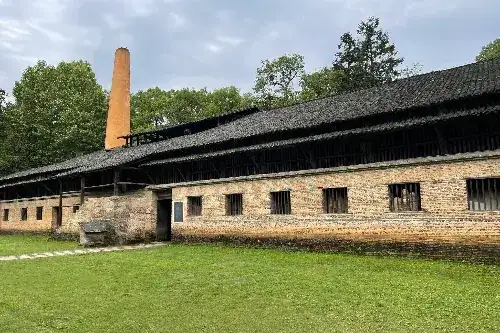
On July 25, 2026, the "Jingdezhen Historic Porcelain Industry Sites" were inscribed on the UNESCO World Heritage List.
Historical Sites
City Flower and City Tree
In 1985, the camphor tree was designated as the city tree—symbolizing the long history of the porcelain capital and the renewal of the ancient city. The camellia was designated as the city flower, with over 60 varieties including the prized "Chidan" and "Xishi Face" varieties, rare in China.
Scenic Spots
Jingdezhen is one of China's first National Famous Historical and Cultural Cities, a National Key Tourist Attraction, and a China Excellent Tourism City. It has 1 national 5A scenic area (Jingdezhen Ancient Kiln Folk Customs Expo Area), 6 national 4A areas (Yaoli Scenic Area, Fuliang Ancient County Government, Hongyen Fairyland, Deyu Ecological Park, Jinxiu Changnan China Porcelain Garden, Taoxichuan Cultural and Creative District), and 3 national 3A areas.
Local Specialties
Jingdezhen cuisine features spicy flavors. Three signature local snacks: cold rice noodles (lengfen), rice dumpling cakes (jiazi ba), and alkaline water rice cake (jianshui ba). Other specialties: Jingdezhen crispy chicken, chili paste cakes, and Leping dog meat.
Famous Figures
Notable ceramic artists include Liu Yucen (1904–1969), Yang Haisheng (1922–1970), Zeng Longsheng (1900–1964), and the "Eight Friends of Zhushan" group. Contemporary arts and crafts masters: Wang Xiliang, Zhang Songmao, Qin Xilin, Tang Ziqiang, Liu Yuanchang, and others.
Honorary Titles
Travel information can change. Check current opening hours, reservations and entry requirements before you travel.
Traveller discussion
Start the conversation with a helpful tip or a question.