
Nanchang City
Nanchang CityNanchang, abbreviated as Hong or Chang, is a prefecture-level city, the capital of Jiangxi Province, and a Type I large city. Located in the central-northern part of Jiangxi, at the lower reaches of the Ganjiang and Fuhe rivers
Nanchang City
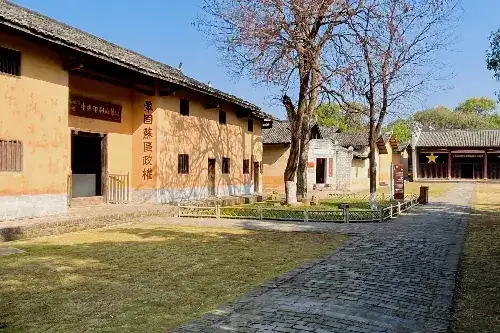
Nanchang, abbreviated as Hong or Chang, is a prefecture-level city, the capital of Jiangxi Province, and a Type I large city. Located in the central-northern part of Jiangxi, at the lower reaches of the Ganjiang and Fuhe rivers and the southwestern shore of Poyang Lake, with predominantly flat terrain descending from northwest to southeast. The climate is subtropical monsoon with four distinct seasons and abundant rainfall. Total area: 7,194.98 square kilometers. As of the end of 2024, the city administers 6 districts and 3 counties, with a permanent resident population of 6,670,400. Nanchang is a National Famous Historical and Cultural City, established in 202 BCE by Western Han general Guan Ying. Over its 2,200+ years, it has been known as Yuzhang, Hongzhou, and Longxing. The name "Nanchang" was fixed in the Ming Dynasty (1368–1644), meaning "southern prosperity" and "flourishing the southern frontier." Nanchang is the political, economic, scientific, educational, and cultural center of Jiangxi. It is the only provincial capital city adjacent to the Yangtze River Delta, Greater Bay Area, and West Coast Economic Zone. It is the birthplace of the People's Liberation Army, with 30+ revolutionary sites. The city boasts 600+ cultural relics, including Tengwang Pavilion, Wanshou Palace, and the Han Dynasty Haihun Marquis Tomb Site. In 2025, GDP was 814.169 billion yuan, up 4.7%.
Name Evolution
In 202 BCE, Western Han general Guan Ying built the city, initially called Guan Ying City. Over 2,200+ years, it was known by various names. The name "Nanchang" was fixed in the Ming Dynasty, meaning "southern prosperity." The Haihun Marquis Tomb excavation yielded a bronze lamp inscribed with "Nanchang," providing the earliest physical evidence of the name. The Marquis Liu He, formerly Prince of Changyi, may have called his former Shandong territory "North Changyi" and his current Jiangxi capital "South Changyi" (Nanchangyi), hence the name.
History
Human activity dates back ~500,000 years. By the Neolithic period (~5,000 years ago), inhabitants cultivated rice and fished. During the Spring and Autumn period (770–476 BCE), it was "the head of Wu and the tail of Chu." In 202 BCE, the Western Han established Yuzhang Commandery with Nanchang as its seat. In 589, the Sui Dynasty (581–618) established Hongzhou. The Tang Dynasty (618–907) saw Hongzhou flourish as one of Jiangnan's most prosperous cities. In 959, the Southern Tang elevated it to Nanchang Prefecture and briefly moved the capital here. The Song, Yuan, Ming, and Qing dynasties maintained it as a key administrative center. In 1926, the city of Nanchang was formally established. On May 22, 1949, Nanchang was liberated. In 2019, Honggutan District was established and Wanli District was merged into Xinjian District.
Administrative Divisions
As of October 2024: 6 districts (Donghu, Xihu, Qingyunpu, Qingshanhu, Xinjian, Honggutan), 3 counties (Nanchang, Anyi, Jinxian). Government: No. 118 Xinfu Road, Honggutan District.
Geographical Environment
Location and Boundaries
Central-northern Jiangxi, at the lower Ganjiang and Fuhe rivers, southwestern shore of Poyang Lake. Between 115°27′–116°35′E and 28°10′–29°11′N. North-south: ~121 km; east-west: ~108 km. Total area: 7,194.98 km².
Climate
Subtropical monsoon climate: warm and humid, abundant sunshine, long summer/winter, short spring/autumn. Average annual temperature: 17.1°C (spring 17.5°C, summer 28.2°C, autumn 20.9°C, winter 6.3°C). Extreme maximum: 40°C; extreme minimum: -15.2°C. Average annual rainfall: 1,559.8 mm (47.55% in April–June). Average annual sunshine: 1,723–1,820 hours (40% rate). Frost-free period: 251–272 days. Average wind speed: 2.3 m/s.
Geology
Located on the southern margin of the Yangtze Stratigraphic Region's "Jiangnan Old Land" and its transition with the South China Stratigraphic Region. Complex geological structure with well-developed faults and rift basins. Exposed strata from the Pre-Sinian to Quaternary, mostly covered by Quaternary sediments.
Landforms
Located on the Ganjiang-Fuhe alluvial plain, with terrain descending from northwest to southeast. Five geomorphic units: tectonic-erosional low mountains, high hills, low hills, denudation ridges, and valley alluvial plains. Plains dominate (35.8%), with water area at 29.78% (top 3 among provincial capitals). The highest peak is Xiyaojian at 841.4m in Meiling; the lowest at 12.79m.
Hydrology
Nanchang is a water city—"seven gates, nine districts, eighteen slopes, three lakes, nine channels connect to the Gan and Poyang." The Ganjiang, Fuhe, Yudaihe, Jinjiang, and Liaohe rivers cross the city. Numerous lakes include Qinghu, Junshanhu, Jinxi, Yao, Baisha, and hundreds more. Urban lakes: four outside (Qingshan, Aixi, Xianghu, Huangjia) and four inside (Donghu, Xihu, Nanhu, Beihu).
Soil
7 main soil types: paddy soil, red soil, fluvo-aquic, red clay, purple soil, new alluvial, and mountain meadow. Red soil is the dominant zonal type.
Natural Disasters
Nanchang is one of China's more disaster-affected provincial capitals, with frequent floods (June–July), wind/hail (late March), and droughts (August–December). 335 geological disasters recorded by end 2020 (253 landslides, 82 collapses), all small-scale with zero casualties.
Natural Resources
Water Resources
In 2023: surface water 7.4192 billion m³ (+19.7%); groundwater 1.42252 billion m³; total 7.80606 billion m³ (+18.5%). Hydropower: theoretical 72,700 kW; developable 24,500 kW.
Biological Resources
2,099 vascular plant species (1,726 wild). 30 nationally protected plant species (1 Class I, 15 Class II). 489 terrestrial wildlife species: 23 Class I (including Chinese pangolin, milu deer, small Indian civet, Siberian crane), 78 Class II, 359 "three-have" protected species. 381 bird species (112 winter migrants, 47 summer, 58 passage, 164 resident). 59 nationally protected bird species (11 Class I, 48 Class II).
Mineral Resources
18 mineral types, mainly non-metallic building materials (granite, quartz, limestone, ceramic clay, river sand). Geothermal and mineral water resources are notable. 6 types with proven reserves, 11 occurrences (2 medium, 9 small).
Land Resources
Per the third national land survey: arable land 251,945.47 ha (3.7792 million mu, 89% in Nanchang/Jinxian/Xinjian); orchard 13,437.8 ha; forest 118,201.73 ha; grassland 5,130.02 ha; wetland 2.73 million mu (25.3% of total, 56% natural wetland protection rate).
Politics
Population
Population Numbers
As of end 2024: 6,670,400 (up 102,200). Urban: 5,329,600 (79.9% urbanization rate). Birth rate: 6.01‰; death rate: 5.51‰; natural growth rate: 0.5‰.
Ethnic Groups
52 ethnic minorities, ~20,000 indigenous minority residents. Mainly in Donghu, Xihu, Qingshanhu, and Qingyunpu districts. The only minority natural village is Lanjia She Village in Jinxian (78 people). Floating minority: 25,000+ (mainly Hui, Uyghur, Dongxiang).
Language
Nanchang dialect is a representative of Gan Chinese, called "a living fossil of ancient Chinese language." However, dialect attrition and Mandarin-ization have led to endangered status. The city's dialect can be divided into four types: Nanchanghua, Xinjianhua, Jinxianhua, and Anyihua.
Religious Beliefs
5 major religions: Buddhism, Daoism, Christianity, Catholicism, Islam. 590 registered religious venues, 1,273 clergy. 226 Buddhist venues (219 clergy), 137 Daoist (781), 1 Islamic (2), 10 Catholic (9), 216 Protestant (262).
Economy
Overview
Nanchang is an important central city in eastern China and the Yangtze Middle Reaches urban cluster—the only provincial capital adjacent to the Yangtze Delta, Pearl River Delta, and Minnan Golden Triangle. GDP grew from ~200 billion to 800+ billion (2012–2025), ranking 15th among provincial capitals. In 2025, GDP was 814.169 billion yuan (up 4.7%). Primary: 26.168 billion (up 3.2%); secondary: 338.113 billion (up 5.5%); tertiary: 449.888 billion (up 4.2%). Structure: 3.2:41.5:55.3.
Primary Industry
In 2024: agricultural output 45.181 billion yuan (up 3.1%). Grain sown area: 342,900 ha; grain output: 2.1378 million tonnes. Meat: 314,600 tonnes. Aquatic products: 478,600 tonnes. Afforestation: 973 ha. Forest coverage: 21.3%. 13 national "One Village, One Product" demonstration villages, 2 national agricultural industry towns, 2 national specialty industry clusters.
Secondary Industry
Nanchang created many Chinese manufacturing "firsts": first aircraft, first coastal defense missile, first motorcycle, first wheeled tractor. Key industries: electronic information, automobiles, food, new materials. 3 national-level development zones, 1,300+ above-designated-size industrial enterprises. In 2024: above-designated-size industry grew 10.2%. 12 of 35 industry categories grew above 10%. High-tech manufacturing grew 15.8%; equipment manufacturing grew 18%. Revenue: 717.086 billion (up 8.3%); profits: 24.347 billion (up 23%). 3 national development zones: Nanchang High-Tech Zone (351.942 billion revenue), Economic Development Zone (105.361 billion), Xiaolan Economic Development Zone (101.185 billion). Construction: 1,593 qualified enterprises, value added 91.263 billion (up 1.2%).
Tertiary Industry
Finance is a pillar industry; Honggutan Financial Business District is the core area for building a regional financial center. In 2024: service industry 427.349 billion (up 3.2%). Wholesale/retail: 72.295 billion (up 4%); financial: 67.773 billion (up 2.3%); IT: 23.724 billion (up 2.4%). Retail sales: 284.767 billion (up 3.7%). Import/export: 108.981 billion (down 2.1%); exports: 72.334 billion (down 8.2%). Actual foreign investment: 167 million USD. Financial deposits: 1,811.152 billion (up 4.9%); loans: 2,070.207 billion (up 4.1%). Insurance premiums: 33.313 billion (up 5.6%). Tourism: 225 million visitors (up 18.1%), revenue 208.084 billion (up 5.2%). Express delivery: 1.247 billion parcels (up 29.7%).
Social Undertakings
Education
As of 2024: 50 general higher education institutions, 3 adult, 25 general secondary, 17 vocational high, 77 general high, 252 junior high, 338 primary, 1,033 kindergartens. Special education: 9 schools, 1,297 students. Notable: Nanchang University, Jiangxi University of Finance and Economics, Jiangxi Normal University.
Healthcare
As of end 2024: 3,681 medical institutions (158 hospitals), 47,900 beds (41,900 in hospitals), 64,700 health workers (24,500 physicians). Annual outpatient visits: 36.8497 million.
Science and Technology
As of end 2024: 4 national engineering technology research centers, 5 national key laboratories; 113 provincial engineering centers, 142 provincial key labs, 13 technology innovation centers. 14,808 patents authorized. Technology contracts: 11,337, valued at 66.656 billion (up 70.4%). 42 provincial industry technology innovation alliances.
Culture
In 2024: 29 provincial+ awards (14 national). 4 performing troupes, 10 public libraries, 10 cultural centers, 28 museums/memorials, 10 national key cultural heritage units.
Sports
In 2024: 324 gold, 253 silver, 276 bronze medals. 6,196 fitness events with 320,000 participants. Sports lottery: 2.852 billion yuan (up 9.6%).
Environmental Protection
As of 2022: 2 national ecological civilization demonstration cities/counties, 18 national ecological towns. Air quality good days: 313 (85.8%, 2nd among 6 central provincial capitals). Urban green coverage: 43.15%; per capita park green: 13.18 m². Industrial energy consumption per 10,000 yuan: down 8.7%.
Social Security
In 2024: employee medical insurance: 1.5595 million (up 31,400); unemployment: 1.1657 million (up 27,000); employee pension: 3.0879 million. 105 welfare institutions with 16,200 beds.
Transportation
Overview
Nanchang has formed a modern water-land-air transportation network. 6 major wharves, Changbei International Airport, Nanchang Railway Station and Nanchang West Station, long-distance bus terminals, and a metro system. The "1688" project (2022) accelerates modern comprehensive transportation construction.
Highways
3 national highways (105, 320, 316) intersect in Nanchang, connecting to 6 neighboring provinces. 29 road routes totaling 967.75 km (285.353 km national, 682.398 km provincial). 203 bridges (16,845.1 linear meters). Expressway ring network connects all suburban counties with ~30-minute travel time to central towns.
Railways
Nanchang is a major railway hub connecting the Shanghai-Kunming HSR, Changji-Gan HSR, and Chang-Jiu intercity, forming a "1-hour HSR economic circle" with 10 Jiangxi cities and a "3-hour economic circle" with Hong Kong, Shanghai, Guangzhou, and Shenzhen. 3 main passenger stations: Nanchang Station (built 1935), Nanchang West (opened 2013, HSR), and Nanchang East (opened 2023, Chang-Jing-Huang HSR). Nanchang International Land Port: 4,166 international freight trains over 6 years, 240,400 TEU, ~$6.602 billion cargo value. Routes to Netherlands, Russia, Belarus, France, Ukraine, Poland, Vietnam, and Laos; plus 10 sea-rail intermodal routes.
Aviation
Nanchang Changbei International Airport (4E level, 97,000 m² terminal, 45 parking positions, handles Boeing 747, capacity 12 million passengers). 93 cities, 158 routes, 49 airlines. In 2022: 4.7246 million passengers, 40,159 tonnes cargo. Nanchang Yaohu Airport (4D, A1 general aviation, opened 2018): 3,600m runway, 100 parking positions. Home to China's first drone aviation operating license and Jiangxi's airworthiness certification center.
Waterways
Nanchang Port: at the Ganjiang's lower reaches, connecting the Yangtze Delta, Pearl River Delta, and Minnan economic zones. One of China's 28 major inland river ports. In 2022: 28.236 million tonnes cargo throughput, 116,000 TEU. 30 water transport enterprises.
Public Transit
Metro: 4 lines operating (1–4), ~160.2 km, 113 stations. Connects airport, HSR stations, and city center with "zero transfer." In 2022: 4,340 buses on 402 routes, 105 depots. 60.83% public transit share, 91.77% satisfaction. 2,139 new energy buses (49.28% of fleet). 12 major cross-river channels (9 road, 3 rail). "Ten Bridges Simultaneously" project: 10 new bridges under construction. 8 completed tunnels including the 2,997m Honggu Tunnel (China's largest underwater interchange system).
Humanities
Overview
Designated a National Famous Historical and Cultural City in 1986 (2nd batch). 50+ national/provincial/municipal key cultural heritage units. Notable historical figures: Linglun (originator of Chinese music), Xu Ruzi (Han Dynasty scholar), Xu Xun (founder of Jingming Daoism, water management expert), Bada Shanren/Zhu Da (Ming-Qing freehand painting master). 600+ cultural relics, 18 cultural landscapes, 26 natural landscapes. 3 "Chinese Folk Culture and Art Hometowns."
Cuisine
Nanchang cuisine is the mainstream and most typical branch of Jiangxi cuisine (Gan cuisine). Features: spicy, tender, crisp, with abundant ingredients and many snacks. Main ingredients: pork, poultry, river fish, and wild vegetables (especially Poyang Lake artemisia). Representative dishes: Three-Cup Dog Meat, Yuzhang Crispy Duck, Five-Element Dragon-Phoenix Soup. Famous snacks: rice noodles, Shitou Street fried dough, white sugar cake, meat-filled flatbread, rice paste, and various braised foods.
Customs
Dragon Boat Racing: The 2024 Nanchang International Dragon Boat Race featured 42 teams and 1,200+ athletes. The tradition dates back over 1,000 years to commemorate three stone-transport officials who sacrificed their lives fighting floods.
Bridge-Pillar Touching: During Mid-Autumn Festival, women traditionally gathered at Gaoshi Bridge to touch its stone pillars, praying for fertility—a custom that faded after the bridge was demolished.
Face-Opening: The day before a wedding, the bride's face was thoroughly cleaned and hair removed using a silk thread technique, shaping the eyebrows into willow-leaf curves.
Intangible Cultural Heritage
As of 2019: 126 intangible cultural heritage items. National-level: Nanchang porcelain plate painting, Shangban Gongguan lantern, Xishan Wanshou Palace temple fair. Provincial: Anyi suona, Dichang work songs, Xinjian Desheng drums, and others.
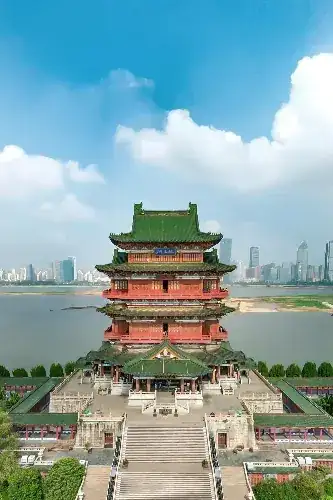
Tengwang Pavilion: One of the "Three Great Towers of Jiangnan," built in 653 CE by Prince Teng Li Yuanying. Made immortal by Wang Bo's Preface to the Tengwang Pavilion—"the sunset clouds and a lone wild goose fly together; the autumn waters share a boundless hue with the sky." National 5A scenic area since 2018.
Nanchang Desheng Drums: Also called "Eighteen Variations," a unique folk percussion art with 18 traditional movements (Dragon Raises Head, Dragon Soars, Charging Head, Return Dragon, etc.), performed with long-hide drums, gongs, cymbals, and small gongs.
Cultural Relics
2,000+ immovable cultural relics, 50+ ancient sites, 70+ national/provincial/municipal key protected units. Shengjin Pagoda: Built in the Tang Dynasty (904–907 CE), 1,100+ years old, Nanchang's "treasure of the city." Haihun Marquis Tomb Site: China's largest, best-preserved, and richest Han Dynasty marquis state settlement site, providing comprehensive historical data for studying Western Han marquis city-building systems.
City Symbols
City flower: Chinese rose (yueji, "monthly red") and gold-edged Daphne (jinbian ruixiang), one of the world's three horticultural treasures—"Peony has the nation's color and heavenly fragrance; Daphne's gold edge is the finest." City tree: camphor tree, planted in Nanchang since before the Han Dynasty, a natural "air purifier."
Scenic Spots
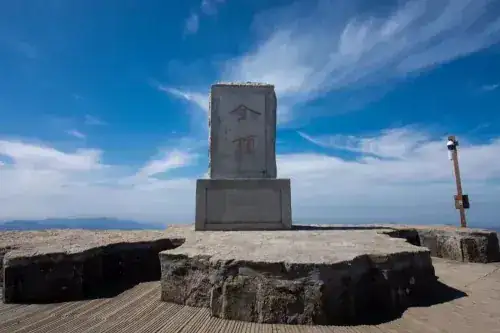
Nanchang's "Ten Views of Yuzhang": Tengwang Pavilion (5A), Poyang Lake, Meiling, Shengjin Pagoda, Bayi Square, Nanchang Star (Ferris wheel), Baihua Island, Yaohu, Qingyunpu, and Nanchang August 1st Uprising Memorial. The city features four scenic districts: Dongjing/Yaohu water entertainment (east), Bada Shanren cultural tourism (south), Meiling/Mengshan resort (west), and Poyang Lake bird watching (north).
Anyi Ancient Village Group (4A): 120+ Ming-Qing era courtyard houses across 464 hectares. Phoenix Valley (4A): 8 km² modern ecological agriculture demonstration park.
Cultural Landmarks
Tengwang Pavilion: One of the Three Great Towers of Jiangnan, built in 653 CE. National 5A scenic area. Wanshou Palace Historical Cultural Block: 123 buildings (118 Qing Dynasty Gan-style), 45 historical buildings, 80 mu site, 146,000 m² total area. Connects to Metro Lines 1 and 3. Haihun Marquis Tomb Site: 3.6 km² city site, the largest and best-preserved Han Dynasty marquis state settlement in China.
External Exchange
Nanchang has established 40 sister/exchange city relationships across 5 continents since 1984 (starting with Skopje, North Macedonia). Active in Belt and Road cultural exchange and tourism promotion.
Famous Figures
Important Honors
Travel information can change. Check current opening hours, reservations and entry requirements before you travel.
Traveller discussion
Start the conversation with a helpful tip or a question.