
Ma'anshan City
Ma'anshan CityMa'anshan City, a prefecture-level city under Anhui Province, is located in eastern Anhui along the lower Yangtze River. It borders Nanjing to the east, Chuzhou to the north, Hefei to the west, and Wuhu and Xuancheng to the so
Ma'anshan City
Ma'anshan City, a prefecture-level city under Anhui Province, is located in eastern Anhui along the lower Yangtze River. It borders Nanjing to the east, Chuzhou to the north, Hefei to the west, and Wuhu and Xuancheng to the south. The total area is 4,044 square kilometers, with terrain dominated by the Yangtze alluvial plain under a northern subtropical humid monsoon climate. As of February 2025, the city administers 3 districts and 3 counties, with the municipal government at 2008 Taibai Avenue, Yushan District. As of end 2024, the permanent resident population is 2.201 million. The city's name derives from a legend in which the warlord Xiang Yu's horse saddle fell and turned into a mountain, or from the local terrain resembling a saddle. Ma'anshan was established as a town in 1954, a county-level mining district in 1955, and a city in October 1956. The city's Yangtze River culture is long-standing, complemented by Li Bai poetry culture and modern industrial culture. Known for "nine mountains encircling one lake, an emerald snail emerging from the great river," the city has 34 A-level scenic areas, including the Caishi Scenic Area (5A) and nine 4A-level areas. Ma'anshan is well-connected, 45 km north of Nanjing and 40 km south of Wuhu, with river-sea intermodal port transport. The city hosts the Ma'anshan Comprehensive Bonded Zone, a national cross-border e-commerce pilot zone, and the Anhui Free Trade Zone Ma'anshan Linked Innovation Area. The economy is industry-driven, covering 36 of 41 industrial categories and 30 of 31 manufacturing categories. In 2025, the city achieved a regional GDP of 292.09 billion yuan (approximately $40.3 billion), up 6.0%.
History
During the Western Zhou Dynasty, the Ma'anshan area belonged to the State of Wu. During the Spring and Autumn and Warring States periods, it came under the State of Yue and then the State of Chu. From the Qin to the Western Jin, it was part of Danyang County (present-day Danyang Town, Bowang District).
In 329 (Eastern Jin), refugees from Danyang County near the Huai River migrated south, and Dangtu County was provisionally relocated to the Nanling area. In 345, the northern province of Yuzhou was relocated to Niuzhu (present-day Caishi). In 502 (Southern Dynasty, Liang), Nan Danyang Commandery was established with its seat at Caishi. In 589 (Sui), Dangtu County was moved to Gushu City (present-day Dangtu town center), where it has remained. In 977 (Northern Song), Taiping Prefecture was established, governing Dangtu, Wuhu, and Fanchang counties. In the Yuan dynasty, it became Taiping Route. In 1355, Zhu Yuanzhang captured Dangtu and renamed it Taiping Prefecture. The Ming and Qing maintained this jurisdiction.
In 1912, after the Xinhai Revolution, the prefecture was abolished and Dangtu County came directly under Anhui Province. During the War of Resistance Against Japanese Aggression, local forces established the Wanjiang Anti-Japanese Base. On January 29, 1949, Hanshan was liberated. On January 30, He County town was liberated. On April 20, the People's Liberation Army launched the Crossing-the-River Campaign. On April 24, the Jianghuai Military Region's Fifth Sub-area crossed the river from He County to the Ma'anshan mining area, liberating Dangtu.
In February 1954, Ma'anshan Town was established under Dangtu County. In August 1955, a county-level mining district government was set up under Wuhu Prefecture. On October 12, 1956, the State Council approved Ma'anshan as a provincially administered city. In July 1983, Dangtu County was placed under Ma'anshan. In August 2011, Hanshan and He counties (formerly under Chaohu City) were transferred to Ma'anshan. In 2012, Jinzhuang and Huashan districts were merged into the new Huashan District, and Bowang District was established.
Administrative Divisions
As of February 2025, Ma'anshan administers 3 districts and 3 counties: Huashan District, Yushan District, Bowang District, Hanshan County, He County, and Dangtu County. The municipal government is seated at 2008 Taibai Avenue, Yushan District.
Geography
Location and Extent
Ma'anshan is located in eastern China, in eastern Anhui Province, straddling both banks of the Yangtze River between 117 degrees 53 minutes and 118 degrees 52 minutes east longitude, and 31 degrees 24 minutes and 32 degrees 2 minutes north latitude. It borders Nanjing's Pukou, Jiangning, Lishui, and Gaochun districts to the east, Chuzhou's Quanjiao County to the north, Hefei's Chaohu City to the west, and Wuhu and Xuancheng districts to the south. Total area: 4,044 square kilometers.
Topography
The city lies in the lower Yangtze alluvial plain, in the central-southern section of the Ningwu fault basin. The terrain is generally flat with a slight north-high, south-low gradient. The highest elevation is 458.8 meters at Hengshan, on the border between Bowang District and Nanjing's Lishui District. Along the northwestern riverside, a series of arc-shaped low hills runs northeast-southwest: Cilao Mountain, Ma'anshan Mountain, Baibi Mountain, Wangfu Mountain, Baoji Mountain, and Cuiluo Mountain.
Hydrology
Major rivers include the Yangtze, Cihu, Caishi, Yushan, Liufen, Guxi, Qingshan, Huangchi, Yunliang, Danyang Xin, and Bowang rivers, all part of the Yangtze system. Lakes include Shijiu, Danyang, Shuangtan, and Yushan lakes. The total water area is approximately 360 square kilometers.
Climate
Ma'anshan has a subtropical humid monsoon climate with distinct seasons. Average annual precipitation is 1,060.7 mm with 129 rainy days. Annual sunshine averages 1,838.3 hours. The mean annual temperature is 16.1 degrees Celsius, with extreme highs of 38.1 and lows of -5.9 degrees. Average wind speed is 3.3 meters per second, and annual evaporation is 1,502.8 mm.
Natural Resources
Mineral Resources
Ma'anshan has identified 40 mineral types, including 9 metallic and 29 non-metallic minerals, with proven reserves for 27 types. It is one of China's seven major iron ore producing areas. Main resources include iron ore, pyrite, gold, gypsum, limestone, feldspar, vanadium pentoxide, alunite, kaolin, and mica. Iron ore is the primary resource, with mines at Nanshan, Gushan, and Huangmeishan.
Animal Resources
Over 200 wild animal species are found, including 166 bird species, 89 fish species, 18 mammal species, 14 reptile species, and 9 amphibian species. Notable species include woodpeckers, red-crowned cranes, Chinese sturgeon, Chinese alligator, and finless porpoise. Introduced species include freshwater pacu, California bass, and channel catfish.
Plant Resources
The city has 167 families, 641 genera, and 1,442 plant species, including ferns, gymnosperms, and angiosperms. Nationally protected species cultivated include ginkgo, dawn redwood, golden larch, tulip tree, and Chinese cork tree.
Population
Population Size
As of end 2024, the permanent resident population is 2.201 million, up 10,000 from the previous year. The birth rate is 5.82 per thousand, death rate 7.12 per thousand, and natural growth rate -1.29 per thousand. The urbanization rate is 74.4%, up 0.78 percentage points.
Ethnic Composition
Ma'anshan is home to 43 ethnic minorities, with the Hui population of approximately 13,000, accounting for 65% of the total minority population.
Politics
The municipal government operates under the Ma'anshan Municipal People's Congress, with administrative functions carried out through district and county-level governments.
Economy
Overview
In 2025, Ma'anshan achieved a GDP of 292.09 billion yuan (approximately $40.3 billion), up 6.0% year-on-year. The primary, secondary, and tertiary sectors contributed 11.37 billion yuan (approximately $1.57 billion), 120.64 billion yuan (approximately $16.6 billion), and 160.08 billion yuan (approximately $22.1 billion), respectively.
In 2024, the GDP was 278.46 billion yuan (approximately $38.4 billion), up 6.0%. The industrial structure ratio was 4.1:43.4:52.5. Per capita GDP was 126,806 yuan (approximately $17,500). Fixed asset investment grew 7.1%. General public budget revenue was 21.684 billion yuan (approximately $2.99 billion), up 4.1%. General public budget expenditure was 36.752 billion yuan (approximately $5.07 billion), up 14.7%.
Primary Industry
In 2024, grain was planted on 2.661 million mu, with output of 1.098 million tons, up 1.3%. Rice output was 806,000 tons, up 1.2%. Vegetable output was 961,000 tons, up 3.7%. Aquatic products reached 133,000 tons, up 4.0%. Hog slaughter was 432,000 head, down 5.2%.
Secondary Industry
Ma'anshan was established around its steel industry and remains a major industrial city, covering 36 of 41 industrial categories and 30 of 31 manufacturing categories. The city has developed a "1+3+N" industrial cluster: one national-level advanced structural materials cluster led by high-quality specialty steel, three provincial-level clusters (intelligent equipment manufacturing, energy conservation, and green food), and N city-level clusters.
In 2024, industrial value added was 87.92 billion yuan (approximately $12.1 billion), up 6.0%. Above-scale industrial value added grew 6.2%. Equipment manufacturing grew 20.6%, with automobile manufacturing up 28.8% and electronics up 43.9%. High-tech manufacturing grew 38.9%. Construction value added was 33.88 billion yuan (approximately $4.7 billion), up 8.9%, with 408 qualified enterprises.
Tertiary Industry
In 2024, total retail sales of consumer goods reached 110.403 billion yuan (approximately $15.2 billion), up 5.4%. Communications equipment sales doubled and new energy vehicle sales grew 86.4%. Wholesale and retail trade value added was 30.85 billion yuan (approximately $4.26 billion), up 9.4%. Transportation, warehousing, and postal services reached 14.62 billion yuan (approximately $2.02 billion). Finance was 10.17 billion yuan (approximately $1.40 billion). Other services reached 69.36 billion yuan (approximately $9.57 billion), up 6.7%.
Tourism revenue totaled 40.73 billion yuan (approximately $5.62 billion), up 9.7%. Total foreign trade was 47.085 billion yuan (approximately $6.50 billion), up 7.6%, with exports of 29.894 billion yuan (approximately $4.13 billion), up 34.2%. Financial institution deposits reached 387.865 billion yuan (approximately $53.5 billion), and loans 374.106 billion yuan (approximately $51.6 billion).
Social Services
Education
As of end 2024, the city has 554 schools: 300 kindergartens, 144 primary schools, 100 secondary schools, 4 special education schools, and 6 higher education institutions. There are 11 provincial demonstrative high schools and 5 national key vocational schools. Non-tertiary schools have 294,000 students and 25,000 staff. Infant childcare slots number 5.1 per 1,000 population, ranking third in the province.
Science and Technology
In 2024, 128 specialized and new enterprises were recognized, including 3 national "little giant" enterprises. The city built 10 provincial-level or above key laboratories and 314 innovation platforms, and attracted 7,734 high-level talents. Per 10,000 people, high-value invention patent ownership was 20.4, up 25.2%. Above-scale industrial enterprises ranked first in the province for R&D coverage.
Culture
The city hosted the 2nd Yangtze River Culture Forum and the 36th Li Bai Poetry Festival. There are 7 public libraries with 3.267 million volumes and 7 comprehensive archives covering 41,000 square meters. National Class I libraries include the Ma'anshan Municipal, Dangtu County, Huashan District, He County, and Hanshan County libraries.
Healthcare
The city has 1,164 healthcare institutions, including 66 hospitals (4 Grade-A tertiary), 38 township health centers, and 423 standardized village clinics. There are 18,389 health workers, including 7,221 licensed physicians and 8,757 registered nurses, with 16,268 beds.
Sports
In 2024, Ma'anshan won 279 medals at provincial competitions, including 81 gold. The city hosted over 10 national-level events. Fifty-eight schools opened their sports facilities to the public.
Social Security
In 2024, per capita disposable income was 55,216 yuan (approximately $7,616), up 5.3%. Urban residents earned 65,635 yuan (approximately $9,054) and rural residents 34,990 yuan (approximately $4,825). The city created 46,000 new jobs, with registered urban unemployment at 2.5%. Social assistance covered 680,000 person-times. Pension insurance covered 821,000 urban workers and 910,000 rural-urban residents, with a 99.7% participation rate. Medical insurance covered 1.456 million rural-urban residents and 661,000 workers.
Environmental Protection
In 2024, the average PM2.5 concentration was 33.2 micrograms per cubic meter, the best on record with the largest improvement in the province. Good air quality days reached 81.7%. Water quality maintained its "six 100%" standards, and the Wujiang monitoring section achieved Class I ammonia nitrogen levels for the first time.
Transportation
Overview
Ma'anshan sits at the geometric center of the Yangtze River Delta, serving as a "dual-circle city" in the Nanjing and Hefei metropolitan areas. In 2024, passenger transport reached 15.53 million trips, up 8.8%, and freight transport 202.48 million tons, up 12.3%. Port cargo throughput was 128.06 million tons, with container throughput at 166,000 TEU, up 3.9%. Civil automobile ownership reached 422,000, including 326,000 private cars.
Highways
Major expressways include the North Yangtze, Wuhe, Ningma, and Ningwu (G4211) expressways, plus national and provincial routes G347, S328, S210, S213, S442, and S205. In 2024, the Ningma Expressway was expanded from four to eight lanes. Total highway mileage is 7,858 km, including 194 km of expressways.
Railways
Railways passing through include the Ning-Tong, Ningma Intercity, Ning'an Intercity, Ningwu, Huainan, Hefu High-Speed, Shanghehang High-Speed, and the Zhengpugang Railway spur.
Water Transport
The Yangtze River flows through the city, enabling river-sea intermodal transport. The port system features a "one river, two banks, nine channels" layout centered on the Ma'anshan Port central and Zhengpugang areas. The Ma'anshan multimodal transport project was designated a "National Multimodal Transport Demonstration Project." Ma'anshan Port is a major inland port handling iron ore, steel, coal, and containers, with 57.145 km of planned shoreline. In 2023, the port handled over 133 million tons of cargo, up 14.85%, maintaining 100-million-ton port status for the eighth consecutive year. Foreign trade throughput was 10.897 million tons, ranking first in the province.
Public Transportation
The city operates 24 customized bus routes for schools, tourism, medical, and commuting, plus 14 "responsive stop" routes, with over 150 age-friendly bus stop upgrades. As of May 2025, there are 18 cross-boundary bus routes totaling over 500 km, with 13 connecting to Nanjing and 1 to Wuhu. In April 2026, the Nanjing Metro Line S2 (Ma'anshan Rail Transit Ningma Line) began operation, marking the city's first rail transit line.
History and Culture
Origin of the Place Name
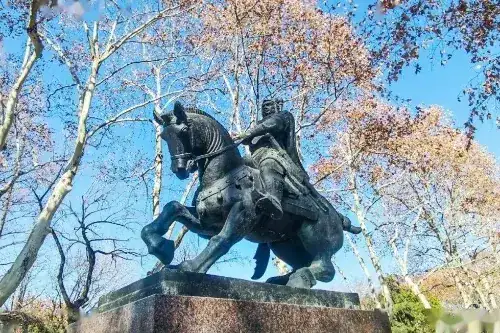
Legend holds that during the Chu-Han War, the warlord Xiang Yu, defeated at Gaixia and pursued to the Wu River in He County, asked a fisherman to ferry his beloved horse Wuzhui across. Ashamed to face his people, Xiang Yu took his own life. The horse, missing its master, rolled and died, and its saddle fell and turned into a mountain, giving Ma'anshan ("Saddle Mountain") its name. The earliest written record appears in the Ming dynasty "Taiping Prefecture Gazetteer."
Historical Relics
Yangtze River culture in Ma'anshan dates back approximately 300,000 years, when the Hexian Man lived here, recognized as a representative of southern Homo erectus. The Lingjiatan Site in Hanshan County, dating back 5,800 to 5,300 years, is celebrated as the "dawn of Chinese civilization."
Folk Culture
The city preserves folk traditions connected to its Yangtze River heritage and Li Bai poetry culture, with local customs and festivals reflecting the region's blend of industrial and literary influences.
City Flower and City Tree
Osmanthus is the city flower, widely planted with peak blooming from mid-September through National Day. The camphor tree is the city tree, beloved by residents as a symbol of longevity and good fortune.
Local Specialties
Local specialties reflect the region's agricultural abundance from the Yangtze River basin, including freshwater fish, crab, and regional agricultural products.
Scenic Spots
Overview
In 2023, tourism revenue reached 37.15 billion yuan (approximately $5.13 billion). The city has 5 star-rated hotels and 33 A-level scenic areas (1 at 5A, 8 at 4A level). Ma'anshan has 79.12 km of Yangtze River shoreline and is part of the Yangtze National Cultural Park (Anhui section). Recent projects include the Yangtze Night City, Lingjiatan Study Town, and Caishi Scenic Area, complemented by events like the Caishiji Yangtze Music Festival and Caishiji Half Marathon.
Main Attractions
Key attractions include the Caishi Scenic Area (5A), the Lingjiatan Site, the Jilong Mountain-Banyue Lake Scenic Area, and other 4A-level areas. The Caishiji area is renowned for its connection to the poet Li Bai and its dramatic riverside landscape.
Notable Figures
Ma'anshan has produced notable historical and contemporary figures across literature, military, and industry, reflecting its rich cultural heritage along the Yangtze River.
Honorary Titles
Ma'anshan has received various national and provincial honorary titles for urban development, environmental protection, and cultural preservation.
External Relations
The city maintains external cooperation ties through its Comprehensive Bonded Zone, cross-border e-commerce pilot zone, and participation in the Anhui Free Trade Zone, facilitating international trade and economic exchange.
Travel information can change. Check current opening hours, reservations and entry requirements before you travel.
Traveller discussion
Start the conversation with a helpful tip or a question.