
Huaian City
Huaian CityHuaian City, abbreviated "Huai," formerly known as "Qingjiang" and "Huaiyin," is a prefecture-level city in Jiangsu Province and a Type II large city. Located in the central-northern part of Jiangsu Province, in the eastern Jiang
Huaian City
Huaian City, abbreviated "Huai," formerly known as "Qingjiang" and "Huaiyin," is a prefecture-level city in Jiangsu Province and a Type II large city. Located in the central-northern part of Jiangsu Province, in the eastern Jianghuai Plain and the Yangtze River Delta region, it sits at the intersection of the ancient Huai River and the Beijing-Hangzhou Grand Canal, along the Qinling-Huaihe line. As of the end of 2025, Huaian covers an area of 10,030 square kilometers, administering 4 districts and 3 counties, with a permanent resident population of 4.4934 million. Established as a county during the Qin Dynasty, Huaian has over 2,200 years of urban history, with the Qingliangang ruins within its borders. Huaian was historically a hub for grain transport and salt shipping, known as the "meeting point of southern boats and northern horses," and hosted the Grand Canal Governor's Office and the Grain Transport Governor's Office. Along with Suzhou, Hangzhou, and Yangzhou, it was known as one of the "Four Great Cities" along the canal. The Huaian section of the Grand Canal is listed as a UNESCO World Heritage site, earning Huaian the title "Canal Capital of China." Huaian is the hometown of Premier Zhou Enlai, and has produced notable historical figures including the military strategist Han Xin, the Han dynasty poet Mei Cheng, the national hero Guan Tianpei, and Wu Cheng'en, author of "Journey to the West." Huaian is a modern central city in the northern Yangtze River Delta, a national comprehensive transportation hub, and a member city of the Nanjing Metropolitan Circle. It holds titles including National Civilized City, National Health City, National Garden City, and National Environmental Protection Model City. As a major birthplace of Huaiyang cuisine, it was designated a "World Capital of Gastronomy" by UNESCO. The city hosts attractions including the Zhou Enlai Hometown Scenic Area, the New Fourth Army Liulaozhuang Company Memorial Park, and the Huaian Journey to the West Park, and is home to Hongze Lake, China's fourth-largest freshwater lake. In 2025, Huaian achieved a regional GDP of 563.011 billion yuan (approximately $78.8 billion), up 5.9% year-on-year.
History
Human activity in the Huaian area dates back to around 4000 BCE, forming the "Qingliangang Culture." During the Xia, Shang, and Zhou dynasties, the area was inhabited by the "Huaiyi" people. In the Spring and Autumn and Warring States periods, its strategic location and fertile land made it a contested territory, successively belonging to the states of Wu, Yue, and Chu.
In 223 BCE, the Qin Dynasty established the county system, creating Huaiyin County, Xuyi County, and Dongyang County in the area. During the Western Han Dynasty (202 BCE), Han Xin was enfeoffed as Prince of Chu. Over the following centuries, administrative boundaries shifted frequently. During the Wei, Jin, and Northern and Southern Dynasties period (220-589 CE), the area was a prolonged military frontier, and prolonged warfare devastated the local economy. The name "Huaian" first appeared in 489 CE during the Southern Qi Dynasty.
During the Sui and Tang dynasties (581-960 CE), the area enjoyed relative stability under Chuzhou Prefecture. The Song Dynasty saw continued peace, though the Southern Song period brought conflict. The Yuan Dynasty established the Huaian Prefecture in 1277. During the Ming Dynasty, Huaian Prefecture was placed under the Southern Metropolitan Region, covering nine counties and two sub-prefectures with an area of 35,000 square kilometers. Throughout the Ming and Qing dynasties, the Grand Canal Transport Governor and South River Governor were stationed in Huaian, making it the largest prefecture by area in Jiangsu.
After the 1911 Revolution, Huaian Prefecture was abolished. During the War of Resistance Against Japan (1937-1945), the Communist Party established anti-Japanese base areas in the region. In 1945, the New Fourth Army captured Huaiyin and Huaian counties, and the CCP established the Central China Bureau and the Su-Wan Border Region Government there. The entire Huaian area was liberated in December 1948. In 1949, Huaiyin Special District was established, renamed Huaiyin City in 1983. In 1996, Suqian was separated as a separate prefecture-level city. In 2001, Huaiyin City was renamed Huaian City.
Administrative Divisions
Administrative Evolution
In 1949, the Huaiyin Special District was established with 10 counties. After various reorganizations, in 1983, Qingjiang City was renamed Huaiyin City, and Qinghe and Qingpu districts were established. In 2012, Chuzhou District was renamed Huai'an District. In 2016, Qinghe and Qingpu districts merged to form Qingjiangpu District, and Hongze County was upgraded to Hongze District. The city now administers 4 districts and 3 counties.
Division Details
As of the end of 2025, Huaian administers 4 districts, 3 counties, 57 towns, 38 sub-districts, 1,232 villages, and 342 communities. The Municipal People's Government is located at No. 1 Xiangyu South Road.
Geography
Location
Huaian is located in the north-central part of Jiangsu Province, between 32 degrees 43 minutes to 34 degrees 06 minutes N latitude and 118 degrees 12 minutes to 119 degrees 36 minutes E longitude. It borders Lianyungang to the north, Yancheng to the east, Yangzhou and Chuzhou (Anhui) to the south, and Suqian to the west. The maximum east-west distance is 132 km and the maximum north-south distance is 150 km, with a total area of 10,030 square kilometers.
Topography
The terrain slopes from west to east. Plains account for 69.39% of the total area, lakes 11.39%, and hills and mounds 18.32%. Except for hills in Xuyi County in the southwest, the city is predominantly flat plainland.
Climate
Huaian sits on the boundary between China's warm temperate and subtropical zones, featuring a monsoon climate with four distinct seasons. The average annual temperature ranges from 14.1 to 14.8 degrees Celsius, with July the hottest and January the coldest. Annual precipitation averages 906-1,007 mm, with more in the south and east. The frost-free period ranges from 210 to 225 days, reaching 236 days near Hongze Lake. Annual sunshine hours range from 2,136 to 2,411.
Hydrology
Huaian has a dense water network with nine major rivers including the Beijing-Hangzhou Grand Canal, Huaishu River, and Subei Irrigation Main Canal. Hongze Lake, one of China's five largest freshwater lakes, lies mostly within Huaian, along with Baima Lake, Gaoyou Lake, and Baoying Lake.
Soil
Huaian sits on the Huang-Huai and Jiang-Huai alluvial plains. Main soil types include paddy soil, fluvo-aquic soil, and sandy black soil, with an average organic matter content of 2.7% and pH values between 6 and 8.
Natural Resources
Water Resources
Huaian has abundant water resources, situated in the middle-lower reaches of the Huai River basin. Surface water resources are relatively scarce with significant annual variation, but groundwater reserves are rich, and the South-to-North Water Diversion Project is operational.
Land Resources
As of 2023, Huaian has 477.12 square kilometers of cultivated land, 529.5 square kilometers of forest land, and 2,747.46 square kilometers of water bodies and water conservancy facilities.
Biological Resources
The city has 275 plant species across 104 families, including 185 wild plant species, and 545 registered ancient and notable trees. Wildlife includes over 300 species across seven groups, with 194 bird species. Protected species include the Oriental White Stork (Class I) and White Spoonbill, Whooper Swan, and Mandarin Duck (Class II).
Mineral Resources
Huaian's main minerals include rock salt, Glauber's salt, attapulgite clay, petroleum, basalt, limestone, and geothermal resources. Rock salt, attapulgite clay, and Glauber's salt reserves rank first in Jiangsu Province. Proven reserves include 315.96 billion tons of rock salt, 19.6052 million tons of attapulgite clay, and 6.79 billion tons of anhydrous Glauber's salt.
Population
As of the end of 2025, Huaian has a permanent resident population of 4.4934 million, with an urbanization rate of 69.30%. The birth rate is 3.68 per mille and the death rate 9.49 per mille. The registered population is 5.4157 million, with 2.7778 million males and 2.6379 million females.
Politics
Huaian's municipal government operates under the leadership of the CCP Huaian Municipal Committee and the Huaian Municipal People's Government, governing the city's administrative, economic, and social affairs.
Economy
Overview
In 2025, Huaian achieved a regional GDP of 563.011 billion yuan (approximately $78.8 billion), growing 5.9% year-on-year. The primary industry added value of 49.732 billion yuan (~$7.0 billion, +4.5%), secondary industry 211.755 billion yuan (~$29.6 billion, +4.1%), and tertiary industry 301.524 billion yuan (~$42.2 billion, +7.5%). Per capita GDP reached 124,879 yuan ($17,483). Fixed asset investment decreased 5.4%, but industrial investment grew 10%. The general public budget revenue was 33.53 billion yuan (~$4.7 billion, +3.0%), and expenditure was 71.83 billion yuan (~$10.1 billion). Per capita disposable income for all residents was 43,553 yuan (~$6,100, +5.4%), with urban residents at 53,283 yuan (~$7,460) and rural residents at 28,643 yuan (~$4,010).
Primary Industry
Huaian is a fertile "land of fish and rice," with five leading agricultural sectors: vegetables, livestock, pigs, aquaculture, and forestry. In 2025, total agricultural, forestry, animal husbandry, and fishery output value reached 83.04 billion yuan (~$11.6 billion, +4.5%). Grain production totaled 4.9482 million tons, and vegetable and edible mushroom output reached 5.065 million tons. The city also constructed 458,500 mu of high-standard farmland and established 2 national-level modern agricultural industrial parks.
Secondary Industry
Huaian is an emerging industrial city with nearly 30,000 industrial enterprises. It has developed an industrial system centered on three 100-billion-yuan industries: special steel, electronic information, and chemical new materials. The city has become a major destination for Taiwan-invested enterprises including Foxconn, establishing itself as China's fourth-largest Taiwan investment hub after Shenzhen, Dongguan, and Kunshan. In 2025, industrial value above designated size grew 8.1%, with computer and electronic equipment manufacturing surging 21.3%.
Tertiary Industry
In 2025, total retail sales of consumer goods reached 187.234 billion yuan (~$26.2 billion, +4.4%). Foreign trade totaled 64.55 billion yuan (~$9.0 billion, +6.4%), with exports of 54.73 billion yuan (+10.5%). Actual foreign investment reached $460 million (+1.7%), with manufacturing accounting for $320 million (+154.9%). Tourism revenue totaled 63.679 billion yuan (~$8.9 billion, +10.7%), receiving 59.05 million visitors. Financial institution deposits reached 755.868 billion yuan (~$105.8 billion, +11.3%) and loans 964.809 billion yuan (~$135.1 billion, +12.2%). Insurance premium income was 14.27 billion yuan (~$2.0 billion, +5.2%).
Social Services
Education
As of 2025, Huaian has 845 schools of all levels with 834,100 students and 61,500 teachers. This includes 433 kindergartens, 193 primary schools, 146 junior high schools, 42 senior high schools, 14 vocational schools, and 8 universities with 135,200 students.
Science and Technology
In 2025, Huaian added 6,602 patent authorizations, including 1,545 invention patents. The city had 9,824 valid invention patents by year-end, with 21.72 invention patents per 10,000 people. The city has 552,100 technical professionals and 244,000 highly skilled personnel.
Culture
Huaian has 8 cultural centers, 9 public libraries, 2 art galleries, and 14 registered museums. Village-level cultural service centers and public digital cultural services achieve 100% coverage. Both radio and TV coverage reach 100%, with 1.7302 million cable digital TV users.
Healthcare
Huaian has 1,043 health institutions (excluding village clinics) with 31,805 beds and 39,100 health professionals, including 15,037 licensed physicians and 18,018 registered nurses.
Sports
The city has 20,846 sports venues covering 19.7463 million square meters, with 4.41 square meters per capita. Over 800 events are held annually, and 40.6% of residents regularly participate in physical exercise.
Social Security
In 2025, 43,200 new urban jobs were created. Enterprise employee pension insurance covered 1.2902 million people, and urban-rural resident basic pension insurance covered 1.9457 million. Per capita pension payments grew 9.7% for urban-rural residents and 4.5% for enterprise retirees.
Environmental Protection
In 2025, 91.2% of monitored water sections met Class III standards. PM2.5 annual average concentration was 34.8 micrograms per cubic meter (improved 5.9%), and good air quality days reached 84.6%. All county-level and above centralized drinking water sources met 100% water quality standards. Three rivers were recognized as provincial-level Beautiful Rivers, with one selected as a national Beautiful River excellent case.
Transportation
Overview
Huaian has a well-developed transportation network spanning highways, railways, aviation, and waterways, with 6 expressways and over 4 railway lines. In 2025, the city completed Huaian Port Phase III automated terminal and Huangma Port smart port. Inland river container throughput ranked first in the province, with foreign trade container volume growing 37.7%. Lianshui Airport cargo throughput grew nearly 70%.
Highways
Major expressways include the Beijing-Shanghai (G2), Changchun-Shenzhen (G25), Huaian-Xuzhou (G2513), Yancheng-Luoyang (G1516), and Yancheng-Bengbu (G1518) expressways, along with national highways G205, G233, G235, and G344.
Railways
The Xinchang Railway runs north-south through the city. The Lianzhen High-Speed Railway connects from the east via Lianshui Station and Huaian East Station. The Xuyan High-Speed Railway merges into the Lianzhen line at Huaian East Station. Planned lines include the Ninghuai Intercity Railway and the Beijing-Shanghai High-Speed Railway Second Line.
Aviation
Huaian Lianshui International Airport is a 4D-level international regional airport and national Class I open aviation port, operational since 2010. It offers flights to major cities including Guangzhou, Shenzhen, Chengdu, Tianjin, Xi'an, Kunming, and Xiamen.
Water Transport
The Beijing-Hangzhou Grand Canal runs through the city, complemented by the Yanhe River channel and Huai River waterways. Huaian Port serves as an inland river port, connecting the canal network to the sea and transforming the city's economy from "canal economy" to "river-sea economy."
Public Transportation
Huaian operates a modern tram system. As of 2023, the system has one line - Huaian Modern Tram Line 1 - running 20.07 km with 23 ground-level stations.
History and Culture
Cultural Relics
Huaian has one World Cultural Heritage site (the Grand Canal) with 2 heritage areas (Qingkou Hub and Grain Transport Governor Site), 1 canal section, and 5 heritage points. The city has 13 national-level key cultural relic protection units, 32 provincial-level units, and 142 municipal-level units.
Intangible Cultural Heritage
Huaian has 7 national-level, 33 provincial-level, 163 municipal-level, and nearly 400 county-level intangible cultural heritage items.
Folk Customs
During the Dragon Boat Festival, Huaian has unique traditions beyond common customs, including hanging Zhong Kui images and "Five Poison" charms, children wearing tiger-head shoes, and "competing for the dock."
Dialect
The Huaian dialect belongs to the Jianghuai Mandarin group, specifically the Hongchao subgroup's Huaian sub-variety.
Shanyang Medical School
Shanyang is the old name of Huaian's Huai'an District. Traditional Chinese medicine culture has deep roots here, forming the Shanyang Medical School in the mid-Qing Dynasty under the leadership of Wu Jutong, a master of warm disease theory. About 500 renowned physicians spread across the region and overseas. The school continued through representative figures including Li Houkun, Han Dayai, Liu Jinfang, and Zhang Zhiping. The two lineages with clear transmission are those of Academician Cheng Xinnong and Professor Liu Shunong.
Scenic Spots
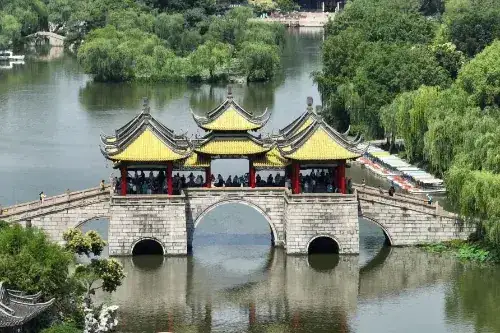
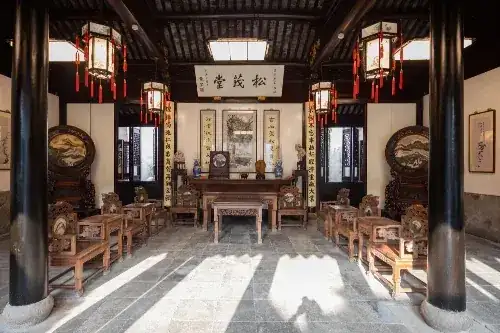
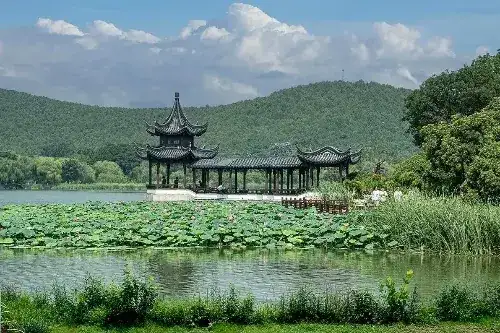
Huaian promotes four city cards: "Hometown of Great Men, Canal Capital, Capital of Gastronomy, Cultural City." As of 2025, the city has 39 national A-level tourist attractions (1 at 5A, 21 at 4A), receiving 32.15 million visitors at 4A+ attractions (+22.2%). It has 15 star-rated hotels (2 five-star), 155 travel agencies, and 1,791 licensed tour guides. Notable sites include the Jiangsu Xuyi First Mountain National Forest Park, Huaian Ancient Huai River National Wetland Park, and various water conservancy scenic areas.
Specialty Foods
As a major birthplace of Huaiyang cuisine - one of China's four great culinary traditions - Huaian is known for its refined cooking techniques emphasizing freshness, tenderness, and original flavors. The city was designated a "World Capital of Gastronomy" by UNESCO, reflecting its deep culinary heritage along the canal.
Notable Figures
Huaian has produced many distinguished historical figures: Han Xin, the renowned military strategist of the Han Dynasty; Mei Cheng, a master of Han dynasty rhapsody; Guan Tianpei, a national hero who died defending Humen Fort against the British in the First Opium War; and Wu Cheng'en, author of the classic novel "Journey to the West." The city is also the hometown of Premier Zhou Enlai, one of the founding leaders of the People's Republic of China.
International Exchange
As of 2023, Huaian and its districts and counties have 14 international sister cities and 29 international friendly exchange cities.
Honorary Titles
Huaian holds numerous national and international honorary titles, including National Civilized City, National Health City, National Garden City, National Environmental Protection Model City, and UNESCO World Capital of Gastronomy. It is also a member of the Nanjing Metropolitan Circle and the founding city of the Huai River Ecological Economic Belt.
Travel information can change. Check current opening hours, reservations and entry requirements before you travel.
Traveller discussion
Start the conversation with a helpful tip or a question.