
Suzhou City
Suzhou CitySuzhou City, a prefecture-level city under Jiangsu Province and a megacity, is located in the Huadong region of China, in the southeastern part of Jiangsu Province, on the south bank of the lower Yangtze River. It borders Shangha
Suzhou City
Suzhou City, a prefecture-level city under Jiangsu Province and a megacity, is located in the Huadong region of China, in the southeastern part of Jiangsu Province, on the south bank of the lower Yangtze River. It borders Shanghai to the east, Jiaxing and Huzhou of Zhejiang Province to the south, and Wuxi to the west. It is a central city in the Yangtze River Delta. Suzhou belongs to the Yangtze River Delta Plain and Taihu Lake Plain, with low, flat terrain, crisscrossing rivers, and numerous lakes—the vast majority of Taihu Lake's surface area lies within Suzhou. The city has a subtropical monsoon marine climate and a total area of 8,657.32 square kilometers. As of 2023, Suzhou has 5 districts and administers 4 county-level cities; the municipal government is located at No. 998 Sanxiang Road, Gusu District. As of the end of 2025, the permanent population was 13.0477 million. Suzhou has over 4,000 years of recorded history. In the Spring and Autumn Period, Shoumeng of the Eastern Zhou established the State of Wu. In 514 BC, King Helu of Wu founded Suzhou City. The name "Suzhou" was first used in 589 AD during the Sui Dynasty. Suzhou is the only city along the Grand Canal to apply for World Heritage status under the "ancient city" concept. Since its founding, the city has maintained a "dual chessboard" layout of parallel land and water routes with adjacent streets and canals, known for its distinctive features of "small bridges, flowing water, white walls, dark tiles, historic sites, and famous gardens," earning it the reputation of "paradise on earth." Suzhou is an important central city in eastern China, a national historic and cultural city, a national comprehensive transportation hub, a member of the Shanghai Metropolitan Circle and the Su-Xi-Chang Metropolitan Circle, and a key national tourism city. Nine classical gardens have been inscribed on the UNESCO World Heritage List. Suzhou's four pillar industries are electronic information, equipment manufacturing, biomedicine, and advanced materials. In 2025, Suzhou achieved a GDP of 2,769.51 billion CNY (approximately $384.7 billion USD), up 5.4% year-on-year.
History
Suzhou has yielded numerous ancient cultural sites, particularly from the late Neolithic Liangzhu Culture, including the Zhaolingshan, Shaoqingshan, Zhuodun, Caoxieshan, and Luodun sites. The Zhaolingshan site was listed among China's top ten archaeological discoveries in 1992.
At the end of the Shang Dynasty, Taibo and Zhongyong—sons of Gugong Danfu, leader of the Zhou clan—journeyed south to Meili and established the state of Gouwu. In the mid-11th century BC, King Wu of Zhou conquered the Shang and enfeoffed Zhouzhang, a descendant of Taibo, as a vassal. In 585 BC, Shoumeng proclaimed himself king, giving Wu its first reliable chronology. In 473 BC, the State of Yue conquered Wu; in 334 BC, Chu annexed Yue. In 262 BC, Lord Chunshen (Huang Xie) was enfeoffed in Jiangdong.
In 221 BC, the Qin Dynasty unified China and established the commandery-county system. Wu belonged to Guiji Commandery, and Wuxian County was established—the origin of the county's name. During the Han Dynasty, Suzhou was variously part of the kingdoms of Chu, Jing, and Wu. In 129 AD (Eastern Han), Wu Commandery was established. During the Three Kingdoms, the area belonged to Sun Wu. In the Western Jin, Wu, Danyang, and Wuxing commanderies were collectively known as the "Three Wu."
In 589 AD (Sui Dynasty), Wu Commandery was abolished and the area was named Suzhou after Gusu Mountain to the west—the first use of the name. During the Tang Dynasty, Suzhou became the only Xiongzhou (prominent prefecture) in the Jiangnan region. In 909 AD, Wujiang County was established. During the Song Dynasty, Suzhou was elevated to Pingjiang Prefecture (1113 AD). The Yuan Dynasty made it Pingjiang Route. In 1367 (early Ming), it became Suzhou Prefecture. The Qing Dynasty established Suzhou as the seat of the Jiangsu provincial governor. During the Taiping Heavenly Kingdom (1860–1863), Suzhou was occupied and made the capital of Sufu Province.
After the 1911 Revolution, Suzhou declared independence on November 5. The city was formally established as Suzhou City in 1928, abolished in 1930, and re-established. Suzhou fell to Japanese forces on November 19, 1937. After liberation on April 27, 1949, Suzhou became a province-administered city in 1953.
In September 2023, Suzhou was officially classified as a megacity based on its urban permanent population of 5.1251 million. In January 2025, the State Council approved the Suzhou Territorial Spatial Plan (2021–2035), confirming Suzhou as an important central city in eastern China, a national historic and cultural city, and a national comprehensive transportation hub.
Administrative Divisions
Division History
After liberation in 1949, Suzhou underwent numerous administrative reorganizations. In 1953, the Suzhou Special District was established, governing 1 city and 8 counties. In 1983, the city-administering-county system was implemented, bringing Changshu, Taicang, Kunshan, Wuxian, Wujiang, and Shazhou under Suzhou. Changshu became a county-level city in 1983; Shazhou was renamed Zhangjiagang (1986); Kunshan (1989), Wujiang (1992), and Taicang (1993) followed. Wuxian became Wuzhong City in 1995. In 2001, the suburbs were renamed Huqiu District, and Wuzhong and Xiangcheng districts were established. In 2012, the Canglang, Pingjiang, and Jinchang districts were merged into Gusu District, and Wujiang became Wujiang District.
Division Details
As of 2021, Suzhou has 5 districts (plus the Suzhou Industrial Park, a functional zone, not an administrative division), administers 4 county-level cities, with 46 sub-districts and 51 towns. The municipal government is at No. 998 Sanxiang Road, Gusu District.
Geography
Location
Suzhou is located in the central Yangtze River Delta, between 119°55′–121°20′E and 30°47′–32°02′N. It borders Shanghai to the east, Jiaxing and Huzhou of Zhejiang to the south, Taihu Lake and Wuxi to the west, and the Yangtze to the north. Total area: 8,657.32 km².
Topography
Suzhou has low, flat terrain with plains accounting for 55% of the total area. The land slopes gently from west to east, with plain elevations of 3–4 meters, dropping to about 2 meters near Yangcheng Lake and Wujiang. Low hills (100–350m) are scattered in the western mountains and Taihu islands, with Qionglong Mountain the highest at 342m.
Climate
Suzhou has a subtropical monsoon marine climate with four distinct seasons, mild temperatures, and abundant rainfall. In 2025, the average temperature was 19.1°C and precipitation 1,105.5 mm.
Hydrology
Suzhou's ancient city features crisscrossing canals and dense lakes. Major lakes include Taihu and Cao Lake to the west; Dianshan Lake to the east; Yangcheng, Jinji, and Dushu lakes in the center. The Yangtze River and the Beijing-Hangzhou Grand Canal traverse the area. The city's three major water systems are formed by Taihu's northern discharge, the canal's flow, and the "three rivers" draining through the Huangpu River. Marco Polo's 13th-century travelogue praised Suzhou as the "Venice of the East."
Natural Resources
Water Resources
In 2025, Suzhou's total water consumption was 9.73 billion cubic meters, down 0.8% year-on-year. Water use per 10,000 CNY GDP was 16.5 cubic meters.
Biological Resources
Suzhou's main crops include rice, wheat, rapeseed, and fruit trees. Aquatic products from low-lying pond fields include lotus root, gorgon fruit, and water bamboo. Local specialties include Biluochun tea, Yangcheng Lake hairy crabs, Taihu white fish, and Yangtze knifefish.
Mineral Resources
Suzhou has 16 types of mineral resources, dominated by non-metals. Kaolin and granite are particularly renowned nationally for their abundant reserves and excellent quality.
Population
At the end of 2025, Suzhou's permanent population was 13.0477 million, up 0.5%. The urbanization rate reached 82.9%. The registered population was 7.988 million, up 0.5%.
Politics
Suzhou's municipal government is led by the Municipal Party Committee and Municipal People's Government. As a prefecture-level city under Jiangsu Province, it hosts the provincial governor's office and multiple provincial-level administrative bodies.
Economy
Overview
Suzhou is one of China's most economically dynamic cities. The Suzhou Industrial Park, established in 1994 with State Council approval, is hailed as "an important window for China's reform and opening up." In 2023, all four of Suzhou's county-level cities ranked in China's top 100 counties, with Kunshan ranking first for 18 consecutive years.
In 2025, Suzhou's GDP reached 2,769.51 billion CNY (approximately $384.7 billion USD), up 5.4% at constant prices. The primary industry added 20.89 billion CNY (up 4.5%), secondary industry 1,284.44 billion CNY (up 5.6%), and tertiary industry 1,464.18 billion CNY (up 5.2%). The three-sector ratio was 0.7:46.4:52.9. Per capita GDP was 213,000 CNY (approximately $29,600 USD), up 5.0%.
In 2025, Suzhou added 415,000 urban jobs, representing nearly 30% of the provincial total. Per capita disposable income for all residents was 80,796 CNY (approximately $11,200 USD), up 4.2%; urban residents earned 90,125 CNY and rural residents 51,303 CNY.
Primary Industry
In 2025, Suzhou's agricultural output value was 37.66 billion CNY (up 4.1%). Total grain output was 961,000 tons, up 0.4%, marking six consecutive years of increase. The city hosted the 2025 Suzhou Agricultural Technology Conference. Agricultural sci-tech contribution rate reached 76.8%, and comprehensive mechanization of major grain crops exceeded 99%.
Secondary Industry
In 2025, above-scale industrial output value reached 4,896.64 billion CNY (up 3.9%). High-tech manufacturing output was 1,858.88 billion CNY (up 5.5%), contributing 53.3% to industrial growth. Above-scale industrial enterprises achieved revenue of 4,939.96 billion CNY (up 2.7%) and total profit of 280.03 billion CNY (up 8.1%). Construction value-added was 120.10 billion CNY, down 3.0%.
Tertiary Industry
Fixed-asset investment totaled 571.37 billion CNY (down 6.5%), with industrial investment at 225.04 billion CNY (up 6.1%). High-tech industry investment reached 106.85 billion CNY (up 4.3%).
Total retail sales of consumer goods reached 909.22 billion CNY (up 2.0%). Suzhou received 200 million domestic and international tourists, generating tourism revenue of 222.74 billion CNY (up 9.1%).
Total import and export value reached a record 2,811.93 billion CNY (approximately $390.5 billion USD), up 7.4%. Exports were 1,760.87 billion CNY, imports 1,051.05 billion CNY. Trade with Belt and Road countries grew 17.3% to 1,265.42 billion CNY. Cross-border e-commerce surged 92.1%. Actual foreign investment was $5.81 billion, up 12.3%.
General public budget revenue was 249.02 billion CNY (approximately $34.6 billion USD, up 1.3%). Financial institution deposits reached 5,727.21 billion CNY and loans 6,015.61 billion CNY. Digital RMB transactions totaled 12.92 trillion CNY, accounting for nearly two-thirds of the national total. The city added 20 listed companies, bringing the total to 284, with total market capitalization of 3.3 trillion CNY (approximately $458 billion USD).
Social Affairs
Education
In 2025, Suzhou newly built or renovated 37 schools and kindergartens, adding 47,500 seats. The city has 868 schools (excluding kindergartens) including 27 regular higher education institutions, with 1.979 million students and 133,000 full-time teachers. Suzhou Vocational University and Suzhou Tourism College were established.
Science and Technology
Suzhou deeply implemented its "Eight Major Projects" for sci-tech innovation; the Shanghai-Suzhou innovation cluster ranked sixth globally. Fiscal science and technology investment was 27.45 billion CNY (10.8% of general public budget expenditure). Valid invention patents reached 184,000 (up 14.7%), with 140.8 per 10,000 people. The city has over 18,500 high-tech enterprises and 25,400 national technology-based SMEs, with 848 national "Little Giant" specialized enterprises. Total talent reached 4.25 million, including 470,000 high-level professionals.
Culture
Suzhou hosted the 7th Jiangnan Culture and Art International Tourism Festival and other major events. Above-scale cultural enterprises generated 430.61 billion CNY in revenue (up 9.2%). The city has 11 public libraries, 50 registered museums, and 11 cultural centers, with 61 national-level and 140 provincial-level protected cultural sites. The Suzhou Archaeology Museum officially opened. There are 57 national-level intangible cultural heritage inheritors.
Sports
In 2025, Suzhou built or renovated 53 sports fields, 5 sports parks, and 40.7 km of fitness trails. Per capita sports area reached 4.12 square meters. The city hosted the China Sports Culture Expo, World Athletics Race Walking Tour, and IFSC Climbing World Cup. Sports lottery sales reached 6.576 billion CNY.
Healthcare
At the end of 2025, Suzhou had 5,027 medical institutions including 288 hospitals, with 37 tertiary hospitals (17 Grade-3A). Ruijin Hospital Taicang Branch and Xiyuan Hospital Suzhou opened. The city has 123,200 health workers including 50,200 licensed physicians (3.85 per 1,000 people). Annual medical visits totaled 113 million (up 2.7%).
Social Security
At the end of 2025, 6.0097 million people contributed to enterprise pension insurance; 8.6355 million had basic medical insurance. The minimum living standard was raised to 1,208 CNY/month. The city built 18,000 affordable rental housing units and renovated 10 farmers' markets.
Environmental Protection
In 2025, Suzhou's PM2.5 annual average was 28 micrograms per cubic meter (down 3.4%). Water quality at 98.8% of monitoring stations met Grade III or above. Taihu Lake achieved safe summer conditions for 18 consecutive years. Suzhou was certified as an "International Wetland City." The city has 188 national-level green factories and 12 national-level green industrial parks. Renewable energy capacity reached 9.042 million kW (24.5% of total).
Urban Construction
Suzhou was founded in 514 BC with over 2,500 years of history, still occupying its original site. It maintains the "dual chessboard" layout of parallel land and water routes. The city has 887 protected cultural heritage sites (61 national-level, 140 provincial-level). In 2023, the built-up area was 776.45 square kilometers. In 2025, Suzhou implemented 96 urban renewal projects, renovated 117 old residential communities, and built 58.77 square kilometers of sponge city area. The city has 65,000 5G base stations with metropolitan network bandwidth of 27.6 TB/s.
Transportation
Highways
As of the end of 2025, Suzhou had 11,125.6 km of highways, including 637.8 km of expressways. The urban area has four long-distance bus stations.
Railways
During the 2025 Spring Festival travel rush, Suzhou Railway Station dispatched 6.4295 million passengers, up 11.8% year-on-year. Suzhou has 14 passenger stations including Suzhou Station, Suzhou North, Suzhou Industrial Park, Kunshan South, Zhangjiagang, Changshu, and Shengze. Suzhou North is at the intersection of the Beijing-Shanghai and Tong-Su-Jia-Yong high-speed railways. Suzhou East Station and Changshu West Station are under construction, planned to open by 2027. Suzhou has 7 completed railways totaling 476.5 km, with 300.8 km under construction.
Aviation
In 2025, Suzhou built 344 low-altitude takeoff and landing points and opened 476 low-altitude routes. The Shanghai Airport–Suzhou forward cargo station is in stable operation.
Water Transport
Suzhou Port was formed in 2002 by merging the Zhangjiagang, Changshu, and Taicang ports. In 2025, the port handled 613 million tons of cargo (up 2.5%) and 10.215 million TEU containers (up 5.7%).
Public Transportation
Suzhou's bus system charges 1 CNY for regular buses and 2 CNY for air-conditioned buses. As of the end of 2025, the urban area had 4,888 buses operating 821 routes, with 220 million annual riders.
As of December 2024, the Suzhou Metro operates Lines 1–8 and 11, totaling approximately 350 km. The long-term plan envisions 9 lines totaling 380 km. As of the end of 2025, total rail transit (including trams) was 392.45 km with 715 million annual riders.
The Suzhou High-tech Tram system has 8 planned lines totaling 116 km. Line 1 opened in 2014, Line 2 in 2018, and Line T5 in 2023.
Taxi fares start at 12 CNY (including 2 CNY fuel surcharge) for the first 3 km; 1.8 CNY/km for Santana and 2.0 CNY/km for Passat from 3–5 km; higher rates beyond 5 km and during night hours (23:00–5:00).
History and Culture
Origin of the Name
In 589 AD, after abolishing Wu Commandery, the area was named "Suzhou" after Gusu Mountain to the west—the first use of the name.
City Symbols
City tree: camphor tree. City flower: osmanthus.
Folk Customs
On the sixth day of the sixth lunar month, Suzhou has a tradition of "drying books"—exposing books and paintings to prevent insect damage. Temples hold "scripture-turning" ceremonies. On the seventh day of the seventh lunar month (Qixi Festival), also called the "Daughter's Festival," locals make qiaoguo (fried dough twists) and practice needle-floating divination.
Suzhou's dragon boat racing originated along the Xumen Tang River, originally commemorating Wu Zixu, later evolving into the liveliest Dragon Boat Festival activity. During the Qing Dynasty, races were held at multiple locations with great fanfare.
Dialect
Suzhou dialect is a variety of Wu Chinese, belonging to the Taihu branch's Su-Hu-Jia subgroup. It has long been considered the standard and representative dialect of Wu Chinese, one of China's earliest-formed dialects, preserving many ancient sounds and vocabulary. Its main features include retaining all voiced initials, a three-way stop consonant distinction, and preservation of entering tone. Suzhou dialect distinguishes between sharp and round consonants. Known for its elegance, it is often described as "soft Wu speech" for its gentle, melodic quality.
Painting
Suzhou's painting tradition dates back thousands of years, from Neolithic Liangzhu Culture decorations to the Ming Dynasty Wu School of Painting. The most prominent Tang Dynasty painters included Zhang Zao, Zhu Jingxuan, and Zhu Shen. During the Yuan Dynasty, Suzhou painters embraced Zhao Mengfu's literati painting concept. Huang Gongwang's masterpiece "Dwelling in the Fuchun Mountains" is a rare gem in world art history.
The Wu School, formed during the Zhengde and Jiajing reigns through the efforts of Shen Zhou, Wen Zhengming, Tang Yin, and Qiu Ying, became the mainstream of Ming Dynasty painting. The school led the art world for 600 years without interruption, producing generations of outstanding painters.
Theater
Suzhou is the birthplace of Kunqu Opera and Suju Opera. Kunqu, China's first World Intangible Cultural Heritage, arose in the late Yuan/early Ming period in the Kunshan-Taicang area. From the late Ming to the early Qing, it flourished enormously, with the annual Huqiu singing gatherings attracting thousands. Kunqu dominated Chinese theater for over 200 years. Notable works include "The Peony Pavilion" and "The Injustice to Dou E." In 2004, Bai Xianyong produced the "youth version" of "The Peony Pavilion," which has toured worldwide over 100 times, including at Vienna's Musikverein.
Major Events
On July 6, 2023, during an inspection in Jiangsu, President Xi Jinping emphasized that the Pingjiang Historic and Cultural Block is a precious asset for preserving and promoting fine traditional Chinese culture.
Scenic Spots
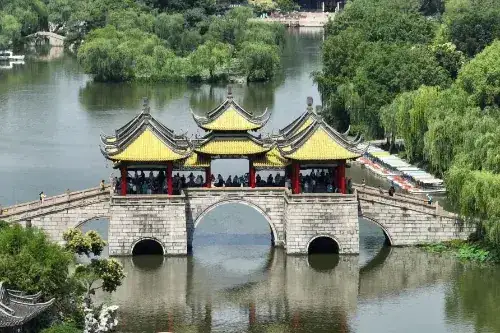
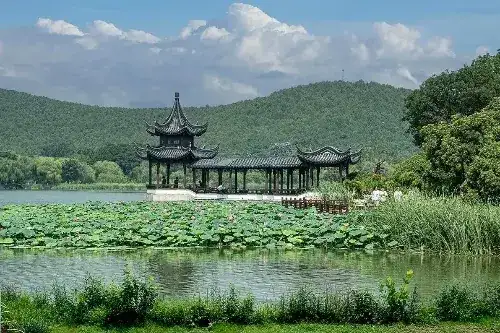
Suzhou is a key national tourism city. Nine classical gardens are inscribed on the UNESCO World Heritage List: Zhuozheng Garden, Liu Garden, Wangshi Garden, Huanxiu Mountain Villa, Canglang Pavilion, Shizi Garden, Yipu, Ouyuan, and Tuisi Garden. The Suzhou section of the Grand Canal is also a World Heritage site. The Jiangnan water towns of Zhouzhuang, Luzhi, Tongli, Shaxi, Qiandeng, and Jinxi are on the World Heritage tentative list.
As of the end of 2024, Suzhou has 6 5A-level and 35 4A-level scenic areas. The city received 181 million domestic and international tourists in 2024, with tourism revenue of 204.11 billion CNY (up 10.4%). The Wujiang East Taihu Eco-Tourism Resort was selected as a national-level tourism resort.
Notable scenic spots include Huqiu (Tiger Hill), Panmen, Lingyan Mountain, Tianping Mountain, and Yu Mountain. The Shajiabang Reed Marshland Scenic Area is a national patriotic education base and AAAA-level tourist area. The New Fourth Army Taihu Guerrilla Memorial Hall in Guangfu Town showcases the anti-Japanese resistance history.
Specialties and Cuisine
Food Culture
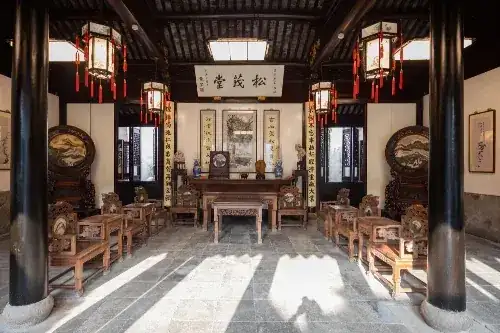
Suzhou's Xuanmiao Temple snacks, along with Nanjing's Confucius Temple, Shanghai's Chenghuang Temple, and Changsha's Fire Palace snacks, are known as China's "Four Great Snacks." Notable restaurants include Songhelou (a time-honored Su-style restaurant) and Zhu Hongxing Noodle House. Suzhou-style noodles with varied toppings are widely popular.
Food streets include Taidian Nong, Shiquan Street, Xueshi Street, and Ligongdi. Signature Suzhou dishes include squirrel-shaped mandarin fish, sizzling eel paste, crab roe tendon, and Taihu water shield soup. Suzhou candies include pine nut candy and three-color soft candy. Suzhou-style preserved fruits have a history dating to the Three Kingdoms period, with over 160 varieties.
Local Specialties
Suzhou's notable local products include Biluochun tea, Yangcheng Lake hairy crabs, Taihu white fish and white shrimp, duck blood glutinous rice, white garlic, loquats, chestnuts, and osmanthus flowers.
Famous Figures
Suzhou has produced many notable historical figures across politics, literature, and the arts throughout its 4,000-year history, including the Wu School painters Shen Zhou, Wen Zhengming, Tang Yin, and Qiu Ying, among numerous others.
External Exchange
Suzhou maintains active international engagement, hosting events such as the 2025 Suzhou Global Investment Conference and the 12th Belt and Road China-Germany Economic Cooperation Dialogue. The city is a comprehensive pilot zone for expanding the opening up of the service sector, with 238 regional headquarters and 317 foreign R&D centers of multinational companies.
Honorary Titles
Suzhou has been recognized as a national historic and cultural city, a national comprehensive transportation hub, a key national tourism city, an "International Wetland City," and has been rated as China's best city for promoting employment for six consecutive years, and the most attractive Chinese city for foreign talent for 14 consecutive years.
Travel information can change. Check current opening hours, reservations and entry requirements before you travel.
Traveller discussion
Start the conversation with a helpful tip or a question.