
Changzhou City
Changzhou CityChangzhou City, a prefecture-level city under Jiangsu Province, is located in the heart of the Yangtze River Delta in southern Jiangsu, between latitudes 31°09'-32°04'N and longitudes 119°08'-120°12'E. It borders Wuxi to the e
Changzhou City
Changzhou City, a prefecture-level city under Jiangsu Province, is located in the heart of the Yangtze River Delta in southern Jiangsu, between latitudes 31°09'-32°04'N and longitudes 119°08'-120°12'E. It borders Wuxi to the east, Nanjing and Zhenjiang to the west, and Wuxi (Yixing) and Xuancheng (Anhui Province) to the south. The terrain features Yangtze River lowland plains with sandy highlands and hilly lake districts - slightly higher in the southwest, lower in the northeast. The climate is subtropical humid monsoon with four distinct seasons and abundant rainfall. Total area: 4,372 square kilometers. As of June 2026, Changzhou administers 5 districts and 1 county-level city; the municipal government is seated at 1280 Longcheng Avenue, Xinbei District. As of end-2025, the permanent population was 5.4154 million. In 547 BCE, Jizha, fourth son of King Shoumeng of Wu, was enfeoffed at Yanling, beginning over 2,500 years of documented history. The city served as a seat of commandery, prefecture, circuit, and fu governments across dynasties, known successively as Yanling, Piling, Jinling, Nanlanling, and Wujin. The name "Changzhou" first appeared in 589 CE under Emperor Wen of Sui. On April 23, 1949, Wujin was liberated and the city and county were separately established. Changzhou is an important central city in the Yangtze River Delta, a member of the Shanghai Metropolitan Circle and Su-Xi-Chang Metropolitan Circle, a national famous historical and cultural city, and an outstanding tourist city. Major attractions include the Spring and Autumn Yancheng Tourism Area, Tianning Zen Temple, Maoshan, Tianmu Lake, and the Global Dinosaur City. Leading industries include high-end equipment, new energy, new materials, new energy vehicles and core automotive components, and next-generation electronic information technology. In 2025, Changzhou achieved a regional GDP of 1,115.87 billion yuan (approximately US$155 billion), up 5.2% at constant prices.
History
Approximately 45 million years ago, the ancient primate Eosimias lived in the Liyang Shanghuang area, predating North African "human ancestors" by 8-10 million years. Over 6,000 years ago, early inhabitants settled around Weidun Village in Qishuyan.
In 547 BCE, King Yuzha of Wu enfeoffed Jizha at Yanling - the first recorded name for Changzhou. In 202 BCE (Western Han), it was renamed Piling. During the Three Kingdoms period (234 CE), Sun Quan implemented military farming across Piling, Wujin, and Yunyang. In 281 CE (Western Jin), Piling Commandery was established, governing seven counties; it was renamed Jinling Commandery in 304 CE, and Lanling Commandery was established in 318 CE.
In 589 CE, Emperor Wen of Sui established Changzhou, governing four counties. During the Tang dynasty (844 CE), Changzhou was elevated to top-tier "Wang" status, ranking among the nation's top ten prefectures. During the Yuan dynasty (1277 CE), it became Changzhou Circuit; in 1357, it was renamed Changchun Fu. In 1409 (Ming dynasty), it was renamed Changzhou Fu, and by 1726 (Qing dynasty), it governed eight counties, earning the title "Eight-County Famous Capital."
After the 1911 Revolution, Changzhou Fu was abolished. During the Anti-Japanese War, the Chinese Communist Party established the South Jiangsu Anti-Japanese Base. On April 23, 1949, Wujin was liberated; Changzhou City and Wujin County were separately established. In 1953, Changzhou became a province-administered city. In 1983, the State Council approved the city-administering-county system, placing Wujin, Jintan, and Liyang under Changzhou.
Administrative Divisions
Division Evolution
Between 1990 and 1995, Liyang, Jintan, and Wujin were successively upgraded from counties to county-level cities. In 2002, Wujin was reorganized as Wujin District, and the suburbs were renamed Xinbei District. In 2015, the State Council approved merging Wujin and Qishuyan districts into a new Wujin District, converting Jintan into Jintan District, and redistributing several towns among Xinbei, Tianning, and Zhonglou districts. The Jiangsu Changzhou Economic Development Zone was established in 2015 and its management was streamlined in 2019 to report directly to the municipal government.
Division Details
As of June 2026, Changzhou has 5 districts and 1 county-level city, comprising 19 subdistricts and 33 towns. The municipal government is seated at 1280 Longcheng Avenue, Xinbei District.
Geography and Environment
Location and Extent
Changzhou lies between 31°09'-32°04'N and 119°08'-120°12'E with a total area of 4,372 square kilometers. It sits in southern Jiangsu in the Yangtze River Delta on the northwest shore of Lake Tai, bordering the Yangtze River to the north. It neighbors Wuxi to the east, Nanjing and Zhenjiang to the west, and Wuxi (Yixing) and Anhui (Xuancheng) to the south, roughly equidistant from Shanghai and Nanjing.
Topography
Changzhou features Yangtze River lowland plains with sandy highlands and hilly lake districts. Plains cover 1,672 square kilometers (38.22%), hilly areas 1,088 square kilometers (24.86%), water bodies 255 square kilometers (5.83%), and polder fields 1,360 square kilometers (31.09%). Elevation ranges from 2 to 9 meters. The highest point is Guodi Mountain at 541 meters in southern Liyang; Maoshan's Damaofeng reaches 372 meters. Low hilly terrain accounts for 15% of the total area, concentrated mainly in the west and south.
Climate
Changzhou has a subtropical humid monsoon climate with four distinct seasons, synchronized rainfall and warmth, and abundant sunshine. The annual average temperature is 15.6 degrees Celsius, and annual precipitation averages 1,086 mm. The city receives about 2,019 hours of sunshine annually. Meteorological disasters such as typhoons, rainstorms, and cold waves occur seasonally.
Hydrology
Changzhou has over 200 rivers and 3,000 ponds, with water bodies covering 700 square kilometers (16% of total area). Major surface water sources include the Yangtze River, the Grand Canal, Lake Tai, Gehu Lake, and Changdang Lake. The Yangtze River has become the primary drinking water source. The Grand Canal's urban section spans 23.8 km with an annual runoff of 380-400 million cubic meters. Groundwater extraction has been strictly controlled by the government in recent years.
Natural Resources
Biological Resources
Changzhou has 168 species of common animals, including over 60 edible species, 50+ medicinal species, and 10+ fur-bearing species. The city has over 138 families of seed plants, including 200+ medicinal plant species and 19 species of ancient trees over a century old. Urban areas feature sycamore, ginkgo, cedar, metasequoia, and magnolia trees.
Mineral Resources
Metallic minerals include iron, manganese, copper, and gold. Non-metallic minerals include rock salt, limestone, calcite, bentonite, clay, basalt, and quartz sandstone. There are 35 mineral deposits (3 large, 6 medium, 26 small). The Jintan salt mine has reserves of 16.3 billion tons; Liyang calcite reserves of 27 million tons rank first in the province.
Population
As of end-2025, Changzhou's permanent population was 5.4154 million, up 0.55%. The urbanization rate reached 79.88%, up 0.88 percentage points. The registered population was 3.8948 million, down 0.11%.
Politics
Changzhou's governance follows standard Chinese municipal structures, with the CPC Changzhou Municipal Committee and the Changzhou Municipal People's Government as the principal administrative bodies.
Economy
Overview
In 2025, Changzhou achieved a regional GDP of 1,115.87 billion yuan (approximately US$155 billion), up 5.2% at constant prices. By sector: primary industry 18.36 billion yuan, up 2.1%; secondary industry 515.44 billion yuan, up 3.3%; tertiary industry 582.07 billion yuan, up 7.0%. The new energy industry reached 1,047.9 billion yuan (approximately US$145.5 billion), making Changzhou the nation's only "double-trillion city" with both a trillion-yuan GDP and a single trillion-yuan new energy industry.
In 2025, the city had 888,000 registered business entities (up 2.7%), including 282,000 private enterprises and 577,000 self-employed businesses. Cumulative registered capital reached 2.7 trillion yuan (approximately US$375 billion). General public budget revenue was 71.55 billion yuan (approximately US$9.9 billion), up 2.5%. Per capita disposable income was 68,295 yuan (approximately US$9,486), up 4.0% - urban residents earned 77,763 yuan (approximately US$10,800) and rural residents 44,647 yuan (approximately US$6,201), with the urban-rural income ratio narrowing to 1.742:1.
Primary Industry
In 2025, the total output value of agriculture, forestry, animal husbandry, and fisheries was 31.83 billion yuan (approximately US$4.4 billion), up 2.8%. Grain sown area was 1.4804 million mu, with total grain output of 712,700 tons. The city built 99,000 mu of high-standard farmland and established 7 national beautiful leisure villages.
Secondary Industry
In 2025, above-scale industrial value-added grew 4.6%. Above-scale high-tech manufacturing output exceeded 300 billion yuan (approximately US$41.7 billion), up 12.3%. New energy vehicle production surpassed 800,000 units, up 16.5%. Construction industry value-added was 52.55 billion yuan, down 7.5%.
Tertiary Industry
In 2025, total retail sales of consumer goods reached 291.81 billion yuan (approximately US$40.5 billion), up 2.6%. Total import and export value was 372.81 billion yuan (approximately US$51.8 billion), up 13.9%, with exports at 304.71 billion yuan (approximately US$42.3 billion). Actual utilized foreign investment was US$1.4 billion, up 1.5%. The city hosted 132 million tourists with tourism revenue of 150.599 billion yuan (approximately US$20.9 billion).
Financial sector value-added was 67.42 billion yuan, up 4.7%. Year-end financial institution deposits reached 1,994.09 billion yuan (approximately US$277 billion), with household deposits at 1,025.4 billion yuan (approximately US$142.4 billion). Insurance premium income was 49.91 billion yuan (approximately US$6.9 billion), up 8.7%. Two foreign enterprises were recognized as world-class "Lighthouse Factories."
Social Services
Education
As of end-2025, Changzhou had 855 schools of all types, including 405 kindergartens, 225 primary schools, 187 secondary schools, 18 secondary vocational schools, and 12 higher education institutions. The city added 12 "New Quality" compulsory education schools and established Changzhou Railway Vocational and Technical College.
Science and Technology
In 2025, Changzhou granted 39,168 patents, including 8,591 invention patents, with 96.5 valid invention patents per 10,000 people. The city had over 5,700 effective high-tech enterprises, 94 (potential) unicorn companies, and 523 gazelle companies. R&D investment intensity was 3.55%, and high-tech industry output accounted for 62.2% of above-scale industrial output.
Culture
Changzhou has 11 performing arts troupes, 8 cultural centers, and 30 museums. It runs 7 radio programs and 6 TV channels. The city added 4 national intangible cultural heritage representative inheritors and held over 2,300 cultural events attracting more than 8 million attendees. Notable venues include the Changzhou Museum, Liu Haisu Art Museum, and Qu Qiubai Memorial Hall.
Sports
Changzhou has 28,000 sports venues with 5.1 square meters of sports area per capita. The city hosted 7 international, 41 national, and 32 provincial-level competitions. Athletes won 133 national-or-above championships, including 2 world titles and 24 Asian titles.
Healthcare
Changzhou has 2,295 medical institutions, including 156 hospitals, with 48,000 health professionals and 36,000 beds. The city pioneered a "one person, one file, one code" digital health record system integrating AI-assisted personal health management.
Social Security
In 2025, Changzhou added 114,000 new jobs. Enterprise employee pension insurance covered 1.953 million people (up 6.5%), and basic medical insurance covered 4.6218 million. The minimum living allowance was raised to 1,080 yuan per person per month (approximately US$150), benefiting 8,453 households and 11,500 people. The city has 108 elderly care institutions.
Transportation
Highways
Changzhou's road network includes the Huning Expressway, National Highway 312, Ninghang Expressway, and Yanjiang Expressway. As of end-2018, total highway mileage was 9,331 km, including 306 km of expressways.
Railways
Rail lines serving Changzhou include the Xinchang Railway, Huning Railway, Beijing-Shanghai High-Speed Railway, and Huning Intercity Railway.
Aviation
Changzhou Benniu International Airport, located in Xinbei District 18 km from the city center, is a 4E-class international civil airport. In 2024, passenger throughput exceeded 4.5 million.
Water Transport
Changzhou Port is a national Class-1 port. In 2024, cargo throughput reached 129.043 million tons, up 3.7%.
Public Transit
In 2025, Changzhou handled 67.458 million passenger trips and 159.263 million tons of freight. Several major expressway expansion and urban road projects were completed or advanced. Changzhou Metro Line 1 opened on September 21, 2019, making Changzhou the fourth city in Jiangsu to open a metro system. Line 2 opened on June 28, 2021.
History and Culture
Changzhou's nickname "Dragon City" (Longcheng) has three main origin theories. The first is a folk legend: the Dragon King of the Eastern Sea's nine princes fought, and six dragons came to Changzhou, hence "Six Dragon City." The second theory notes the ancient city walls resembled a turtle, and since turtles were considered a dragon species, the city was called Dragon City. The third theory traces to the Northern and Southern Dynasties, when 15 emperors emerged from Changzhou during the Qi and Liang dynasties; since emperors were called "true dragon sons of heaven," the city earned the name. Emperor Qianlong inscribed a plaque reading "Dragon City Buddhist Teaching" during his southern inspection tour.
Scenic Spots
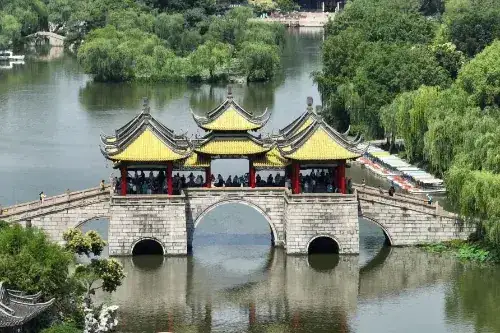
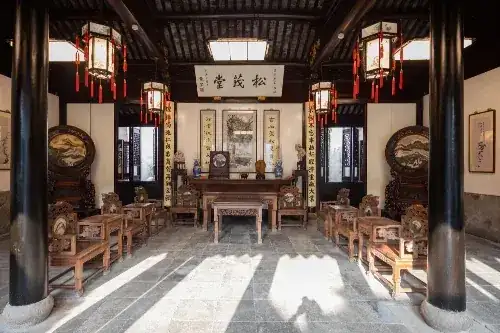
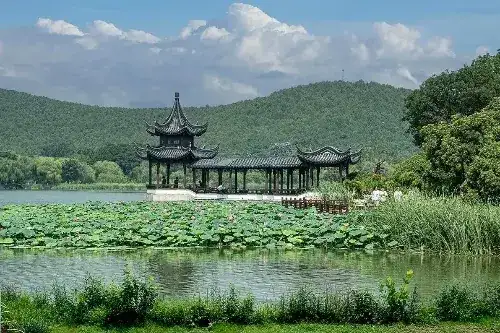
Changzhou is an outstanding tourist city featuring the Spring and Autumn Yancheng Tourism Area, Tianning Temple, Maoshan, Global Dinosaur City, Red Plum Pavilion, and Wenbi Pagoda. Over 30 former residences of notable figures include those of Qu Qiubai, Zhang Tailei, Tang Jingchuan, Yun Nantian, Huang Zhongze, Zhao Yi, Li Boyuan, Li Gongpu, and Shi Liang. Changzhou's classical gardens, historically numbering over 40, flourished during the Ming and Qing dynasties.
The city has 36 rated tourist attractions, including 3 national 5A-level and 11 4A-level scenic areas. Notable attractions include Yandun Neolithic Ruins, Spring and Autumn Yancheng, Tianning Temple, Red Plum Pavilion, Wenbi Pagoda, Chinese Dinosaur Park, Tianmu Lake, Maoshan Scenic Area, Joyland, Eastern Salt Lake City, and Jiaoxi Ancient Town.
Local Specialties
Local specialties include dried radish, sesame cakes, sesame candy, Liyang wind-dried goose, wild bamboo shoots, Liyang water celery, Nanshan chestnuts, Changdang Lake crabs, Changzhou combs, brick-carved screens, cloisonne wire craft paintings, random-stitch embroidery, Chinese colored velvet paintings, bamboo carving, and Jintan paper-cutting.
Notable Figures
Changzhou has produced many distinguished figures throughout history, including Qu Qiubai (early CPC leader), Zhang Tailei (revolutionary), Tang Jingchuan (Ming dynasty scholar-general), Yun Nantian (Qing dynasty painter), Zhao Yi (Qing dynasty poet and historian), Li Boyuan (late Qing novelist), Li Gongpu (patriotic activist), and Shi Liang (jurist and politician). Over 30 former residences of notable figures are preserved in the city.
International Exchange
Changzhou has established sister-city relationships with 53 foreign cities. In 2025, the city hosted 189 batches of foreign guests totaling 1,567 visitors and pioneered a "1+1" dual-center model establishing overseas exchange and business centers in Tanzania, Saudi Arabia, and the UAE.
Honors and Titles
Changzhou has been designated a National Famous Historical and Cultural City and an Outstanding Chinese Tourist City, and holds numerous national and provincial honors recognizing its economic development, cultural heritage, and social governance.
Travel information can change. Check current opening hours, reservations and entry requirements before you travel.
Traveller discussion
Start the conversation with a helpful tip or a question.