
Xuzhou City
Xuzhou CityXuzhou City, abbreviated as "Xu," also known as Pengguo, Pengcheng, Zhuolu, and Xuguo, is a prefecture-level city under Jiangsu Province, a sub-center city of the province, and a National Famous Historical and Cultural City, Nati
Xuzhou City
Xuzhou City, abbreviated as "Xu," also known as Pengguo, Pengcheng, Zhuolu, and Xuguo, is a prefecture-level city under Jiangsu Province, a sub-center city of the province, and a National Famous Historical and Cultural City, National Comprehensive Transportation Hub, and central city of the Huaihai Economic Zone designated by the State Council. As of 2025, Xuzhou administers 5 districts, 3 counties, and 2 county-level cities, with a total area of 11,765 square kilometers and a permanent population of 8.9671 million. Located in the southern part of the North China Plain and northern Jiangsu Province, the Beijing-Hangzhou Grand Canal flows through the city, and the Longhai and Beijing-Shanghai railways intersect here, earning it the reputation as the "Gateway to Five Provinces." Xuzhou is an important gateway city in eastern China, a major economic, educational, cultural, financial, medical, and foreign trade center in the East China region, and a key node city in the national Belt and Road initiative, a National Sustainable Development Agenda Innovation Demonstration Zone, a sub-center of the northern wing of the Yangtze River Delta, and the core city of the Xuzhou Metropolitan Area, known as "China's Engineering Machinery Capital." In primitive society, during the time of Emperor Yao, Pengzu established the Peng State, the earliest city to appear in Jiangsu. Xuzhou was historically one of the Nine Provinces of ancient China, a strategic military gateway between north and south, a center of commerce, and the political, economic, and cultural center of the Huaihai region. With over 6,000 years of civilization and 2,600 years of urban history, Xuzhou is the hometown of emperors, said to be the birthplace of rulers across nine dynasties. It is the origin of Han Dynasty culture, known as "the former state of Pengzu, the hometown of Liu Bang, and the capital of Xiang Yu." Due to its rich cultural heritage and historical depth, it is also called the "Athens of the East." Xuzhou has four distinct seasons and is a scenic tourist city with attractions such as Yunlong Lake, Yunlong Mountain, Pengzu Garden, Hubu Mountain, and Pan'an Lake. Historical figures from Xuzhou include Pengzu, Liu Bang, Sun Quan, Liu Yu, and Li Yu. The city has received the UN Habitat Scroll of Honour and the title of National Innovative City. In 2025, Xuzhou's GDP was 995.722 billion yuan (approximately $138.3 billion USD), with per capita GDP of 110,777 yuan (approximately $15,383 USD).
History
Xuzhou has a long history, with its early inhabitants living and working here over 6,000 years ago. In the late primitive society, Emperor Yao granted Pengzu the territory of present-day Xuzhou, establishing the Great Peng State, and Xuzhou has since been called Pengcheng. During the Xia Dynasty, Boyi assisted Yu the Great in flood control, and his son Ruomu was granted the Xu territory around present-day Pizhou, establishing the Xu State.
During the Spring and Autumn and Warring States periods, Pengcheng belonged to the Song State, later to the Chu State, and the Qin Dynasty established Pengcheng County after unification. During the Chu-Han contention, the Hegemon-King of Western Chu made Pengcheng his capital. The Western Han established the Chu Kingdom and Pengcheng Commandery; the Eastern Han established the Pengcheng Kingdom with its capital at Pengcheng. During the Three Kingdoms period, Cao Wei moved the administrative seat to Pengcheng, and Cao Cao relocated the Xuzhou Inspectorate there, after which Pengcheng was officially called Xuzhou.
Through the Wei, Jin, Southern and Northern Dynasties, various regimes maintained the Pengcheng Kingdom or Xuzhou, with capitals mostly at Pengcheng. The Sui established Xuzhou, later renamed Pengcheng Commandery. The Tang, Five Dynasties, Song, Jin, and Yuan all maintained Xuzhou with varying jurisdictions. In the early Ming Dynasty, Xuzhou was directly under the capital, later under Nanjing. In the Qing Dynasty, Xuzhou became a prefecture during the Yongzheng reign, governing 1 sub-prefecture and 7 counties.
During the Republic of China era, Xuzhou was one of eight key cities designated for national development. After the Anti-Japanese War, the famous Huaihai Campaign was centered on Xuzhou. In 1949, before Jiangsu was fully liberated, Xuzhou was temporarily administered by Shandong Province. In 1953, Jiangsu Province was re-established, and Xuzhou was placed directly under provincial jurisdiction. Administrative adjustments continued through the 1950s to 1970s, and in 1983, Jiangsu abolished the regional commissioner system, implementing city-administering-county governance.
Administrative Divisions
After Xuzhou's liberation on December 1, 1948, the city and surrounding counties underwent numerous administrative reorganizations under Shandong's temporary administration. From 1949 to 1953, districts and counties were repeatedly established, merged, and renamed. In 1953, the Xuzhou Special District was established with its seat in Xuzhou, governing Xinhailian City and nine counties. In 1955, Dangshan and Xiao counties were transferred to Anhui Province. Major changes continued through the decades: in 1983, the Xuzhou Special District was abolished, with six counties placed under Xuzhou's leadership. In 1990 and 1992, Xinyi and Pi counties were upgraded to county-level cities. In 2010, Jiuli District and Tongshan County were abolished, and Tongshan District was established. In 2021, Shitun Subdistrict was transferred to Gulou District.
Division Details
As of April 2025, Xuzhou administers 5 districts, 3 counties, and 2 county-level cities. The municipal government is located at No. 1 Kunlun Avenue, Dalonghu Subdistrict, Yunlong District.
Geography
Location
Xuzhou is located in the southeastern part of the North China Plain, between 116 degrees 22 minutes to 118 degrees 40 minutes east longitude and 33 degrees 43 minutes to 34 degrees 58 minutes north latitude. It borders Lianyungang and Suqian to the east, Anhui Province to the south, and Shandong Province to the west and north. The city extends approximately 210 kilometers east-west and 140 kilometers north-south, with a total area of 11,258 square kilometers.
Topography
Xuzhou's terrain is predominantly plains, accounting for about 90% of the total area, with an average elevation of 30 to 50 meters and a gentle slope from northwest to southeast. Hills and mountains make up about 9.4% of the area, with the highest peak being Dadong Mountain in Jiawang District at 361 meters.
Geology
Xuzhou sits on the southern part of the North China Block, with relatively stable geological conditions and low seismic activity. Major fault zones include the Tancheng-Lujiang, Fengxian-Pizhou, and Old Yellow River fault zones.
Climate
Xuzhou has a temperate monsoon climate with four distinct seasons: no extreme heat in summer or severe cold in winter. The annual average temperature is 14 degrees Celsius, annual sunshine ranges from 2,284 to 2,495 hours, the frost-free period lasts 200 to 220 days, and annual precipitation is 800 to 930 millimeters.
Hydrology
Xuzhou is located in the lower reaches of the ancient Huai River's tributaries: the Yi, Shu, and Si rivers. The Old Yellow River serves as a watershed dividing the northern Yi-Shu-Si system from the southern Sui-An river system. The Beijing-Hangzhou Grand Canal runs north-south through the city. In 2017, Xuzhou became Jiangsu's first National Water Civilization City, forming a "nine rivers encircling the city, seven lakes nourishing Peng" water system. The seven lakes include Yunlong Lake, Dalong Lake, Jinlong Lake, Daba Lake, Pan'an Lake, Jiuli Lake, and Lvliang Lake.
Natural Resources
Water Resources
Xuzhou has 2 large reservoirs, 5 medium reservoirs, and 84 small reservoirs with a total capacity of 331 million cubic meters. In 2025, total water resources amounted to 3.354 billion cubic meters.
Land Resources
Xuzhou's soils are mainly classified into six categories: brown soil, cinnamon soil, purple soil, alluvial soil, lime concretion black soil, and paddy soil. Alluvial soil covers 649,900 hectares, accounting for 79.5% of the city's total soil area.
Mineral Resources
Xuzhou is an important coal production base and a power base for eastern China. Major mineral resources include coal, iron, limestone, marble, quartzite, gypsum, and rock salt. Coal geological reserves exceed 3.9 billion tons, iron ore proven reserves are 8.3 million tons, limestone reserves are 105 billion tons, and gypsum proven reserves are 3.2 billion tons. Diamond and associated minerals have also been discovered at multiple sites.
Population
As of end-2025, Xuzhou's permanent population was 8.9671 million, with a birth rate of 4.72 per thousand and a death rate of 8.22 per thousand. The urbanization rate reached 69.08%, an increase of 0.68 percentage points. As of May 2022, the city had 49 ethnic minorities with 21,818 permanent ethnic minority residents, making it a multi-ethnic dispersed-residence area.
Politics
The political leadership of Xuzhou consists of the Municipal Party Committee and Municipal People's Government, administering the city's 5 districts, 3 counties, and 2 county-level cities under provincial jurisdiction.
Economy
Overview
In April 2020, the National Development and Reform Commission designated Xuzhou as a national industrial transformation and upgrading demonstration zone. In July 2022, the State Council approved Xuzhou as a National Sustainable Development Agenda Innovation Demonstration Zone. In 2025, Xuzhou achieved a GDP of 995.722 billion yuan (approximately $138.3 billion USD), a year-on-year increase of 5.8%. The primary industry added value of 79.246 billion yuan ($11.0 billion USD), the secondary industry 365.629 billion yuan ($50.8 billion USD), and the tertiary industry 550.847 billion yuan ($76.5 billion USD), with a structure ratio of 8.0:36.7:55.3. Per capita GDP was 110,777 yuan (approximately $15,383 USD), up 6.1%.
In 2025, general public budget revenue was 57.533 billion yuan ($8.0 billion USD), up 2.7%. Per capita disposable income was 42,230 yuan ($5,865 USD), up 4.9%, with urban residents at 48,978 yuan ($6,803 USD) and rural residents at 30,639 yuan ($4,255 USD). The urban-rural income ratio narrowed from 1.62:1 to 1.60:1. Per capita consumption expenditure was 27,158 yuan ($3,772 USD), up 4.7%. The Engel coefficient was 29.3%.
Primary Industry
Xuzhou is a national agricultural sustainable development demonstration zone. In 2025, total grain output reached 5.0415 million tons. The city has 11 national-level, 99 provincial-level, and 270 municipal-level agricultural leading enterprises. Products such as ginkgo, Fuji apples, and burdock are renowned domestically and internationally.
Secondary Industry
In 2021, Xuzhou's engineering machinery industry accounted for about one-fifth of the national market. The Xuzhou Intelligent Manufacturing Industrial Cluster and Xuzhou Engineering Machinery Cluster were both selected as national-level industrial clusters. In 2025, industrial added value reached 279.248 billion yuan ($38.8 billion USD), up 6.1%, and construction industry added value was 87.269 billion yuan ($12.1 billion USD). The city added 29 national-level specialized "little giant" enterprises and 354 provincial-level specialized SMEs. As of end-2025, Xuzhou had 17 listed companies with a total market value of 253.4 billion yuan ($35.2 billion USD), and 25 New Third Board listed companies.
Tertiary Industry
In 2025, the tertiary industry's added value grew 8.0% year-on-year. Retail sales of consumer goods grew 5.5%. Total import and export volume reached 112.121 billion yuan ($15.6 billion USD), with exports of 89.463 billion yuan ($12.4 billion USD) and imports of 22.659 billion yuan ($3.1 billion USD). Actually utilized foreign investment was $346 million USD.
Xuzhou's financial cluster is the most comprehensive financial center in the Huaihai Economic Zone, with 12 national joint-stock banks. As of end-2025, RMB deposit balances reached 1.302 trillion yuan ($181.0 billion USD) and loan balances 1.352 trillion yuan ($187.7 billion USD). Total insurance premium income was 34.625 billion yuan ($4.8 billion USD), up 8.0%. XCMG Bank in Brazil (BANCOXCMG S.A.) is the first overseas bank established by a Chinese manufacturing enterprise.
Xuzhou has been designated as a national backbone cold chain logistics city and a land-port national logistics hub. In 2025, postal industry business volume reached 12.445 billion yuan ($1.7 billion USD), with express delivery volume of 1.275 billion pieces. The Xuzhou International Mail Exchange Bureau enables direct global mail dispatch.
Tourism boomed significantly. In 2025, Xuzhou received 94.0678 million domestic and international visitors, up 10.8%, with total tourist spending of 98.797 billion yuan ($13.7 billion USD). International overnight visitors numbered 52,400, with tourism foreign exchange earnings of $75.25 million USD. The city consistently ranked among the top destinations in Jiangsu for tourist arrivals and consumption growth across multiple holidays, including Spring Festival, May Day, Dragon Boat Festival, and National Day.
Social Affairs
Education
Xuzhou is a renowned center of science and education, with full-time schools, university students, academicians, university student entrepreneurship parks, and national key disciplines ranking second in Jiangsu Province, behind only the provincial capital Nanjing. As of end-2025, the city had 2,202 schools of all levels with 2.0276 million enrolled students and 135,600 full-time teachers. The city has 8 undergraduate institutions, including one national key university directly under the Ministry of Education, with 256,500 university students enrolled. Xuzhou historically valued education: during the Ming Dynasty, six of Jiangsu's 19 academies were in Xuzhou, and the Yunlong Academy, founded in 1735, produced numerous distinguished scholars.
Science and Technology
Xuzhou is a National Innovative City and a National Intellectual Property Strong City. As of end-2025, the city had 243 provincial-level or above innovation platforms and 49 provincial-level or above incubators. It added 771 high-tech enterprises, with 2,519 technology-based SMEs registered. Patent grants totaled 14,779, including 5,126 invention patents, with 38.84 invention patents per 10,000 people.
Cultural Affairs
In 2018, Xuzhou became the fourth Chinese city to host the World Cities Day China Main Event. In November 2022, the 13th China (Xuzhou) International Garden Expo opened, the first time held in a non-provincial-capital prefecture-level city. As of end-2025, the city had 181 public cultural centers, 18 museums, 11 public libraries with 60.7496 million volumes, 7 radio stations, and 8 TV stations.
Sports
Xuzhou hosted the 11th Jiangsu Provincial Games in 1986, becoming the first non-provincial-capital city to host a provincial comprehensive games. Since 2017, the Xuzhou International Marathon has been held annually. The city is the only prefecture-level city to have consecutively hosted Asian Games, World Championships, and Olympic qualifying events. As of end-2025, the city had 98 sports venues and 100 swimming pools, with 53,000 social sports instructors.
Healthcare
Xuzhou is an important medical center in eastern China. As of end-2025, the city had 4,944 health institutions, including 379 hospitals. There were 28 Grade III hospitals (including 14 Grade III Class A), 64,200 hospital beds (7.16 per thousand people), and 84,100 health technical personnel, including 34,300 practicing physicians and 37,400 registered nurses.
Environmental Protection
In July 2022, the State Council approved Xuzhou's construction as a National Sustainable Development Agenda Innovation Demonstration Zone, themed on innovation-led high-quality development of resource-based regional center cities.
Urban Planning
The National Main Functional Zone Plan includes the East Longhai region as a national key development area. Xuzhou's positioning includes enhancing the Longhai economic belt, strengthening population and economic agglomeration, and building important energy, advanced manufacturing, logistics, and commodity distribution bases. In 2021, the State Council approved support for Xuzhou to build as a provincial sub-center city.
The Huaihai Economic Zone comprises ten prefecture-level cities across Jiangsu, Shandong, Henan, and Anhui provinces. The Huaihai City Cluster consists of 8 cities. The East Longhai Economic Belt, with Xuzhou and Lianyungang as its core, is an important component of the national Belt and Road initiative. The Xuzhou Metropolitan Area spans four provinces and was identified as one of 23 key metropolitan areas for national development in 2013. The planned central urban area covers 3,126 square kilometers, with a projected population of 5 million by 2030, forming a "dual centers, six clusters, fifteen functional zones" spatial layout.
Transportation
Overview
Xuzhou possesses strategic geographical advantages, connecting east and west, north and south. It is a national comprehensive transportation hub where the Lianhuo, Beijing-Shanghai, and Beijing-Taipei expressways intersect, and the Beijing-Shanghai and Longhai railways meet. The Beijing-Hangzhou Grand Canal passes by the city, and Xuzhou Guanyin International Airport is the only large trunk airport in the Huaihai Economic Zone. The city has built a modern multi-modal transportation system integrating rail, aviation, highway, waterway, and pipeline. In 2023, the "Lianyungang-Xuzhou-Huai'an" consortium was selected for the national comprehensive freight hub program.
Highways
Xuzhou has a rare road network for a prefecture-level city, with 22 trunk roads, four ring roads, and 90 county and township roads. As of end-2025, total highway mileage reached 16,200 km, including 527.86 km of expressways. All counties are connected by expressways, and all administrative villages have access to passenger bus services. In 2022, the Xuzhou Outer Ring Road (southeast section) opened at 80 km, marking Xuzhou's entry into the "five-ring era," expanding the enclosed area to 1,100 square kilometers.
Railways
Xuzhou is China's second-largest railway hub, where the Beijing-Shanghai and Longhai trunk lines intersect. In 2011, the Beijing-Shanghai High-Speed Railway opened, bringing Xuzhou into the high-speed rail era and connecting it to 3-hour economic circles of the Yangtze River Delta and the Bohai Rim. As of end-2025, Xuzhou had 787.5 km of railway, including 391.3 km of high-speed rail, with direct high-speed rail service to 296 cities nationwide, the most in the province. Xuzhou North Station is Asia's second-largest marshaling station. The city's China-Europe freight trains ranked 9th nationally in 2019, and in 2025, the National Development and Reform Commission approved the construction of the Lianyungang-Xuzhou China-Europe (Asia) freight train assembly center.
Aviation
Xuzhou Guanyin International Airport, located in Shuanggou Town, Suining County, is a Class I aviation trunk airport. In 2025, passenger throughput reached 4.083 million, up 19.1%. The airport opened in November 1997, with a terminal area of 58,000 square meters and a 3,400-meter runway. The city also has a military airport in Tongshan District and general aviation airports, including Yangmiao Airport in Pei County, the only agricultural aviation station in Jiangsu and the largest fixed-wing general aviation airport in the Huaihai Economic Zone.
Water Transport
In 2014, Xuzhou Port was included in the national key construction ports of the Yangtze River Economic Belt. As one of China's 28 major inland ports and top ten inland ports nationally, Xuzhou Port saw 2025 water freight volume of 58.235 million tons, up 10.1%, and port cargo throughput of 69.481 million tons, with container throughput of 345,000 TEU, up 20.4%. The Beijing-Hangzhou Grand Canal traverses Xuzhou for 181.16 km as a Class II navigable channel.
Public Transportation
As of September 2025, the Xuzhou Metro operates 4 lines totaling 95.14 km with 76 stations, including 6 transfer stations. The second-phase construction plan includes Lines 4, 5, and 6, with a total investment of 53.59 billion yuan ($7.4 billion USD). The third-phase network plan comprises 14 lines totaling 574.8 km. The city also operates single-deck and double-deck public buses, public bicycles (499 stations, 25,600 bicycles with one-hour free rides), shared electric bicycles, and public electric vehicles. Taxi base fare is 8 yuan for the first 3 km, with 2 yuan per additional km.
Historical Culture
Han Dynasty Culture
"Chu elegance and Han grandeur, southern grace and northern strength" characterizes Xuzhou's most distinctive regional cultural traits. Xuzhou is the birthplace of Han Dynasty culture, with relics including the Lion Mountain Chu King Mausoleum, Turtle Mountain Han Tomb, Horse Training Terrace, and Han Dynasty Terracotta Warriors. As the hometown of Emperor Liu Bang, founder of the Han Dynasty, which rivaled the Roman Empire as one of the world's most powerful empires, Xuzhou's heritage is the origin of the terms "Han ethnicity," "Chinese characters" (Hanzi), and "Chinese language" (Hanyu).
Pengzu Culture
Xuzhou is the birthplace of Pengzu culture and the culmination of Xu culture. Pengcheng's founding dates back over 4,000 years to the Great Peng State established by Pengzu during Emperor Yao's reign. Pengzu, credited as the founder of Chinese culinary arts and qigong, is said to have lived 800 years. His health cultivation philosophy, "medicine and food share the same origin, nourish through diet," profoundly influenced the formation of Han culture.
Cultural Relics
As of end-2025, Xuzhou had 304 municipal-level or above protected cultural relics sites, including 9 national-level and 33 provincial-level sites. The city also has 10 national-level and 90 provincial-level intangible cultural heritage projects, with 10 national-level and 66 provincial-level heritage representative inheritors.
Folk Customs
Xuzhou is known as the "Hometown of Folk Arts." Popular theatrical forms include Liqin Opera (about 200 years old), Jiangsu Bangzi (about 300 years old), Hui Opera, Peking Opera, and shadow puppetry. The city's folk arts combine northern vigor with southern delicacy. Pizhou is designated as a "Hometown of Chinese Modern Folk Painting" and "Hometown of Folk Paper-cutting." Xuzhou is also a birthplace of Chinese martial arts, with 37 styles practiced in the city and athletes winning 13 world martial arts championships.
Xuzhou Dialect
Xuzhou dialect belongs to the Central Plains Mandarin group of northern dialects, similar to Shandong and Henan dialects. Its phonological system is relatively close to Standard Mandarin, retaining many ancient Chinese words that preserve the features of classical Chinese.
Religious Beliefs
Xuzhou has all five major religions: Buddhism, Taoism, Islam, Catholicism, and Protestantism. As of end-2017, there were 679 registered religious activity venues, 791 religious staff, and 31 patriotic religious organizations.
Scenic Attractions
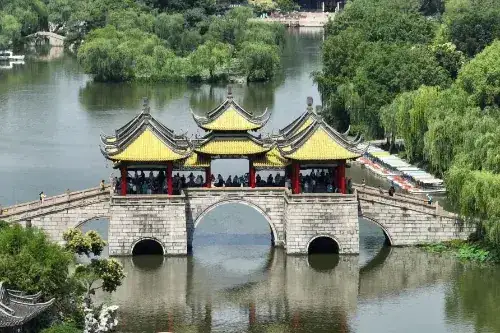
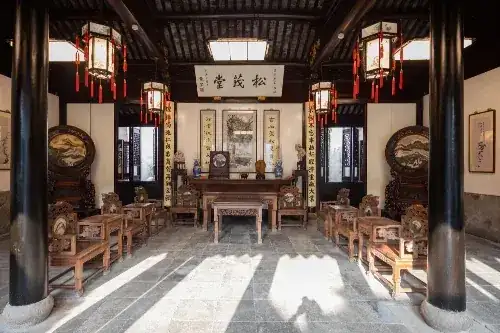
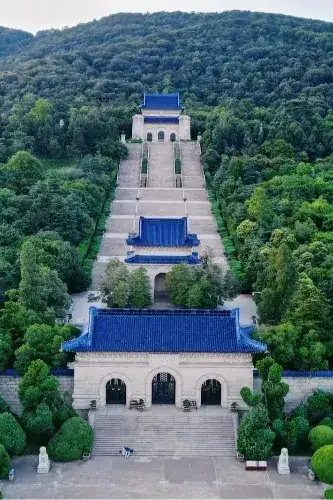
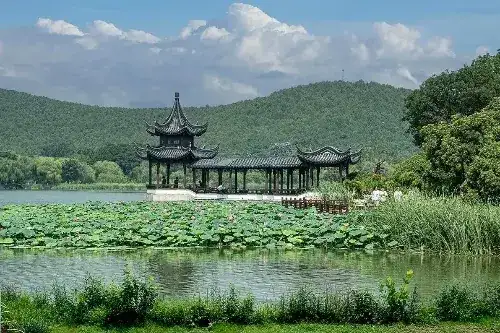
Xuzhou's cultural heritage is best represented by the "Three Wonders of the Han Dynasty": Han Terracotta Warriors, Han Tombs, and Han Dynasty Stone Reliefs. As the birthplace of Han culture, Xuzhou is building a world-class Han culture heritage and tourism destination, with the Yunlong Lake and Jiawang tourist clusters as major destinations. As of end-2025, the city had 58 national A-level tourist attractions, 3 provincial-level tourist resorts, and 13 provincial-level or above rural tourism key villages. In 2025, Xuzhou topped the New Beijing News "Internet-Famous City Potential List" and consistently ranked among top destinations on major travel platforms.
Specialties and Cuisine
Xuzhou is the birthplace of Chinese culinary culture. Pengzu is recognized as the progenitor of Chinese cuisine, said to have earned Emperor Yao's favor through his wild pheasant soup. The city's dishes, inheriting the Great Peng culinary tradition, are elaborately prepared with unique flavors, and nearly every dish has an associated legend.
International Exchange
In 2016, Xuzhou was among the first batch of Sino-UK local cooperation key cities. As of September 2022, Xuzhou had 20 international sister cities and 41 international friendship exchange cities across nearly 50 countries and regions on five continents.
Famous Figures
Known as the "Imperial City of Dragon Roars and Tiger Howls," Xuzhou has produced over 10 founding emperors since the Han Dynasty. Notable ancient figures include Han Dynasty statesmen Xiao He, Cao Shen, Fan Kuai, and Xiahou Ying; Three Kingdoms figures Zhang Zhao and Yan Jun; Eastern Jin generals Liu Wei and Liu Laozhi; Tang Dynasty generals Liu Mian and Shi Xiong; Song Dynasty anti-Jin general Zhao Li; Qing Dynasty officials Li Wei and Li Pan; and literary figures including Liu An, Liu Xiang, Liu Xin, Liu Yiqing, Liu Zhiji, and Li Yu. The "Five Li, Three Lords" refers to three Han Dynasty marquises born within five li of each other: Zhou Bo, Wang Ling, and Guan Ying.
Modern Era
Xuzhou has continued to produce distinguished modern and contemporary figures across various fields, including renowned artists, scholars, and public figures.
Honors
Xuzhou has created or broken multiple national and world records recognized by the China World Records Association, and has received numerous honorary titles including the UN Habitat Scroll of Honour and National Innovative City.
Travel information can change. Check current opening hours, reservations and entry requirements before you travel.
Traveller discussion
Start the conversation with a helpful tip or a question.