
[2027 Sichuan-Tibet Northern Route G317 Travel Guide] A practical travel guide you can't miss for your first trip to Tibet via the Sichuan-Tibet Highway.
[2027 Sichuan-Tibet Northern Route G317 Travel Guide] A Practical Travel Guide for First-Time Travelers to Tibet via the Sichuan-Tibet Highway Author: Xiao Zhou | Updated: December 12, 2024 This article provides you with a highly practical 2027 Sichuan-Tibet Northern Route G317 travel guide, covering comprehensive information including a Sichuan-T…
[2027 Sichuan-Tibet Northern Route G317 Travel Guide] A practical travel guide you can't miss for your first trip to Tibet via the Sichuan-Tibet Highway.
Author: Xiao Zhou | Updated: December 12, 2024
The G317, the northern route of the Sichuan-Tibet Highway, is an important part of the ancient Tea Horse Road. The scenery along the way is pristine and magnificent, rich in cultural atmosphere and full of mystery, earning it the reputation of "the Tibetan Cultural Landscape Highway." However, before exploring the breathtaking natural scenery and unique cultural customs of the northern Sichuan-Tibet Highway, it's helpful to take a look at this comprehensive travel guide for the G317, helping you easily understand travel information, master the best ways to travel, and plan your perfect Sichuan-Tibet journey more smoothly.
I. Route Information for the G317 Northern Sichuan-Tibet Highway
1. Overview of G317, the northern route of the Sichuan-Tibet Highway
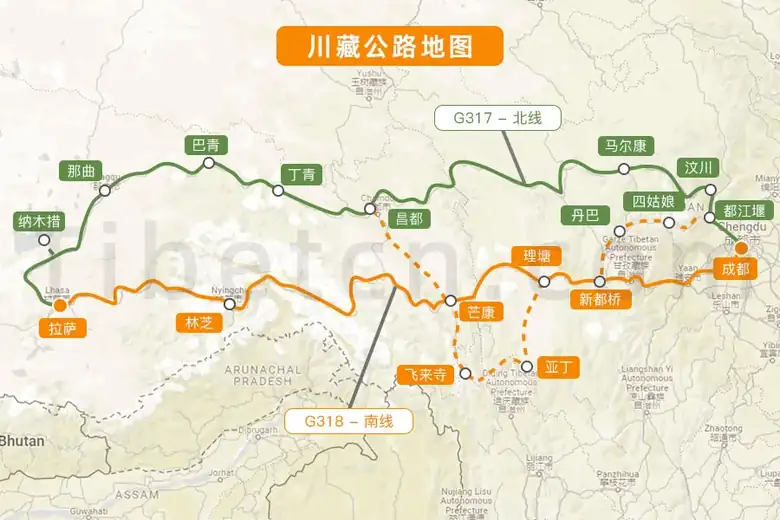
The G317 northern route of the Sichuan-Tibet Highway has a relatively flat terrain and is 2,412 kilometers long. It starts in Chengdu, passes through Dujiangyan, Wenchuan, Ma'erkang, Changdu, Nagqu and other places, and finally reaches Lhasa, the City of Sunshine. Along the way, it passes through more than 50 ethnic groups and offers the magnificent scenery from the rich Chengdu Plain to the desolate Qiangtang Plateau. It also provides an in-depth understanding of the history and culture of Tibet.
2. Route of the Northern Sichuan-Tibet Highway
Chengdu → 71 km → Dujiangyan → 75 km → Wenchuan → 177 km → Ma'erkang → 853 km → Changdu → 231 km → Dingqing → 217 km → Baqing → 259 km → Nagqu → 181 km → Namtso → 241 km → Lhasa
Information on the G317 Sichuan-Tibet Highway
3. Time required to enter Tibet via the northern route of Sichuan-Tibet
[Western Sichuan Mini-Loop + G318] Chengdu + Siguniang Mountain + Danba + Xinduqiao + Batang + Ranwu + Nyingchi + Lhasa Classic 11-Day Tour
Chengdu - Mount Siguniang - Danba - Xinduqiao - Litang - Batang - Mangkang - Zuogong - Basu - Bomi - Nyingchi - Lhasa
II. 12 Must-Visit Attractions on the G317 Northern Sichuan-Tibet Highway
NO.1 Mount Siguniang (approximately 3500 meters above sea level)
Mount Siguniang is renowned for its magnificent peaks, beautiful scenery, and rich Tibetan culture. Shuangqiao Valley, with its glaciers and primeval forests, is ideal for leisurely sightseeing; Changping Valley is a paradise for hikers and photographers, boasting vast meadows and azure lakes; Haizi Valley features numerous stunning alpine lakes and abundant rare flora and fauna, perfect for nature exploration. Furthermore, autumn is the most beautiful season at Mount Siguniang, when the mountain displays a riot of colors, resembling a vibrant and captivating landscape painting.
NO.2 Larung Gar Buddhist Academy in Seda (altitude approximately 4000 meters)
Larung Gar Buddhist Academy in Seda, known as "the world's largest Buddhist academy," is built against the mountainside. Tens of thousands of crimson Tibetan-style bungalows stretch for kilometers, resembling a red sea—a truly magnificent and awe-inspiring sight. Here, you can experience a wealth of religious and cultural activities, circumambulate prayer wheels for blessings, or try local delicacies.
NO.3 Tagong Grassland and Tagong Monastery (altitude approximately 3700 meters)
Tagong Grassland, one of the most famous grasslands in Ganzi Prefecture, China, is renowned for its beautiful natural scenery and rich Tibetan culture. It is known as "the pure land most loved by Bodhisattvas," and visiting between June and October offers the best opportunity to appreciate its stunning landscapes. Nearby Tagong Monastery, often called "Little Jokhang Temple," is a historically significant temple with over a thousand years of history, making it an ideal place to learn about Tibetan Buddhist culture.
Tagong Grassland
NO.4 Buga Snow Mountain (approximately 6328 meters above sea level)
Buga Snow Mountain is one of the seven sacred mountains of Tibet and a holy mountain of the Bon religion. It is famous for its magnificent and unique glacial landscape and has many picturesque glacial lakes. July and August are the best time to take photos, when wildflowers bloom everywhere and the vegetation is lush and verdant, allowing you to capture stunning scenery in all four seasons.
NO.5 Ganzi Monastery (altitude approximately 3700 meters)
Ganzi Monastery, known as the "Holy Land of Buddhism in Southern Kham," has a history of over 300 years. Its magnificent and solemn architecture blends Tibetan and Han architectural styles, making it extremely beautiful. The monastery also houses a large collection of exquisite murals and sculptures, making it an excellent place to learn about Tibetan Buddhist culture.
NO.6 Que'er Mountain (approximately 5050 meters above sea level)
Que'er Mountain, known as "Cuo La" in Tibetan, meaning "the wings of a large bird," is famous for its towering peaks and deep valleys, and is known as the "most dangerous place on the Sichuan-Tibet Highway." Summer is the best season to appreciate the magnificent glacier landscape and alpine lake scenery. Here, you can experience the wonders of nature firsthand.
NO.7 Balang Mountain (approximately 4000 meters above sea level)
Balang Mountain, known as the "Summit of the Panda Kingdom," is a majestic and rugged mountain, a paradise for nature lovers. From the Balang Mountain Pass, one can enjoy breathtaking natural scenery, with the distant, undulating snow-capped mountains being particularly magnificent and awe-inspiring.
NO.8 Yulongla Lake (altitude approximately 4000 meters)
Yulongla Tso, also known as "Xinluhai," is a famous glacial lake in Ganzi Prefecture and one of the most beautiful lakes in China, often referred to as the "Jade Pool of the Western Paradise." The lake boasts stunning scenery, crystal-clear waters, and is surrounded by highland spruce, fir, cypress, rhododendron trees, and lush meadows, creating a picturesque and captivating landscape. Furthermore, legend has it that Zhumu, the beloved wife of King Gesar, a hero in the famous Tibetan epic "King Gesar," once lingered here.
NO.9 Zizhu Monastery (altitude approximately 4800 meters)
Zizhu Monastery is one of the highest-altitude monasteries in Tibet and one of the oldest and most important temples of the Yungdrung Bon religion, often referred to as the "City in the Sky." It is not only a religious holy site but also a scenic tourist destination. Built against the mountainside and surrounded by snow-capped peaks, the monastery evokes a sense of otherworldly paradise.
NO.10 Dege Printing House (approximately 3200 meters above sea level)
Dege Printing House is a renowned repository of traditional Tibetan culture, known as a "cultural treasure trove under the snow-capped mountains" and an "encyclopedia of Tibetan culture." Here, you can admire the exquisite traditional Tibetan architecture, visit precious historical artifacts, and experience the rich atmosphere of Tibetan Buddhist culture up close.
NO.11 Namtso Lake (altitude approximately 4700 meters)
Namtso Lake is the second largest lake in Tibet, the third largest inland saltwater lake in China, and one of the three holy lakes of Tibet. With its enchanting scenery, you can leisurely stroll along the shores of Namtso Lake and feel the tranquility and mystery of this sacred lake. In early winter, Namtso Lake is filled with rippling blue waves and whitecaps, with red-billed seagulls occasionally skimming across the surface. It is a wonderful place for photography and sightseeing.
Namtso
NO.12 Lake Casa (approximately 3500 meters above sea level)
Lake Casa is a typical high-altitude freshwater lake, the largest habitat for wild mandarin ducks in western Sichuan, and the "mother river" of the area. It is deeply respected and worshipped by the local people. Its water is clear, and it is surrounded by mountains, with the lake and mountains reflecting each other, making it a very beautiful place.
III. Best Time to Visit and Weather Conditions on the G317 Northern Sichuan-Tibet Highway
1. Best time to travel on the G317 northern route of the Sichuan-Tibet Highway
May to October is the best time to enter Tibet via the G317 northern route of the Sichuan-Tibet Highway. At this time, the climate is mild and the scenery is beautiful, making it an excellent choice whether you choose cycling, self-driving, or group tours. In May, the temperature along the northern Sichuan-Tibet Highway warms up, the sun shines brightly, and road conditions are relatively good. Wildflowers along the way are in full bloom, creating a vibrant spring scene that blends with the surrounding snow-capped mountains, lakes, forests, and grasslands. From June to August, the abundant sunshine makes the snow-capped mountains and glaciers appear even more sacred. Herds of cattle and sheep graze leisurely on the lush green grasslands, and if you're lucky, you might even witness a beautiful rainbow after the rain. September and October are the most beautiful months along the northern Sichuan-Tibet Highway. The highland trees and grasslands along the way are adorned in golden hues. Under the sunshine, meadows, snow-capped mountains, lakes, cattle, sheep, and villages complement each other, creating a breathtaking autumn landscape. The comfortable weather allows you to immerse yourself in exploring various historical and cultural sites in the most comfortable way.
2. Weather conditions on the G317 northern Sichuan-Tibet Highway
Spring (March to May):From March to May, temperatures along the northern Sichuan-Tibet Highway gradually rise, with sunny skies and daytime temperatures reaching 10°C. However, mornings and evenings can be quite cold, with temperatures potentially dropping as low as -7°C. It is recommended to wear multiple layers, such as sweaters and sweatshirts underneath, and warm jackets or windbreakers on top, to easily cope with both warm and cold weather.
Summer (June to August):From June to August, the average temperature along the northern Sichuan-Tibet Highway is around 15°C to 25°C, which is quite comfortable. However, rainfall is frequent, so it is recommended to check the weather forecast before traveling and plan your itinerary accordingly. During this period, the sun is quite strong, so sun hats, sunglasses, and sunscreen are essential. For clothing, it is recommended to wear long-sleeved shirts underneath and windbreakers, overcoats, or waterproof jackets on top.
Autumn (September to November):From September to November, temperatures along the northern Sichuan-Tibet Highway drop, with mostly sunny weather and significant temperature differences between day and night. It is recommended to wear sweaters, long-sleeved shirts, warm jackets, and long pants. Furthermore, autumn weather is quite pleasant, making it ideal for hiking; wearing comfortable shoes is highly recommended.
Winter (December to February):December to February is the coldest season on the northern Sichuan-Tibet Highway, with temperatures potentially dropping to around -17°C. However, the snow scenery is particularly captivating. It is recommended that you wear warm clothing such as thermal underwear, sweaters, down jackets, and fleece-lined trousers, and bring a scarf, gloves, and a hat. Shoes should be warm and slip-resistant. In addition, the weather is quite dry, so moisturizing measures are essential.
IV. How to better enjoy the G317 northern route of the Sichuan-Tibet Highway
【G317 Sichuan-Tibet Highway】11-Day, 10-Night All-Inclusive Group Tour from Chengdu to Lhasa on the G317 Northern Sichuan-Tibet Highway
Chengdu - Mount Siguniang - Jiaju Tibetan Village - Moshishi Park - Ganzi - Jiangda - Karma Valley - Dingqing - Zizhu Temple - Baqing - Nagqu - Damxung - Namtso - Lhasa
V. Altitude and Altitude Sickness Conditions Along the G317 Northern Sichuan-Tibet Highway
1. Altitude of G317, the northern route of the Sichuan-Tibet Highway
The G317 northern route of the Sichuan-Tibet Highway has an average altitude of about 3,200 meters. It starts in Chengdu (altitude about 503 meters), passes through Dujiangyan (altitude about 720 meters), Wenchuan (altitude about 1,236 meters), Lixian (altitude about 2,700 meters), Ma'erkang (altitude about 3,500 meters), Luhuo (altitude about 3,860 meters), Ganzi (altitude above 3,500 meters), Dege (altitude about 3,188 meters), Changdu (altitude above 3,500 meters), Leiwuqi (altitude about 4,500 meters), Dingqing (altitude about 3,873 meters), Baqing (altitude about 4,500 meters), Suoxian (altitude about 4,100 meters), Nagqu (altitude above 4,500 meters), and finally arrives in Lhasa (altitude about 3,650 meters).
The altitude of major cities along the Sichuan-Tibet Northern Route (National Highway 317)
The route will also traverse the following mountain ranges: Balang Mountain (approximately 4477 meters above sea level), Que'er Mountain (approximately 5050 meters above sea level), Aila Mountain (approximately 4452 meters above sea level), Zonglayi Mountain (approximately 4494 meters above sea level), Zhujiaola Mountain (approximately 4615 meters above sea level), Qiongniela Mountain (approximately 4460 meters above sea level), Xiela Mountain (approximately 4890 meters above sea level), Gangla Mountain (approximately 4809 meters above sea level), and Nyainqentanglha Mountain (approximately 4575 meters above sea level).
The main mountain ranges along the Sichuan-Tibet Northern Route (National Highway 317) have varying elevations.
2. Is altitude sickness common on the G317 northern route of the Sichuan-Tibet Highway?
The overall altitude variation of the G317 northern Sichuan-Tibet Highway is not significant. Mild altitude sickness symptoms may occur, but acclimatization usually occurs within 1-2 days, depending on individual circumstances. Furthermore, the high-altitude areas along the route will not be stayed for long before heading to lower-altitude areas. In addition, by the time you reach the high-altitude locations, you will have already traveled along the northern Sichuan-Tibet Highway for some time and have largely adapted to the altitude changes. Therefore, there is no need to worry too much about altitude sickness.
If you are still concerned, you can choose to join our Sichuan-Tibet tour group. Experienced local guides will accompany you throughout the trip to ensure your safety and provide immediate assistance in case of altitude sickness, making your journey safer and more worry-free. In addition, you can take preventative measures against altitude sickness in advance and relax to effectively reduce its occurrence.
[A Brief Tour of Sichuan and Tibet] 7 Days 6 Nights Essential Tour of Chengdu + Xinduqiao + Daocheng Yading + Ranwu + Linzhi + Lhasa
Chengdu-Luding-Xinduqiao-Litang-Daocheng Yading-Shangri-La Town-Litang-Mangkang-Basu-Ranwu-Bomi-Nyingchi-Lhasa
3. Measures to alleviate altitude sickness
a. Replenishing energy:If you experience altitude sickness, you can drink glucose and eat high-calorie foods such as chocolate and Snickers to give your body enough energy to cope with the altitude.
b. Take a break:If you experience altitude sickness, be sure to rest more, reduce your travel, and allow your body sufficient time to adapt.
c. Relieve fatigue:Holding American ginseng in your mouth for a few minutes can effectively relieve fatigue caused by altitude sickness.
d. Acidic foods:Preparing some acidic snacks or fruits can alleviate nausea, vomiting, and loss of appetite caused by altitude sickness. In addition, yak butter tea can also relieve the discomfort of altitude sickness.
e. Relieve headaches:Pain relievers such as ibuprofen and fenbid can effectively relieve headache symptoms;
f. Oxygen inhalation:Oxygen inhalation can effectively alleviate altitude sickness. You can carry a portable oxygen cylinder with you. If you have mild altitude sickness, you can adapt to the altitude on your own and try not to use oxygen. This will allow you to adapt to the altitude more quickly.
VI. Recommended Food Along the G317 Northern Sichuan-Tibet Highway
1. Chengdu hot pot
Chengdu hot pot, as one of the outstanding representatives of Chinese hot pot culture, is famous throughout China and even the world for its spicy and fragrant broth and rich variety of ingredients. In the streets and alleys of Chengdu, whether in upscale restaurants or small shops on street corners, you can find steaming hot pot restaurants. You can choose the classic spicy broth, or you can choose from unique broths such as the yin-yang pot, tomato pot, or mushroom pot, satisfying the needs of different tastes. The ingredients are also dazzling, from specialty ingredients such as tripe, duck intestines, and beef aorta, to various fresh vegetables, bean products, and meats—everything you could want, making it irresistible.
2. Crispy cheese cake
Butter cake is a traditional dessert loved by the Tibetan people, especially popular in the Tibet Autonomous Region and surrounding areas. It is made primarily from high-quality milk butter and cheese curds, through meticulous processing. It has a golden color, a soft and delicate texture, a rich and sweet taste, and a strong milky aroma, making it very delicious.
3. White intestines
White sausage is a distinctive dish in Tibetan cuisine, with a long history in the Qinghai-Tibet Plateau region. It is made using the small intestines of sheep or cows as the outer layer, stuffed with a mixture of tsampa (barley flour), minced meat, chopped green onions, and other ingredients. After cooking, the sausage has a pure white appearance, hence its name "white sausage." Its flavor is delicious and not greasy, possessing both the richness of meat and the unique aroma of barley, making it a nutritious and flavorful delicacy.
[Sichuan-Qinghai Exit] Chengdu-Xinduqiao-Daocheng Yading-Linzhi-Lhasa-Tuotuohe-Golmud-Qinghai Lake-Xining 15-Day 14-Night Group Tour
Chengdu-Xinduqiao-Daocheng Yading-Mangkang-Ranwu-Bomi-Nyingchi-Lhasa-Nagqu-Golmud-Qinghai Lake-Xining
VII. Accommodation along the G317 Northern Sichuan-Tibet Highway
Most accommodations along the G317 northern Sichuan-Tibet Highway are concentrated in county towns and townships, such as Ma'erkang, Luhuo, Ganzi, Changdu, and Nagqu. Larger county towns offer star-rated hotels and characteristic guesthouses with relatively good accommodation conditions and facilities; some hotel rooms even have oxygen supply. However, in more remote areas, accommodations may not be as luxurious as star-rated hotels, but they will meet basic needs and are cheaper. It's worth noting that during peak tourist season on the Sichuan-Tibet Highway, accommodation is in high demand and prices may rise; therefore, it is recommended to book accommodations in advance to ensure a comfortable trip.
VIII. Travel Precautions for the G317 Northern Sichuan-Tibet Highway
2. Prepare medicines:Prepare some commonly used medications, such as fever reducers, cold medicine, bandages, diarrhea medicine, and stomach pain medicine, in case of emergency;
3. Bring snacks:The northern route of the Sichuan-Tibet Highway is quite long, so we suggest you bring some of your favorite snacks to replenish your energy if you encounter situations where your preferred meals are unavailable.
4. Pay attention to sun protection, moisturizing, and keeping warm:The weather along the northern Sichuan-Tibet Highway is changeable, especially at high altitudes where temperatures are low. It is recommended to bring warm clothing. In addition, the ultraviolet radiation is strong and the weather is dry along the northern Sichuan-Tibet Highway, so take precautions against sunburn and keep your skin moisturized.
5. Prepare cash:In some remote areas along the southern Sichuan-Tibet Highway, cell phone signal is not very good, and mobile phones may not be able to complete payments. It is advisable to prepare a few hundred yuan in cash for emergencies.
In conclusion, the northern route of the Sichuan-Tibet Highway is an excellent destination for gaining a deeper understanding of Tibetan culture and people. Whether you are seeking adventure, exploring culture, or simply photographing or appreciating the beauty of nature, the northern route can meet your travel needs. The scenery along the way is magnificent, the history and culture are profound, and the religious atmosphere is rich. From snow-capped mountains to vast and magnificent grasslands, from prayer flags fluttering in the wind to magnificent temples, every place will bring you a great visual impact, allowing you to immerse yourself in this mysterious land.
Travel information can change. Check current opening hours, reservations and entry requirements before you travel.



Traveller discussion
Start the conversation with a helpful tip or a question.