
Jiamusi City
Jiamusi CityJiamusi City is a prefecture-level city under Heilongjiang Province, located in Northeast China at the confluence of the Songhua, Heilong, and Wusuli rivers in the heart of the Sanjiang Plain. Bordered by the Heilong River to th
Jiamusi City
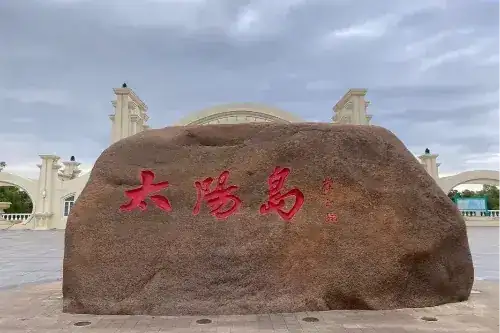
Jiamusi City is a prefecture-level city under Heilongjiang Province, located in Northeast China at the confluence of the Songhua, Heilong, and Wusuli rivers in the heart of the Sanjiang Plain. Bordered by the Heilong River to the north and the Wusuli River to the east, it faces Khabarovsk and Birobidzhan of Russia. As the easternmost prefecture-level administrative region in China, it is known as the "Eastern Pole of China" — the first place to greet the sunrise. The total area is 32,460 square kilometers. As of October 2022, the city administers 4 municipal districts, 3 counties, and 3 county-level cities. As of end-2024, the registered population was 2.213 million. Jiamusi was officially established as a city on June 27, 1937. It is a regional center city in eastern Heilongjiang designated by the State Council, focused on green food industry and light industry as an inland port city. With a 382-kilometer border with Russia, 7 national Class-I ports, and 1 temporarily open port, it is a key frontier city for China-Russia trade. The city sits on the Sanjiang Plain, one of the world's three remaining black soil plains, with organic matter content 5-6 times the national average. The name derives from the Manchu "Jiamukesigashan," meaning "station official village." In 2025, the city achieved a regional GDP of 105.23 billion CNY (~$14.6 billion USD), up 4.7% year-on-year.
History
The name "Jiamusi" originates from the Manchu "Jiamukesigashan," meaning "post station official" or "station official village." Historical sovereignty: Sushen (Zhou Dynasty); Yilou (Han-Jin); Wuji (Northern-Southern Dynasties); Mohe (Sui-Tang); Wuguo Department (Liao); Huligai Route (Jin); Shuidada Route (Yuan); Nurgan Regional Military Commission (Ming); Jilin General's Sanxing Vice Commander jurisdiction (Qing).
In 1888, Dongxing Town was established. In 1906, Yilan Prefecture was set up. In 1910, Huachuan County was formally established. In 1930, Jiamusi Village and Dongxing Town merged to form Jiamusi Town. In December 1934, the puppet Manchukuo established Sanjiang Province with its capital at Jiamusi. On June 27, 1937, Jiamusi was officially designated as a city. After WWII in 1945, Hejiang Province was established with Jiamusi as its capital. In 1949, Hejiang Province merged into Songjiang Province. In 1954, Jiamusi came under Heilongjiang Province. In 1984, the State Council abolished Hejiang Prefecture and placed 13 counties under Jiamusi's administration.
Administrative Divisions
Division Evolution
The city's administrative boundaries evolved significantly from 1946 through the 2010s. Key milestones: establishment of 4 districts in 1952; village transfers from Huachuan County (1956-1957); creation of Chang'an, Sanhe, Heping, and Suburb districts (1958); district renaming in 1968 (to Xiangyang, Yonghong, Qianjin, and Dongfeng); transfer of 13 counties from Hejiang Prefecture (1984); establishment of county-level Tongjiang City (1987), Fujin City (1988), and Fuyuan City (2016); abolition of Yonghong District (2006); and various township-to-town conversions (2017-2021).
Division Details
As of October 2022, Jiamusi City administers 4 municipal districts, 3 counties, and 3 county-level cities. The municipal government is located at 816 Chang'an West Road, Suburb District.
Geography
Location
Jiamusi is located in northeastern Heilongjiang Province, between latitudes 45 degrees 56 minutes to 48 degrees 28 minutes North and longitudes 129 degrees 29 minutes to 135 degrees 5 minutes East. The city has a 382-kilometer international border, separated from Russia's Khabarovsk and the Jewish Autonomous Oblast by the Heilong and Wusuli rivers. It borders Shuangyashan to the east, Harbin and Yichun to the west, Mudanjiang, Qitaihe, and Jixi to the south, and Hegang to the north. Total area: 32,460 sq km; urban area: 1,875 sq km.
Topography
The terrain slopes from southwest to northeast, divided into southern low mountains and hills (250-350m elevation, part of the Wandashan range) and northern riverside plains (around 80m elevation, part of the Sanjiang Plain). The plains, with their flat terrain and fertile soil, form a major agricultural base.
Climate
Jiamusi has a mid-temperate continental monsoon climate with synchronized rain and heat. Winters are long and cold; summers are warm and rainy; spring is windy with little precipitation; autumn is cool. Average annual temperature: 3 degrees Celsius. Frost-free period: approximately 146 days. Average annual precipitation: 530.7mm. Annual sunshine: 2,319.3 hours. Effective accumulated temperature: 2,866.6 degrees Celsius.
Hydrology
The city contains three major river systems — Heilong, Songhua, and Wusuli — with 315 rivers, lakes, and reservoirs. Six provincial-level rivers include the Heilong, Songhua, Wusuli, Tangwang, Woken, and Naoli. Total river channel length: 2,070 km, including 305 km of the Songhua, 240 km of the Heilong, and 148.4 km of the Wusuli.
Natural Resources
Water Resources
Annual precipitation exceeds 500mm. Surface water totals 3.78 billion cubic meters. The Songhua River and 9 tributaries provide 678.16 billion cubic meters at 80% guarantee rate. Average annual surface water resources: 3.156 billion cubic meters; groundwater: 3.61 billion cubic meters; total water resources: 5.314 billion cubic meters.
Plant Resources
The suburban area hosts over 900 wild plant species, including 4 nationally Class-II protected species: Korean pine, Manchurian ash, Amur cork tree, and purple linden. Medicinal herbs include plantain, schisandra, poria, ginseng, and bupleurum. Ornamental plants include azalea, peony, and lily. Grasses include reed grass and various sedge species.
Animal Resources
The city has over 330 wild animal species, including 12 Class-I nationally protected species (Siberian tiger, sable, Oriental white stork, Chinese merganser, red-crowned crane) and 45 Class-II protected species (black bear, brown bear, otter, lynx). Cold-water fish comprise 9 orders, 16 families, and 72 species, including prized salmon, sturgeon, and kaluga.
Mineral Resources
Over 38 mineral types have been discovered, with 16 currently exploited. Key resources include gold, coal, natural gas, mineral water, marble (proven reserves near 100 million tons, ranking among the province's best), iron, and cobalt. Potential advantage minerals include graphite, geothermal energy, dolomite, porcelain stone, quartz sand, and decorative stone.
Population
Population Size
According to the 7th National Census (November 1, 2020), Jiamusi had 2,156,505 permanent residents, a decrease of 395,592 (15.50%) from the 2010 census, with an average annual growth rate of -1.67%. As of end-2024, the registered population was 2.213 million, down 22,000 year-on-year. Urban population: 1.145 million (urbanization rate: 51.7%). Births: 7,030 (up 607); deaths: 14,786 (down 2,854).
Ethnic Composition
The city has 42 ethnic groups, including 41 minorities. The minority population totals 67,228 (2.63% of total). Major minorities: Manchu (32,508), Korean (24,874), Hezhen (4,407), Hui (4,143), and Mongol (2,431). The remaining 36 minorities each have fewer than 1,000 members.
Politics
Current Leadership
The city is governed by the CPC Jiamusi Municipal Committee and the Jiamusi Municipal People's Government, following standard prefecture-level city governance structures.
Sister Cities
Jiamusi maintains sister city relationships with several international cities, particularly in Russia, leveraging its border location.
Economy
Overview
In 2024, Jiamusi achieved a regional GDP of 100.77 billion CNY (~$14.0 billion USD), up 4.8%. The primary, secondary, and tertiary sectors contributed 40.67 billion, 9.64 billion, and 50.46 billion CNY respectively, with a ratio of 40.4:9.5:50.1. General public budget revenue reached 8.15 billion CNY (~$1.13 billion USD), up 5.7%, with tax revenue of 2.94 billion CNY. General public budget expenditure was 41.57 billion CNY (~$5.77 billion USD), up 12.3%. Fixed asset investment grew 2.2%.
Primary Industry
In 2024, total agricultural, forestry, animal husbandry, and fishery output value reached 69.7 billion CNY (~$9.68 billion USD), up 3.6%, with value-added of 41.38 billion CNY (~$5.75 billion USD). Grain was planted on 29.31 million mu, producing 233.6 billion jin (116.8 million tons). Rice: 12.211 million mu; corn: 9.186 million mu; soybeans: 7.895 million mu. Forestry output: 1.41 billion CNY, up 6.2%. Animal husbandry: 11.67 billion CNY, up 3.6%. Fishery: 2.41 billion CNY, up 7.1%.
Secondary Industry
Industrial value-added reached 7.62 billion CNY, up 6.9%. Above-scale industrial output: 46.61 billion CNY (~$6.47 billion USD), with above-scale industrial value-added up 7.7%. Among six leading industries, pharmaceuticals (+51.7%), building materials (+27.6%), food (+11.1%), and energy (+5.2%) grew, while equipment manufacturing (-7.9%) and petrochemicals (-11.4%) declined. Construction output: 7.26 billion CNY (~$1.01 billion USD), up 10.1%.
Tertiary Industry
In 2024, wholesale and retail value-added: 7.68 billion CNY, up 12.0%; transportation, warehousing, and postal services: 7.86 billion CNY, up 9.8%; accommodation and catering: 0.9 billion CNY, up 3.4%; finance: 5.21 billion CNY, up 5.4%; real estate: 5.11 billion CNY, up 1.3%; other services: 22.95 billion CNY, up 3.8%. Retail sales declined 0.8%. Notable growth: new energy vehicles (+176.4%), coal products (+24.2%), automobiles (+9.1%). Tourism: 31.335 million visitors, revenue 11.81 billion CNY (~$1.64 billion USD). The city has 37 A-level scenic areas (10 at 4A). Foreign trade: 9.7 billion CNY (~$1.35 billion USD), down 23.1%; exports: 5.59 billion CNY (up 60.7%); imports: 4.11 billion CNY (down 55.0%). Bank deposits: 263.78 billion CNY (~$36.64 billion USD), up 10.0%. Bank loans: 219.0 billion CNY (~$30.42 billion USD), up 7.9%. Insurance premiums: 7.8 billion CNY (~$1.08 billion USD), up 1.6%.
Social Affairs
Science and Technology
In 2024, Jiamusi introduced the Yazhou Bay National Laboratory — the highest-level national science and technology innovation platform — and signed an agreement for a grain and oil crop experimental base. The city now has 20 incubation carriers and 84 provincial-level or above innovation platforms. 90 enterprises passed national high-tech enterprise certification (98.9% pass rate). Technology contract transactions reached 580 million CNY (~$80.6 million USD), with 117 scientific achievements commercialized.
Education
As of end-2024, Jiamusi has 5 regular universities with 53,705 enrolled students (180 doctoral, 3,170 master's, 30,500 undergraduate, 19,855 associate degree). There are also 14 secondary vocational schools, 127 general middle schools, 92 primary schools, and 315 kindergartens.
Culture
The city has 7 libraries (1.33 million visits), 11 museums, 11 mass art centers, 74 township cultural stations, 4 national-level protected cultural sites, 30 provincial-level sites, 4 national intangible cultural heritage items, and 55 provincial-level items. Comprehensive radio and TV coverage: 100%.
Healthcare
Jiamusi has 2,105 medical institutions, including 103 hospitals (11 tertiary, 25 secondary), 1,965 primary care facilities, and 31 specialized public health institutions. Total beds: 19,213. Staff: 24,912 (19,808 health professionals, including 7,355 physicians and 8,722 nurses; physician-to-nurse ratio: 1:1.19).
Sports
In 2024, athletes won 102 gold, 87 silver, and 121 bronze medals in domestic and international competitions. 12 athletes were sent to provincial and national teams. The city granted national first-class athlete status to 30 individuals and second-class to 63. Sports lottery sales reached 4.67 billion CNY, up 7.41%.
Social Security
In 2024, urban-rural social pension insurance covered 608,000 participants, with 268,400 receiving benefits. Enterprise pension insurance covered 432,273 urban workers, with 326,080 retirees. Unemployment insurance covered 222,042 participants, with 1,913 receiving benefits.
Transportation
Jiamusi is the transportation hub of eastern Heilongjiang with well-developed rail, road, water, and air networks. Five railway lines (Suijia, Jiahe, Tujia, Jiafu, and Qianfu) connect nationwide. The Harbin-Jiamusi and Mudanjiang-Jiamusi high-speed railways are operational. Major highways include the Hatong, Jianhei, and Hedagang expressways, supplemented by 5 national highways and 7 provincial highways.
The city has 3 airports — Jiamusi Songjiang International Airport, Fuyuan Dongji Airport, and Jiansanjiang Wetland Airport — the most of any prefecture-level city in the province. River navigation spans 735 km with 36 berths handling 1,000-ton vessels.
In 2024, total freight reached 65.066 million tons (rail: 14.044 million; road: 48.47 million; water: 2.55 million). Total passengers: 47.592 million (rail: 5.783 million; road: 40.545 million; water: 0.16 million; air: 1.104 million). The city's four water ports (Jiamusi, Tongjiang, Fujin, and Fuyuan) enable international river-sea combined transport via the Songhua and Heilong rivers to Russian ports and onward to the Sea of Japan — known as the "Eastern Water Silk Road."
Scenic Spots
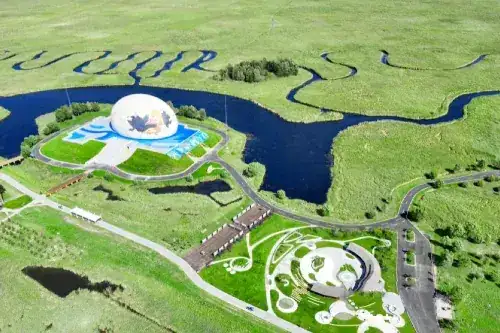
As of end-2022, Jiamusi has 31 A-level scenic areas (9 at 4A, 20 at 3A, 2 at 2A), 5 national-level rural tourism key villages, 5 provincial-level villages, and 3 provincial-level tourism resorts. Key 4A attractions: Daliangzi River National Forest Park, Fujin National Wetland Park, Suburb Aqi Bay Hezhen Tourism Area, and Tongjiang Sanjiangkou Tourism Area.
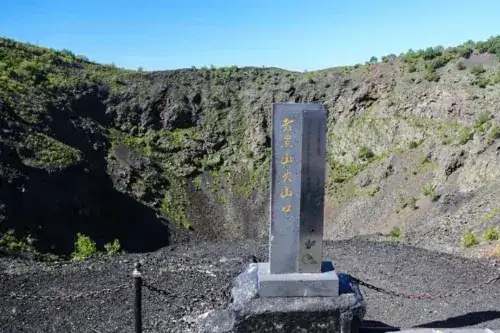
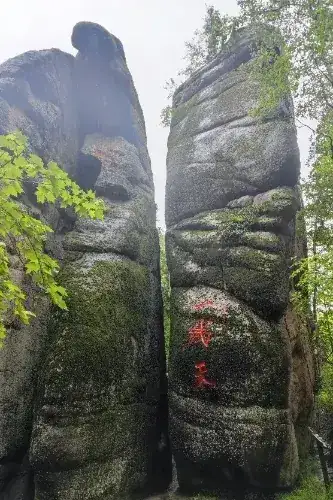
Notable attractions: Mengjiagang Forest Park (established 1956, 250,000 mu area, 81.7% forest coverage); Qixing Peak National Forest Park (highest peak 852.7m, the tallest in the Sanjiang Plain); Jiejin Mountain National Forest Park (25 km of Heilong River shoreline); Bacha Island National Nature Reserve (50+ islands, 331 vertebrate species, 593 plant species); Heixiazi Island (the world's only inland border island shared by two nations, 335 sq km, 171 sq km returned to China in 2008); Songhua River Scenic Belt with the 10th Anniversary of the Founding Memorial Tower; Zhiqing (Sent-down Youth) Square; and the Huanan Forest Steam Train (national industrial heritage, 13.14 km heritage railway).
Local Specialties
Local delicacies feature Hezhen ethnic cuisine centered on river fish: Talaha (grilled raw fish, a Hezhen specialty), raw fish slices, and fish banquets. Other specialties include fish bone art (crafted from freshwater and seawater fish bones), Korean-style bibimbap, guobaorou (crispy sweet and sour pork), iron-pot stewed Songhua River fish, and various Northeast Chinese dishes including small chicken stewed with mushrooms, pork and vermicelli stew, and steamed salmon.
Famous People
Jiamusi has produced notable figures across various fields, consistent with its history as a regional center in northeastern China.
Honorary Titles
Jiamusi holds various honorary titles recognizing its role as a border city, agricultural center, and gateway for China-Russia trade.
Travel information can change. Check current opening hours, reservations and entry requirements before you travel.
Traveller discussion
Start the conversation with a helpful tip or a question.