
Daqing City
Daqing CityDaqing City is a prefecture-level city in Heilongjiang Province, China, designated by the State Council as an important central city in central-western Heilongjiang and a major national petroleum production and petrochemical indu
Daqing City
Daqing City is a prefecture-level city in Heilongjiang Province, China, designated by the State Council as an important central city in central-western Heilongjiang and a major national petroleum production and petrochemical industry base. Located in the northern Nenjiang Plain, it features alluvial first-terrace landforms of the Songhua and Nenjiang rivers with a northern temperate continental monsoon climate. The total area is 21,000 square kilometers. As of 2022, Daqing administers 5 districts, 3 counties, and 1 autonomous county, with a resident population of 2.727 million. In 1959, the discovery of the Daqing Oilfield gave rise to the name "Daqing." The city was formally renamed Daqing City in 1979. Born and thriving on oil, Daqing is among the first pilot cities for national safe development demonstration and a National Civilized City, fostering the "Daqing Spirit" (Iron Man Spirit) embodying patriotism, entrepreneurship, pragmatism, and dedication. The city serves as a transportation hub with intersecting Binzhou and Tongrang railway lines, the Haqi high-speed railway, and the Daguang and Suiman expressways. In 2025, Daqing's GDP reached 269.32 billion yuan (approximately $37.4 billion), growing 3.5% year-on-year at constant prices.
History
Human activity in the Daqing area dates to the late Paleolithic period, approximately 10,000–12,000 years ago. During the Shang-Zhou through Han-Wei periods, the area was a primary settlement of the Fuyu people. In the Eastern Jin dynasty, remnants of Eastern Fuyu migrated to the northern Nenjiang Plain and established the Damolou regime, which was absorbed by the Shiwei and Heishui Mohe tribes in the early 8th century. The Tang dynasty established the Shiwei Commandery. Under the Liao and Jin dynasties, the area was administered under Shangjing Circuit; Zhaozhou was established in 1130. During the Yuan dynasty, it was governed as Mongolian noble fiefdoms. The Ming dynasty placed it under the Nurgan Regional Military Commission. The Qing dynasty established Mongol banners, later opening land to Han settlers. During the Republic of China era, Zhaozhou and Anda counties were established.
In 1959, the Daqing Oilfield was discovered, and Daqing District was established. On May 26, 1960, the State Council approved the creation of prefecture-level Anda City, incorporating Daqing District. In 1964, Daqing District was separated to form the Anda (Daqing) Special District. In 1979, it was officially renamed Daqing City.
Administrative Divisions
As of November 2023, Daqing administers 5 districts (Saertu, Longfeng, Ranghulu, Honggang, and Datong), 3 counties (Zhaozhou, Zhaoyuan, and Lindian), and 1 autonomous county (Dorbod Mongol Autonomous County). The municipal government is seated at No. 15 Dongfeng Road, Saertu District.
Geography
Location
Daqing is located in western Heilongjiang Province, in the northern part of the Songliao Basin's central depression, between 123°45′–125°47′E and 45°23′–47°29′N. The urban area spans approximately 138 km north-to-south and 73 km east-to-west, covering 5,107 square kilometers (1.19% of Heilongjiang's total). The city's total area is 21,219 square kilometers. It borders Anda and Zhaodong to the east, Shuangcheng to the southeast, Jilin Province across the Songhua River to the south, Tailai County to the west, and Qiqihar to the north. Saertu is 159 km southeast of Harbin and 139 km northwest of Qiqihar.
Topography
Daqing's landforms belong to the first alluvial terrace of the Songhua and Nenjiang rivers. Situated on a basin plain, the terrain slopes from edges toward center in a concentric pattern. There are no mountain ranges; elevation ranges from 126 to 165 meters, gradually decreasing north to south. The landscape features gently undulating low plains with relative height differences of 10–35 meters. Western soils are primarily aeolian sandy; eastern soils are black calcareous and meadow types.
Climate
Daqing has a northern temperate continental monsoon climate with abundant sunshine and low precipitation. Winters (November–February) are long, cold, and dry; summers (June–August) are short with concurrent heat and rain. The soil freezing period lasts approximately 220 days, with maximum frost depth reaching 248 cm. The frost-free period is short, with an average crop growing season of about 150 days. Annual sunshine exceeds 50%. Precipitation is low and concentrated in summer. Wind is a notable feature—northwest winds prevail in winter, southwest winds in summer—with an average speed of 3.4 m/s. The highest recorded wind speed was 22.7 m/s on April 24, 1996.
Natural Resources
Water Resources
Surface water systems include the Nenjiang, Songhua River mainstream, Wuyuer River, and Shuangyang River. The Nenjiang originates from the Yilehuli Mountains in the Daxing'anling range, flowing 1,370 km with a basin of 282,700 square kilometers; 260.96 km passes through Daqing. Total usable surface water resources amount to approximately 2.275 billion cubic meters.
Plant Resources
Daqing has 70 families and 509 species of wild plants, including over 10 forage grass varieties and approximately 130 medicinal plant species such as saposhnikovia, licorice root, Scutellaria baicalensis, Bupleurum, and Platycodon.
Animal Resources
The city has over 270 insect species (11 orders, 65 families) and 272 bird species (17 orders, 48 families). Seven bird species are under national first-class protection, including red-crowned crane, white crane, and golden eagle; 44 species are under second-class protection. There are 23 mammal species, 7 amphibian and reptile species, and 45 fish species.
Mineral Resources
Daqing's basin center has sedimentary sequences reaching 7,000–9,000+ meters thick, with approximately 11.3 billion tons of petroleum resources. The Songliao Basin's deep northern layers contain natural gas resources estimated at 1.17 trillion cubic meters. The Qingshen Gas Field, with proven reserves of 100 billion cubic meters (2005), became China's fifth-largest natural gas field. Total proven natural gas reserves reach 162.752 billion cubic meters. Daqing crude oil is medium-density, high-viscosity, high-wax, high-pour-point, and low-sulfur—ideal petrochemical feedstock. Natural gas is predominantly methane (64.5%–91.3%), suitable for fertilizer production.
Population
According to the Seventh National Census (November 1, 2020), Daqing's resident population was 2,781,562, down 122,970 (–4.23%) from 2010. As of end-2022, the population was 2.727 million (1.987 million urban, 72.88% urbanization rate). The birth rate was 3.4‰, death rate 7.2‰, and natural growth rate –3.8‰. The registered population was 2.627 million. Thirty-one ethnic minorities are represented, with Manchu, Mongol, Korean, Hui, and Xibe each exceeding 1,000 members.
Politics
(Governance and political structure details are not provided in the source article.)
Economy
Overview
In 2025, Daqing's GDP reached 269.32 billion yuan (approximately $37.4 billion), up 3.5% at constant prices. Primary, secondary, and tertiary industries contributed 24.48 billion, 128.93 billion, and 115.91 billion yuan respectively. Following final verification, the 2024 GDP was 279.88 billion yuan (approximately $38.9 billion), up 3.2%.
Primary Industry
In 2022, total agricultural, forestry, animal husbandry, and fishery output was 53.37 billion yuan (approximately $7.4 billion), up 2.7%. Grain was planted on 709,000 hectares, yielding 4.608 million tons. Livestock included 1.363 million hogs and 270,000 dairy cattle. Aquaculture covered 2.1 million mu (about 140,000 hectares) with 169,000 tons output.
Secondary Industry
In 2022, there were 532 above-scale industrial enterprises. Key outputs: crude oil 29.71 million tons, natural gas 5.54 billion cubic meters, gasoline 3.847 million tons, ethylene 1.28 million tons, and automobiles 83,000 units. Total industrial assets reached 599.02 billion yuan (approximately $83.2 billion), revenue 393.96 billion yuan (approximately $54.7 billion), and profits 33.97 billion yuan (approximately $4.7 billion). Construction value-added was 5.84 billion yuan.
Tertiary Industry
In 2022, total retail sales of consumer goods reached 66.95 billion yuan (approximately $9.3 billion), down 9.8%. Total imports and exports reached 141.28 billion yuan (approximately $19.6 billion), up 35.7%, with exports of 6.7 billion yuan to international markets. Financial institution deposits reached 397.63 billion yuan (approximately $55.2 billion) and loans 133.76 billion yuan (approximately $18.6 billion).
Social Affairs
Education
In 2022, higher education institutions enrolled 19,286 students with 63,428 total enrollment. Regular senior high schools enrolled 19,410; junior high schools 21,594; primary schools 17,054.
Science and Technology
As of end-2022, Daqing had 300 national technology-based SMEs (+42%), 500 high-tech enterprises (+33%), and 110 provincial-or-above innovation platforms including 11 national-level. Annual technology contract transactions reached 5.6 billion yuan (approximately $778 million), up 86.5%.
Culture
Daqing has 6 public libraries with 2.567 million volumes. Radio and TV coverage both reached 100%.
Healthcare
The city has 1,461 healthcare institutions including 126 hospitals, with 22,833 health professionals and 18,032 beds. Annual outpatient visits reached 10.8943 million.
Sports
In 2022, Daqing athletes won 500 provincial-level medals: 162 gold, 170 silver, and 168 bronze.
Social Security
As of end-2022, 920,000 people participated in urban employee basic pension, 2.186 million in basic medical insurance, 400,000 in unemployment insurance, and 556,000 in work-related injury insurance. Social welfare institutions provided 1,718 beds. 8,300 urban and 35,000 rural residents received minimum living allowances.
Transportation
Overview
In 2022, highway passenger volume was 4.585 million (–3.7%), highway freight 42.59 million tons. Railway passengers totaled 3.104 million. Daqing Saertu Airport handled 369,000 passengers with 14 routes.
Highways
Daqing is the starting point of the Daguang Expressway and terminus of the Hada Expressway. As of end-2022, the city had 866,000 civilian motor vehicles (+7.4%), including 755,000 private vehicles.
Railways
Lines include the Binzhou Railway, Tongrang Railway, and Haqi High-Speed Railway. Stations include Daqing, Daqing East, and Daqing West. The Haqi High-Speed Railway (282 km, 11 stations) connecting Harbin and Qiqihar opened on August 17, 2015, operating at 250 km/h. By August 2019, it had carried over 57 million passengers.
Waterways
Daqing is flanked by the Songhua and Nenjiang rivers, enabling water transport to border ports via the Songhua River golden waterway.
Aviation
Daqing Saertu Airport opened on September 1, 2009. China Southern Airlines operates a base here, with routes to Beijing, Shanghai, Chengdu, Guangzhou, Qingdao, Xi'an, Hangzhou, Dalian, Nanjing, and other cities. A codeshare route connects Daqing–Guangzhou–Bangkok. The airport handled 728,000 passengers and operated 13 domestic routes to 17 cities.
History and Culture
Local Spirit
In 1974, China Post issued a set of "Daqing Red Flag" commemorative stamps featuring five designs at 8 fen each, with 10 million copies per design. The Daqing Spirit and Iron Man Spirit emerged from the 1960s oil campaign, when Iron Man Wang Jinxi declared: "I would rather live 20 years less to secure this great oilfield." The Daqing Spirit embodies patriotism, self-reliance, scientific pragmatism (the "three honest, four strict" ethos), and selfless dedication, consistently promoted by national leaders as an important component of the Chinese national spirit.
Cultural Heritage Sites
The Baijinbao Site, on a secondary terrace of the Nenjiang River's left bank, was designated a National Key Cultural Heritage Site in 1996. Excavations since 1974 have uncovered semi-subterranean dwellings and pottery reflecting Central Plains cultural influence.
The Iron Man Well No. 1 (Sa-55 Well), in Honggang District, was the first oil well drilled by Wang Jinxi's 1205 drilling team during the Daqing oil campaign. It was designated a provincial heritage site in 1999, a National Key Cultural Heritage Site in 2013, a National Industrial Heritage site in 2018, and a China Petroleum Industrial Heritage site in 2021.
Scenic Spots
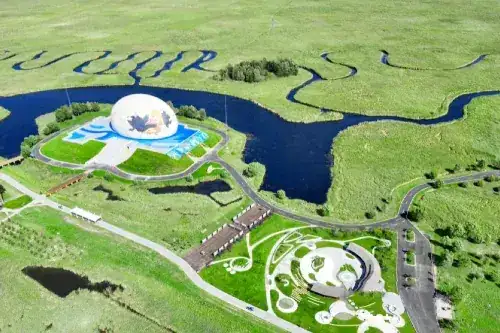
Notable attractions include Liming Lake, the Iron Man Wang Jinxi Memorial Hall, Daqing Museum, Daqing Racing Town, Longfeng Wetland, Heiyu Lake, Dorbod Lianhuan Lakes, Dorbod Grassland, Dangnai Wetland, and Heming Lake. AAAA-level tourist attractions include the Iron Man Wang Jinxi Memorial Hall, Daqing Oilfield History Exhibition Hall, and Daqing Racing Town. Daqing National Forest Park and Hongqi Reservoir Honghu Water Scenic Area are also designated sites. Key wetlands include Dangnai Wetland, Longfeng Wetland Nature Reserve, and Heming Lake Wetland Hot Spring Scenic Area.
International Exchange
(International exchange and sister city details are not provided in the source article.)
Notable People
(Notable people information is not provided in the source article.)
Honorary Titles
(Honorary title details are not provided in the source article.)
Travel information can change. Check current opening hours, reservations and entry requirements before you travel.
Traveller discussion
Start the conversation with a helpful tip or a question.