
Panjin City
Panjin CityPanjin City, a prefecture-level city under Liaoning Province, also known as the "Crane City," "Oil City," and "Wetland Capital," is located in southwestern Liaoning at the center of the Liao River Delta and the mouth of the Liao
Panjin City
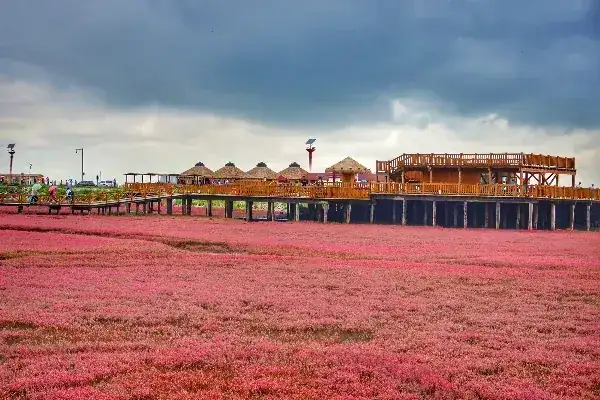
Panjin City, a prefecture-level city under Liaoning Province, also known as the "Crane City," "Oil City," and "Wetland Capital," is located in southwestern Liaoning at the center of the Liao River Delta and the mouth of the Liao River. The terrain is flat with abundant water and no mountains, forming China's northernmost coastline. Situated in the northern temperate zone, it has a warm temperate continental semi-humid monsoon climate with four distinct seasons, concurrent rain and heat, concurrent dry and cold periods, suitable temperatures, and abundant sunshine. Total area: 4,062.34 square kilometers. As of end 2023, Panjin administers 1 county and 3 districts. As of end 2024, the permanent population was 1.376 million. On June 5, 1984, the prefecture-level Panjin City was established. Panjin is the headquarters of Liaohe Oilfield and a "Petrochemical New City," built and thriving on oil, with rich underground deposits of petroleum, natural gas, and well salt. Designated by the State Council as an important national petroleum and petrochemical industrial base and a key central city of the Liaoning Coastal Economic Belt, Panjin is also an ecological city of scenic beauty. The Red Beach Scenic Area, centered on the Red Beach National Scenic Corridor, is a national 5A-level scenic spot and an outstanding tourist attraction in Liaoning Province. Tianzhuangtai within its territory was the site of the final land battle of the First Sino-Japanese War and serves as a patriotic education base. Panjin is a "Zero-Waste City" pilot city, a National Food Safety Demonstration City, a National Agricultural Product Quality Safety City, a National Government Services Standardization pilot city, a National Cultural Consumption pilot city, a National Home and Community Elderly Care Service Reform pilot city, a National Beidou Large-Scale Application Pilot City, a National Civilized City, a National Hygienic City, a National Garden City, and an International Wetland City. On April 27, 2020, the State Council approved the establishment of a Cross-Border E-Commerce Comprehensive Pilot Zone in Panjin. In 2025, Panjin's regional GDP was 141.76 billion yuan (approximately $19.55 billion), up 3.3% at constant prices.
History
Seven Neolithic sites have been discovered in the area, yielding stone axes, microliths, and painted pottery shards representative of the Hongshan Culture. Carbon-14 dating confirms human slash-and-burn agriculture here 5,000 years ago.
In 195 BC (12th year of Han Gaozu), Fangxian County was established, later abolished during the Western Jin Dynasty. During the Northern and Southern Dynasties, the area belonged to Yingzhou of the Northern Wei, later occupied by Goguryeo. After the Tang conquered Goguryeo, the area came under the Balhae Kingdom's Xiande Prefecture. Under the Liao Dynasty, the territory belonged to Xianzhou Fengxian Army. Under the Jin, Yuan, Ming, and Qing dynasties, it belonged to Guangning Prefecture, Guangning Route, Guangning Guard, and Guangning County, respectively.
After the Qing founding, an imperial horse ranch was established in the north, and a chief administrative office was set up at Panshe Post. In 1644 (first year of Shunzhi), Haicheng County was established, with the southern territory placed under its jurisdiction. In 1813, Xinmin Sub-prefecture was established, administering the northeastern part of the territory. In 1903, the ranch was surveyed and divided into five sections: Gong, Kuan, Xin, Min, and Hui. In 1906, Panshan Sub-prefecture was established.
In 1913, Panshan County was established. On January 9, 1948, the Panshan County Democratic Government was formed, successively under the Fifth and Second Special Districts of Liaoning Province. In August, it was placed under direct provincial leadership. In April 1949, Panshan County came under Liaoxi Province. That year, Panshan Farm was established (now Dawaz District) under the Northeast Administrative Committee's Ministry of Agriculture and Forestry.
In 1950, the farm became Liaoxi Province Panshan First Rice Farm. In February 1953, it became Panshan Mechanical Farm, and in 1955, the Liaoning Panjin State Farm Administration Bureau. In February 1956, Panshan County was placed under Liaoyang Special District; in November, the bureau became the Panjin Land Reclamation Bureau under the Ministry of Land Reclamation. In April 1961, the Panjin District People's Committee was established under Yingkou City. In April 1962, Liaobin Reed Farm's east-bank reed fields were transferred to Yingkou County and Haicheng County.
In January 1966, Panshan County merged with the Panjin Land Reclamation Bureau to form the Panjin Reclamation District (prefecture-level), under direct provincial administration. In August 1968, Yingkou's Shuguang People's Commune and the provincial Shishan Breeding Farm were transferred to the Panjin Reclamation District; in October, Dongguo and Yangquanzi reed farms were also transferred. In December 1968, Tai'an County was assigned to the Panjin Reclamation District, along with various Hebei Street facilities.
In January 1970, Panshan and Dawaz districts (county-level) were established within the reclamation district. On July 15, the Panjin Reclamation District became Panjin Prefecture (prefecture-level), overseeing Liaohe Oilfield, Panshan District, Dawaz District, Tai'an County, and Xinsheng Farm. In November 1975, Panjin Prefecture merged with Yingkou City; Panshan and Dawaz districts became counties under Yingkou; Tai'an County was transferred to Anshan City. In 1978, Hebei Street was reassigned to Yingkou's Xishi District.
On June 5, 1984, with State Council approval, Panshan County was abolished and Panjin City (prefecture-level) was established, overseeing Panshan District, Xinglongtai District, the Suburban District, and Dawaz County. In March 1985, Shishan Breeding Farm was transferred to Panjin City. In November 1986, the Suburban District was abolished and Panshan County was restored; Panshan District was renamed Shuangtaizi District. In March 2016, the State Council approved abolishing Dawaz County and establishing Dawaz District with the former county's territory.
Administrative Divisions
As of end 2024, Panjin City administers 1 county and 3 districts: Panshan County, Shuangtaizi District, Xinglongtai District, and Dawaz District, comprising 27 sub-districts, 21 towns, 256 communities, and 285 villages. The municipal government is seated at Hongguan Building in Dawaz District (Liaodong Bay New Area).
Geographical Environment
Location
Panjin is located in southwestern Liaoning at the center of the Liao River Delta and the mouth of the Liao River. It borders Anshan to the east and northeast, faces Yingkou across the Daliao River to the southeast, borders Jinzhou to the west and northwest, and faces the Liaodong Bay of the Bohai Sea to the south. Coordinates: north latitude 40 degrees 39 minutes to 41 degrees 27 minutes, east longitude 121 degrees 25 minutes to 122 degrees 31 minutes. Total area: 4,062.34 square kilometers.
Topography
Panjin sits on the northeastern edge of the North China Platform, a Cenozoic sedimentary basin formed since the Yanshan Movement. Through prolonged alluvial, diluvial, marine, and aeolian deposition, thick Quaternary loose sediments cover the area. The terrain slopes from north to south, flat with abundant water and no mountains.
Climate
Panjin has a warm temperate continental semi-humid monsoon climate. Spring is windy with little rain and dry conditions; summer is hot and rainy; autumn is clear with rapid cooling; winter is cold with little snow. Four distinct seasons, concurrent rain and heat, concurrent dry and cold periods, suitable temperatures, and abundant sunshine characterize the climate.
Hydrology
Panjin has 21 rivers of various sizes with a total length of 634 kilometers and a basin area of 3,570 square kilometers. Four major rivers: the Liao, Daliao, Raoyang, and Daling rivers, plus 17 medium and small rivers. The city has 7 small-to-medium plain reservoirs with a total capacity of 151 million cubic meters and effective capacity of 102 million cubic meters.
Natural Resources
Plant Resources
Panjin's flora belongs to the North China plant system, with 242 wild plant species across 70 families. Forested area covers 7,106 hectares with 423,600 cubic meters of standing timber and a 4.8% forest cover rate. The 37 families and 123 species of wild weeds are distributed across farmland, forests, marshes, wetlands, and tidal flats, with some having economic value for papermaking, pharmaceuticals, food, weaving, and oil extraction.
Animal Resources
Panjin has 699 wild animal species, including 236 bird species, 23 mammal species, 5 amphibian species, 10 reptile species, 300 insect species, and 180 fish species. The southern coastal waters within the 15-meter isobath cover approximately 200,000 hectares, with fish, shrimp, and crab resources of about 40,000 to 50,000 tons, accounting for 70% of the Liaodong Bay total. Shellfish resources in shallower waters total about 27,000 tons.
Mineral Resources
Panjin has rich underground deposits of petroleum, natural gas, and well salt. Liaohe Oilfield exploration began in 1955, with large-scale development from 1970. Three exploration areas have cumulative proven petroleum reserves of 5.212 billion tons and natural gas reserves of 72.86 billion cubic meters. The Liaohe area has discovered 41 oil and gas fields, with 37 under development. In 2021, crude oil production reached 10.08 million tons and natural gas 790 million cubic meters, maintaining million-ton-scale stable production for 36 consecutive years. Natural brine resources cover 150 square kilometers at depths of 30 to 100 meters, with total reserves of approximately 1.329 billion cubic meters of brine.
Population
According to the Seventh National Census (November 1, 2020), the permanent population was 1,389,691.
As of end 2022, the registered population was 1.293 million. Births: 6,332 (rate 4.9 per mille); deaths: 6,021 (rate 4.7 per mille); natural growth rate: 0.2 per mille.
As of end 2023, the registered population was 1.285 million. Births: 5,964 (rate 4.6 per mille); deaths: 13,370 (rate 10.4 per mille); natural growth rate: -5.8 per mille.
As of end 2024, the permanent population was 1.376 million, with a registered population of 1.280 million. Births: 6,397 (rate 5.0 per mille); deaths: 10,018 (rate 7.8 per mille); natural growth rate: -2.8 per mille. By age: 0 to 17 years: 165,000 (12.9%); 18 to 34 years: 216,000 (16.9%); 35 to 59 years: 538,000 (42.1%); 60 years and above: 361,000 (28.2%).
Politics
Economy
Overview
In 2024, Panjin's regional GDP reached 141.35 billion yuan (approximately $19.50 billion), up 4.0% at comparable prices. The primary industry added value of 10.72 billion yuan, up 4.2%; secondary industry 70.70 billion yuan, up 2.6%; tertiary industry 59.93 billion yuan, up 5.1%. The three sectors accounted for 7.6%, 50.0%, and 42.4% of GDP respectively. Per capita GDP was 102,468 yuan (approximately $14,132), up 4.4%.
Fixed asset investment grew 39.6%, with industrial investment up 72.0% and real estate investment down 27.1%. General public budget revenue was 14.05 billion yuan (approximately $1.94 billion), up 8.3%, of which tax revenue was 10.24 billion yuan, up 0.6%. General public budget expenditure was 21.08 billion yuan (approximately $2.91 billion), up 0.3%.
Primary Industry
In 2024, grain crop planting area was 122,356 hectares, up 207 hectares. Rice: 110,883 hectares (up 965); corn: 9,905 hectares (down 895). Grain output was 1.072 million tons, down 6.7%. Rice: 994,000 tons (down 5.8%); corn: 73,000 tons (down 18.1%). Pork, beef, mutton, and poultry meat production was 121,000 tons, down 9.2%. Aquatic product output was 221,000 tons, up 4.3%, including 63,000 tons of river crab.
Secondary Industry
In 2024, value-added of designated industrial enterprises decreased 0.1%. By ownership: state-controlled enterprises down 1.3%; joint-stock enterprises down 1.7%; foreign and Hong Kong-Macau-Taiwan invested enterprises up 24.3%; private enterprises down 11.1%. By sector: mining down 6.0%; manufacturing up 4.3%; power, heat, gas, and water production down 7.4%. Petroleum and natural gas extraction accounted for 31.9%; petroleum processing for 44.9%; chemical raw materials and products manufacturing for 10.7% of industrial value-added. Product sales rate was 100.0%. Construction enterprises signed contracts totaling 22.55 billion yuan, down 1.5%. Building construction area was 541,000 square meters, up 93.8%.
Tertiary Industry
In 2024, total retail sales of consumer goods were 40.94 billion yuan (approximately $5.65 billion), up 3.0%. Urban retail sales: 36.32 billion yuan (up 2.9%); rural: 4.62 billion yuan (up 3.7%). Goods retail: 37.52 billion yuan (up 2.7%); catering: 3.42 billion yuan (up 5.8%). Key growth categories: grain, oil, and food up 19.9%; daily necessities up 21.7%; home appliances up 29.7%; automobiles up 14.0%; communications equipment up 25.6%.
Total import and export value was 15.22 billion yuan (approximately $2.10 billion), up 43.6%. Exports: 2.84 billion yuan (up 44.6%); imports: 12.38 billion yuan (up 43.3%). Actual foreign investment utilized: $768.91 million, down 22.1%. Actual domestic investment in place: 42.31 billion yuan, up 12.7%.
As of end 2024, financial institution deposits totaled 318.90 billion yuan (approximately $44.0 billion), up 9.79 billion yuan from the year's start. Loan balance was 170.58 billion yuan. Insurance premium income was 6.128 billion yuan, up 10.22%, with total claim payments of 2.636 billion yuan. Social welfare lottery sales reached 360 million yuan, up 18.7%.
Social Affairs
Science and Technology
In 2024, 1,580 domestic patents were granted, including 265 invention patents. There were 240 high-tech enterprises, up 23. The city had 235 enterprise engineering technology research centers, including 28 provincial-level ones. Technology contracts signed: 358, with a transaction value of 1.26 billion yuan.
Education
In 2024: kindergarten enrollment 25,498; primary school enrollment 11,290, total students 69,671; junior high enrollment 13,703, total students 36,827; senior high enrollment 8,321, total students 24,385; secondary vocational school enrollment 3,958, total students 12,580; higher vocational college enrollment 4,281, total students 10,864.
Culture
As of end 2024: 5 cultural and art centers, 6 public libraries, 1 urban construction archive. Radio and TV coverage both 100%, with 79,000 cable TV households. Three newspaper titles published with a total circulation of 9.04 million copies.
Healthcare
As of end 2024: 1,249 medical and health institutions, including 73 hospitals, 4 disease prevention and control centers, 3 maternal and child health centers, and 55 community health service institutions. There were 5,455 licensed (assistant) physicians.
Social Security
As of end 2024: urban employee basic pension insurance covered 744,000 persons; basic medical insurance covered 572,000 urban employees and 668,000 urban residents; work injury insurance 370,000; maternity insurance 270,000; unemployment insurance 324,000. The urban-rural integrated minimum living standard was 800 yuan per month. The city had 13 public nursing homes (1,885 beds, 1,188 residents) and 72 private ones (3,285 beds, 1,756 residents).
Transportation
Overview
The Dandong-Xilingol and Naiman-Yingkou expressways run north-south, while the Qinhuangdao-Shenyang Passenger Dedicated Line and Gouhai Railway cross the territory. Combined with the Panjin Port-linking Railway and Panjin-Yingkou High-Speed Railway, Panjin has become the nearest sea access channel for Northeast China.
In 2024, highway and waterway freight volume was 92.95 million tons, up 3.5%; freight turnover 151.6 billion ton-kilometers, up 6.8%. Passenger volume was 19.01 million, up 16.3%; passenger turnover 560 million person-kilometers, up 22.5%. Port cargo throughput was 42.46 million tons, up 1.0%.
Highways
Panjin has the densest highway network in Liaoning Province. Expressways through Panjin include the G1 Jingha Expressway (Gaosheng and Panjin North toll stations), G16 Danxi Expressway (Panjin, Panjin South, and Xi'an Town toll stations), S29 Panjin Port-link Expressway (Taiqian toll station), and G4513 Naiying Expressway (Tianshui toll station). Long-distance bus stations include Panjin City Passenger Station, Panjin Long-distance Bus Station, Xi'an Passenger Station, and the Liaohe Oilfield Passenger Terminal.
Railways
The Gouhai Railway, Qinhuangdao-Shenyang Passenger Dedicated Line, Shenjin Railway, and Panjin-Yingkou High-Speed Railway intersect in the city. Panjin Station and Panjin North Station serve both regular and high-speed trains, with freight handled at Bohai Station.
Water Transport
Panjin Port is located in the Panjin Liaobin Economic Development Zone on the right bank of the Daliao River estuary.
Aviation
Panjin is 177 km from Shenyang Taoxian International Airport, 279 km from Dalian Zhoushuizi International Airport, 88 km from Jinzhou Jinzhouwan Airport, and 80 km from Yingkou Lanqi Airport.
Scenic Spots
Panjin's natural landscapes are notably beautiful, featuring plain terrain, rice paddies, reed seas, grasslands, oil derricks, the Red Beach, rare birds, and rivers.
Local Specialties
Famous People
Honorary Titles
Travel information can change. Check current opening hours, reservations and entry requirements before you travel.

Traveller discussion
Start the conversation with a helpful tip or a question.