
Dandong City
Dandong CityDandong City, formerly known as Andong, is a prefecture-level city under Liaoning Province, located in the southeastern part of the province. It faces Sinuiju of the Democratic People's Republic of Korea (DPRK) across the Yalu R
Dandong City
Dandong City, formerly known as Andong, is a prefecture-level city under Liaoning Province, located in the southeastern part of the province. It faces Sinuiju of the Democratic People's Republic of Korea (DPRK) across the Yalu River to the east, borders the Yellow Sea to the south, connects with Anshan to the west, adjoins Dalian to the southwest, and borders Benxi to the north. The terrain gradually descends from northeast to southwest, belonging to the warm-temperate humid monsoon climate zone, with a total area of 15,289.6 square kilometers. As of the end of 2024, Dandong City administers 3 municipal districts, 1 autonomous county, and 2 county-level cities. As of the end of 2025, the total population was 2.208 million. Dandong is an important border port city in Liaoning Province and a central city in the Liaodong region, designated by the State Council. It is a key port city in the Liaoning Coastal Economic Belt, an important intersection point of the Northeast Asia Economic Circle and the Bohai Rim Economic Circle, and the primary land route connecting the Korean Peninsula with China and Eurasia. It is the easternmost starting point of the Great Wall and the northernmost starting point of China's coastline. The Tang Dynasty established the Andong Protectorate in 668 CE, giving rise to the name "Andong." In 1876, during the Qing Dynasty, Andong County was formally established. Dandong is a riverfront, coastal, and border city centered on industry, commerce, port operations, logistics, and tourism. It is a national-level border cooperation zone and a coastal open city, with 10 ports of 5 types (port, railway, highway, pipeline, and airport), plus 1 China-DPRK border resident mutual trade zone. In 2025, Dandong achieved a regional GDP of 101.92 billion yuan (approximately 14.2 billion USD), up 3.7% year-on-year at constant prices.
Historical Evolution
Dandong has a long history dating back to the late Paleolithic period, approximately 18,000 years ago. By 6,000 to 7,000 years ago, the region's inhabitants had entered the Neolithic Age, and by 3,500 to 4,000 years ago, the Bronze Age.
During the legendary era of Emperor Yao, the area belonged to Qingzhou; under Emperor Shun, it was part of Yingzhou. During the Warring States period, the Dandong area was under the State of Yan's Liaodong Commandery. In 300 BCE, King Zhao of Yan established five commanderies including Liaodong, which had 18 counties. During the Tang Dynasty (668 CE), the Andong Protectorate was established, giving rise to the name "Andong." After the Liao Dynasty conquered the Balhae Kingdom, the Dandong area became territory of the Jurchen people. Under the Jin Dynasty, the area was placed under Posu Prefecture (present-day Jiulian City). The Yuan Dynasty maintained postal stations at locations corresponding to present-day Tongyuanbao, Xueli Village, Fenghuang City, Tangshan City, and Jiulian City.
During the Ming Dynasty, the area fell under the Liaodong Regional Military Commission. Border walls were constructed along the north bank of the Ai River beginning in 1467, with fortifications including Fenghuang Fort and 12 beacon towers. During the Jiajing reign (1522 to 1566), a second large-scale border expansion took place with additional castles built. After the Battle of Sarhu (1618), Later Jin forces advanced into the Dandong area.
During the Qing Dynasty, the administrative structure evolved. In 1877, Kuandian County was established alongside Andong County, both under Fengtian Prefecture. After the First Sino-Japanese War (1894), Japanese forces occupied Jiulian City and Andong. During the Russo-Japanese War (1904 to 1905), Andong served as a key military site. In 1906, Andong was opened as a treaty port, becoming a major distribution center for timber, grain, and tussah silk cocoons in southeastern Manchuria.
In 1914, Andong County was placed under the Dongbian Circuit of Fengtian Province. Following the Mukden Incident of 1931, Andong fell under Japanese puppet rule. After World War II, Andong was first liberated in September 1945 and again in June 1947. In 1949, Andong became the capital of the newly formed Liaodong Province. In 1954, Liaoxi and Liaodong provinces were merged to form Liaoning Province. In 1965, Andong City was renamed Dandong City, Andong County was renamed Donggou County, and Zhenxing District was renamed Zhen'an District. In 1993 and 1994, Donggang City and Fengcheng City were established respectively. The city now administers Zhenxing District, Yuanbao District, Zhen'an District, Kuandian Manchu Autonomous County, Donggang City, and Fengcheng City.
Administrative Divisions
As of 2026, Dandong City administers 3 municipal districts (Zhenxing, Yuanbao, and Zhen'an), 1 autonomous county (Kuandian Manchu Autonomous County), and 2 county-level cities (Donggang and Fengcheng), comprising 20 subdistricts, 59 towns, and 5 townships, with 208 communities and 671 administrative villages. The municipal government is located at 100 Yinhe Avenue, Zhenxing District.
Geography
Location and Territory
Dandong City is located on the northwest bank of the Yalu River in southeastern Liaoning Province and is China's largest border city. It sits on the southeastern Liaodong Peninsula at the confluence of the Yalu River and the Yellow Sea, in the heart of Northeast Asia. It borders the DPRK's Sinuiju across the Yalu River to the southeast, connects with Ji'an City of Jilin Province across the Hun River to the east, and borders Huanren Manchu Autonomous County and Benxi Manchu Autonomous County to the north. The geographic coordinates are 123 degrees 23 minutes to 125 degrees 42 minutes east longitude and 39 degrees 44 minutes to 41 degrees 9 minutes north latitude, with a maximum east-west span of 196 kilometers and north-south span of 165 kilometers, totaling 15,289.6 square kilometers.
Topography and Geomorphology
Dandong is part of the Liaodong Hills, an extension of the Changbai Mountain Range. The terrain descends from northeast to southwest and can be divided into four major geomorphic units: the northern mid-low mountain area (elevation 400 to 1,000 meters, with 28 peaks above 1,000 meters; Huabozi Mountain reaches 1,336.1 meters), the central low-mountain hilly area (300 to 800 meters), the southern hilly area (below 500 meters), and the coastal plain area near Donggang (2 to 5 meters elevation). Major urban areas and farmland are concentrated on plains, basins, and first-order terraces.
Climate
Dandong has a warm-temperate humid monsoon climate. The annual average temperature is 8.9 degrees Celsius, with average precipitation of 967.7 millimeters, 2,368.5 sunshine hours, average wind speed of 2.2 meters per second, and average relative humidity of 70%. The city has distinct seasons with abundant rainfall. In 2022, the annual average temperature was 8.7 degrees Celsius, precipitation was 1,215.7 millimeters, and sunshine hours totaled 2,223.8.
Hydrology
Dandong has 944 rivers exceeding 2 kilometers in length, with 93 rivers having catchment areas over 50 square kilometers. Four major rivers have catchment areas exceeding 3,000 square kilometers: the Yalu River (mainstream length 821 km, total catchment 64,471 square kilometers), the Ai River (181.95 km, 5,902 square kilometers), the Dayang River (182 km, 6,554 square kilometers), and the Hun River (431 km, 15,340 square kilometers). The Yalu River is the border river between China and the DPRK, originating from the southern foot of Changbai Mountain and flowing into the Yellow Sea near Donggang.
Natural Resources
Water Resources
Dandong has relatively abundant water resources. According to the third water resource assessment, the average total water resource is 8.285 billion cubic meters, accounting for one-quarter of the provincial total, including 8.132 billion cubic meters of surface water and 1.523 billion cubic meters of groundwater.
Land Resources
As of early 2022, Dandong had 1.3213 million hectares of agricultural land (including 241,800 hectares of cultivated land, 59,300 hectares of orchard land, and 986,600 hectares of forest land), 99,500 hectares of construction land, and 108,100 hectares of unused land.
Plant Resources
Dandong has 250 families and 1,860 species of plants, including 13 nationally protected species such as ginseng and wild soybean. The city has 362 species of fungi, 158 species of lichens, 265 species of mosses, and 1,056 species of vascular plants. Valuable tree species include Korean pine, red pine, Chinese pine, Manchurian fir, Manchurian ash, yellow phellodendron, Amur cork tree, and Chinese cedar, among many others.
Animal Resources
Dandong has 410 species of terrestrial wild vertebrates, including 360 bird species, 28 mammal species, 11 amphibian species, and 11 reptile species. Sixty-four species are under national key protection, including 12 under Class I protection (red-crowned crane, Oriental white stork, Steller's sea eagle, sable, and musk deer, among others) and 52 under Class II protection (black bear, otter, dhole, whooper swan, and water deer, among others).
Mineral Resources
Dandong is one of Liaoning's most important metallogenic belts. The city has identified 50 mineral types across 650 deposits. Gold, silver, lead, zinc, boron, and brucite hold advantageous positions provincially. The Wengquangou iron-boron deposit in Fengcheng is the nation's largest super-large boron deposit, with 21.85 million tons of boron trioxide reserves and 234 million tons of associated iron ore, making it a major national boron resource base. Dandong holds 56.4% of the national total solid boron reserves and 82% of the provincial total.
Population
Population Size
As of November 1, 2020 (Seventh National Census), the resident population was 2,188,436. As of the end of 2025, the total population was 2.208 million, with 1.093 million males and 1.115 million females (ratio 98 to 100). The birth rate was 3.3 per thousand, death rate 10.8 per thousand, and natural growth rate negative 7.5 per thousand.
Ethnic Composition
Dandong is a multi-ethnic region with 47 minority groups totaling 774,800 people, accounting for 35.41% of the total population, the highest proportion in the province. The Manchu population numbers 709,700 (91.6% of the minority total), followed by Mongolian (24,900), Korean (16,900), Hui (13,000), and Xibe (7,300). Eighteen minority groups have fewer than 10 members each.
Politics
The municipal government operates under the leadership of the Mayor and the People's Congress system. Dandong's administrative structure includes party and government organs at the municipal, district, county, and township levels, governing the city's three districts, one autonomous county, and two county-level cities.
Economy
Overview
In 2025, Dandong achieved a regional GDP of 101.92 billion yuan (approximately 14.2 billion USD), up 3.7% at constant prices. The primary sector contributed 19.95 billion yuan (approximately 2.8 billion USD, up 3.9%), the secondary sector 25.92 billion yuan (approximately 3.6 billion USD, down 0.5%), and the tertiary sector 56.04 billion yuan (approximately 7.8 billion USD, up 5.5%). The three-sector structure was 19.6 to 25.4 to 55.0. Fixed-asset investment fell 27.2% year-on-year. The general public budget revenue was 8.45 billion yuan (approximately 1.17 billion USD, up 5.2%), with tax revenue of 4.65 billion yuan. General public budget expenditure was 23.56 billion yuan (approximately 3.3 billion USD). The per capita disposable income of all residents was 35,215 yuan (approximately 4,891 USD, up 4.8%), with urban residents at 40,555 yuan (approximately 5,633 USD) and rural residents at 25,182 yuan (approximately 3,498 USD).
Primary Industry
In 2025, the agriculture, forestry, animal husbandry, and fishery value-added was 20.57 billion yuan (approximately 2.9 billion USD, up 3.9%). Total grain output was 1.205 million tons, maintaining above 1 million tons for the 11th consecutive year. Notable products included corn (777,000 tons), rice (387,000 tons), strawberries (289,000 tons), and chestnuts (136,000 tons). Meat production reached 547,000 tons, and aquatic products totaled 724,000 tons. Agricultural machinery totaled 1.659 million kilowatts with 45,000 tractors.
Secondary Industry
In 2025, value-added of industrial enterprises above designated size was flat year-on-year. Industrial electricity consumption was 7.62 billion kWh (up 4.7%), with 593 enterprises above designated size. Of the 36 industry categories, 15 achieved growth. Above-scale industrial enterprises had total assets of 88.52 billion yuan, revenue of 66.61 billion yuan, and total profits of 4.51 billion yuan. The construction industry completed output of 7.37 billion yuan. Total energy consumption of above-scale industry was 2.084 million tons of standard coal (up 4.5%).
Tertiary Industry
In 2025, total retail sales of consumer goods reached 28.13 billion yuan (approximately 3.9 billion USD, down 0.7%). Urban retail sales were 23.91 billion yuan, and rural retail sales were 4.22 billion yuan. Foreign trade totaled 20.81 billion yuan (approximately 2.9 billion USD, up 21.8%), with exports of 18.07 billion yuan and imports of 2.74 billion yuan. Actual foreign investment utilized was 8.13 million USD (up 83.0%). The financial sector's tax contribution was 960 million yuan (up 29.7%). As of end-2025, financial institution deposits totaled 389.69 billion yuan (up 7.6%), and loans totaled 159.87 billion yuan (up 5.2%). Insurance coverage totaled 4,452.74 billion yuan (up 16.7%), with premium income of 7.06 billion yuan. Postal and telecommunications business volume was 3.0 billion yuan, with 104 million express deliveries.
Social Affairs
Science and Technology
In 2025, Dandong authorized 165 invention patents, with 1,398 valid invention patents (up 5.7%). The city had 293 recognized high-tech enterprises, with technology contract turnover of 850 million yuan (up 16.8%).
Education
As of 2025, Dandong had 677 schools of all types with 26,078 staff (including 21,047 full-time teachers) and 239,650 students. Enrollment included 41,474 in higher education, 31,795 in senior high school, 42,670 in junior high, 82,985 in primary school, and 29,611 in kindergarten. School-age enrollment rate was 100%.
Culture
Dandong had 106 cultural institutions including 7 libraries, 8 public cultural centers, and 84 township and subdistrict cultural stations. There were 5 medium-wave and 6 FM broadcasting transmitters with 99.2% population coverage, and 6 TV transmitters also achieving 99.2% coverage.
Healthcare
As of 2025, Dandong had 1,977 health institutions including 87 hospitals and 72 township health centers, with 20,647 beds and 21,561 health technical personnel (including 7,319 licensed physicians and 10,092 registered nurses).
Sports
In 2025, Dandong participated in 33 provincial-level or above competitions, winning 393.5 medals including 90.5 gold. The city hosted 15 national and 18 provincial events, organized 87 municipal fitness activities, and installed 195 fitness trails.
Social Security
In 2025, registered urban unemployed numbered 15,554, with 16,949 new urban jobs created. Basic pension insurance covered 1.166 million people, with 5.97 million retirees. Basic medical insurance covered 808,000 urban employees and 1.188 million urban-rural residents. The city had 158 welfare and nursing homes with 12,745 beds, and 43,000 households receiving minimum living allowances with 3.5 billion yuan in benefits distributed.
Environmental Protection
In 2025, Dandong had 360 days of good air quality (98.6% compliance rate). PM2.5 annual average was 25.3 micrograms per cubic meter, and PM10 was 44 micrograms per cubic meter.
Urban Construction
As of 2025, Dandong had 1,150 kilometers of urban water supply pipelines delivering 77.6 million tons of water (100% coverage), 892.1 kilometers of natural gas pipelines supplying 55.246 million cubic meters, and 3,026 tons of liquefied petroleum gas. Natural gas served 365,000 households and LPG served 17,000 households.
Transportation
Overview
Dandong has a 300-kilometer border with the Korean Peninsula. By rail, it is 220 kilometers from Pyongyang and 420 kilometers from Seoul, serving as a key node in the Eurasian railway corridor connecting Beijing, Pyongyang, Seoul, and Moscow. Dandong Port is 245 nautical miles from Incheon, South Korea. In 2025, highway freight reached 56.73 million tons, waterway freight 3.036 million tons, and civil aviation freight 219.6 tons. Highway passenger volume was 16.91 million, Dandong railway station dispatched 4.987 million passengers, and port cargo throughput was 35.823 million tons with 250,000 TEU containers.
Railway
Dandong has 260 kilometers of railway lines, including the Shenyang-Dandong Railway, Shenyang-Dandong Passenger Dedicated Line, Dandong-Dalian Rapid Railway, Fengshang Railway, Dandong-Tonghua Rapid Railway, and Tongguan Railway. Dandong Station is the terminus of the Shenyang-Dandong line, connecting to DPRK railways via the Yalu River Bridge for international services to Pyongyang and Moscow. The Shenyang-Dandong Passenger Dedicated Line (207.3 km) opened in August 2015 with a runtime of about 1 hour 20 minutes. The Dandong-Dalian Rapid Railway (292 km) also opened in 2015, with a runtime of 1 hour 30 minutes at 200 km/h.
Highway
Dandong was designated a national regional highway transport hub in 2007. The city has 24 passenger stations, with Dandong, Donggang, and Fengcheng meeting Class I standards. Expressways include the Shenyang-Dandong, Hegang-Dalian, and Dandong-Xilingole expressways. As of 2025, Dandong had 10,052.9 kilometers of highways (excluding expressways), with 9,987.3 kilometers of high-grade roads. Urban roads totaled 663.5 kilometers in length with 12.443 million square meters of surface area.
Maritime Transport
Dandong Port is China's northernmost deep-water ice-free port, connecting to the Eastern Northeast Railway and serving over 30 million people across 13 cities and more than 40 counties. The port has three port areas (Dadong, Langtou, and Haiyanghong), over 50 production berths with a maximum capacity of 300,000-ton vessels, and annual comprehensive throughput capacity of 160 million tons. It maintains shipping routes with over 90 countries and regions including Japan, South Korea, Russia, the United States, Brazil, and India.
Aviation
Dandong Langtou Airport, a 4C-level facility in Zhenxing District, opened in 1985 and can accommodate Boeing 737, 757, 767, MD-90, Airbus A320, and TU-154 aircraft. In 2024, the airport operated 7 domestic routes connecting to Beijing, Shanghai, Shenzhen, Yantai, Qingdao, Chengdu, and Guangzhou, with 1,934 flight movements and 235,000 passengers.
Public Transit
As of 2025, Dandong had 603 urban public buses operating on 59 routes (including branches) with a total length of 1,738.3 kilometers.
History and Culture
Folk Arts
Dandong Dangu (single drum) is a traditional folk activity widely practiced in Kuandian, Fengcheng, and Donggang, commonly called "incense burning." It is divided into "folk incense" (Han Chinese) and "banner incense" (Manchu-Han military). Dating back to Jurchen shamanistic spirit-dancing practices centuries ago, Dangu combines storytelling with singing and dancing. It has interacted with Northeast folk songs, Dagu ballads, and Errenzhuan, making it significant for preserving excellent Chinese cultural heritage.
Folk Customs
Gule (drum and wind music) has been practiced in the Dandong area for over a century, documented in early county gazetteers including the Andong County Gazetteer and Fengcheng County Gazetteer. Locally known as "drum and wind music," it features diverse instruments and melodies, performed primarily with traditional wind and percussion instruments. Drum and wind ensembles are traditionally hired for festivals, weddings, and funerals. The genre is divided into suona-based and sheng-guan-based categories and is a precious intangible cultural heritage.
Scenic Spots
Overview
Dandong's tourism resources cover 1,500 square kilometers (10% of the city's territory). The city has 24 national and provincial-level scenic areas, nature reserves, and forest parks. The Yalu River flows 210 kilometers through Dandong, with 6 major scenic areas and over 100 attractions forming a distinctive border tourism corridor. Key scenic sites include the Yalu River, Hushan Great Wall, Fenghuang Mountain, Wulong Mountain, Tianhua Mountain, Huangyi Mountain, Dagu Mountain, Tianqiao Valley, Qingshan Valley, Pushi River, Yulong Lake, Dalu Island, and Zhang Island. As of 2022, Dandong had 30 A-level tourist attractions (9 at 4A, 20 at 3A, 1 at 1A) and 29 protected natural areas of various levels.
Scenic Areas
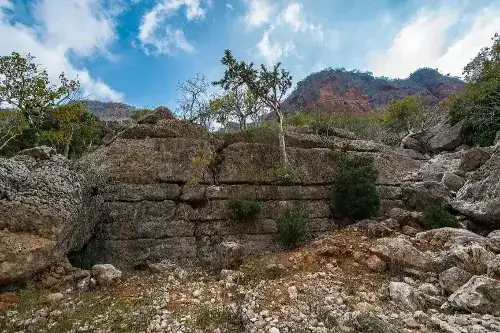
The Yalu River Scenic Area spans from the Hun River confluence to Donggang Port, covering 400 square kilometers across 5 sub-areas including Shuifeng Lake, Taiping Bay, Hushan, the Yalu River Bridge, and Donggang. Jinjiang Mountain Park, the city's largest comprehensive park covering 91.06 hectares, was built in 1916 and is one of the Eight Great Scenic Spots of the Northeast. Yueliang Island is a 134,000-square-meter island on the Yalu River, 200 meters from the Chinese shore and 600 meters from the DPRK side. Hushan Great Wall, the eastern starting point of the Ming Great Wall built around 1469, was confirmed by Great Wall experts in the 1990s as the easternmost terminus, extending the Great Wall by over 1,000 kilometers. Fenghuang Mountain, 60 kilometers northwest of Dandong, was designated a National Key Scenic Area in 1994. Tianqiao Valley National Forest Park, a 4A-level scenic area covering over 4,000 hectares with 96% forest coverage, is located in Kuandian. The Memorial Hall of the War to Resist U.S. Aggression and Aid Korea, built in 1958 and opened in 1993 on the 40th anniversary of the Korean Armistice, covers 182,000 square meters and houses over 20,000 artifacts.
Famous Figures
Dandong has produced numerous notable figures throughout its history, contributing to various fields including politics, military affairs, arts, and sciences.
Honorary Titles
Dandong has been designated as a National Hygienic City, National Garden City, China Excellent Tourism City, National Double Support Model City, and Provincial Historical and Cultural Famous City.
External Relations
Consular Institutions
Dandong's strategic border location has made it an important diplomatic point for China-DPRK relations and international exchange.
Sister Cities
Dandong maintains sister city relationships and international partnerships leveraging its position as a major border port and gateway to the Korean Peninsula.
Travel information can change. Check current opening hours, reservations and entry requirements before you travel.

Traveller discussion
Start the conversation with a helpful tip or a question.